


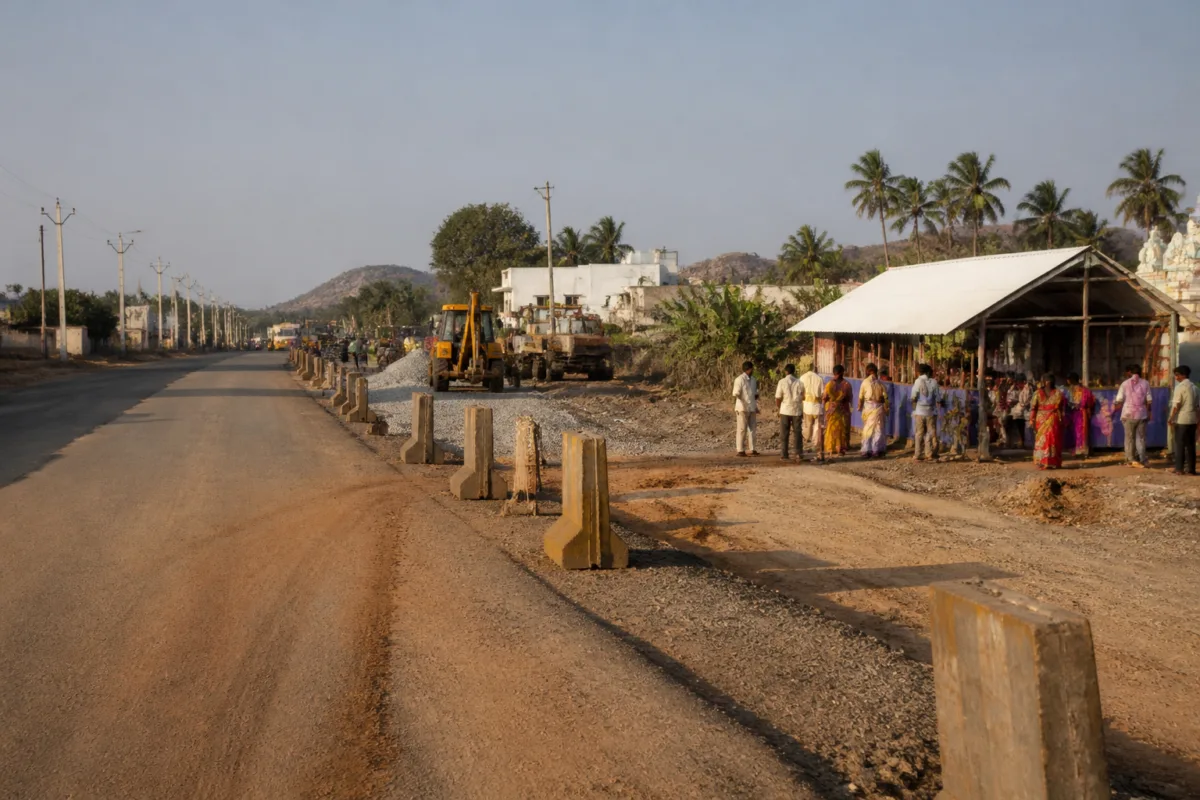
Tirupati district authorities have defended the relocation of the Abhayanjaneya temple at Anjaneyapuram to enable the expansion of National Highway-716 between Kadapa and Renigunta.
The temple in Renigunta mandal was removed on November 23 after its main idols were shifted to a nearby government-allotted site a day earlier. The relocation followed religious rituals, including Balalayam and Shanti Homam, and consultations involving villagers, priests and Endowments Department officials, according to Tirupati district collector S Venkateswar.
Speaking at a press conference, Venkateswar said the process was undertaken with villagers’ consent and in accordance with religious traditions. He was accompanied by villagers, priests, Endowments Department officials and representatives of the National Highways Authority of India, the report said.
The temple, established about 60 years ago by villager Sukhadanayya, was affected by the highway expansion. The collector said the highway alignment had been prepared in 2019, followed by a land acquisition notification in January 2023 and an award in August that year. He said the district administration did not have the authority to alter an alignment approved by the Union Ministry of Road Transport and Highways.
According to the report, ₹59.3 lakh was deposited with the Endowments Department in August 2026 as compensation for the temple. Villagers requested that the amount be used to construct a new temple. The former structure occupied 10 cents, while an alternative 50-cent site was allotted for the replacement building.
A temporary facility has been arranged so that daily worship can continue during the transition. Priests said the idols were ceremonially moved to temporary idols after rituals including Kalasharadhana and cow puja, and were placed in Navadhanyas.
Hemant Kumar, son of the temple’s founder, said officials had informed the family about the highway project and proposed relocation around four years ago. He said villagers agreed after being offered alternative land and compensation, and that there had been no coercion.

