


Navi Mumbai has been named India’s cleanest city in the Super Swachh League category of Swachh Survekshan 2025-26, but the award also highlights a larger urban question: how should cleanliness be measured when formal civic performance and everyday experience do not always align?
The city rose from third place last year to the top position among cities with populations of more than one million that have remained in the country’s top tier over several consecutive years. Surat finished second and Vijayawada third. President Droupadi Murmu presented the award in Delhi to Navi Mumbai Municipal Corporation commissioner Kailas Shinde, mayor Sujata Patil and deputy mayor Dashrath Bhagat.
For the Navi Mumbai Municipal Corporation, the result is the outcome of a multi-year administrative effort. Shinde credited citizens, civic employees, sanitation workers and elected representatives, saying that the civic body’s aim of finishing on the top podium had been achieved after years of work. The administration said its approach was guided over the past three to four years by the motto “Resolved, Number One”.
That explanation is significant because cleanliness rankings are not produced by a single intervention. They reflect a chain of municipal functions: waste collection, transportation, processing, roadside maintenance, public-space cleaning, complaint handling, enforcement and citizen participation. Navi Mumbai’s account of its performance brings each of these elements into view.
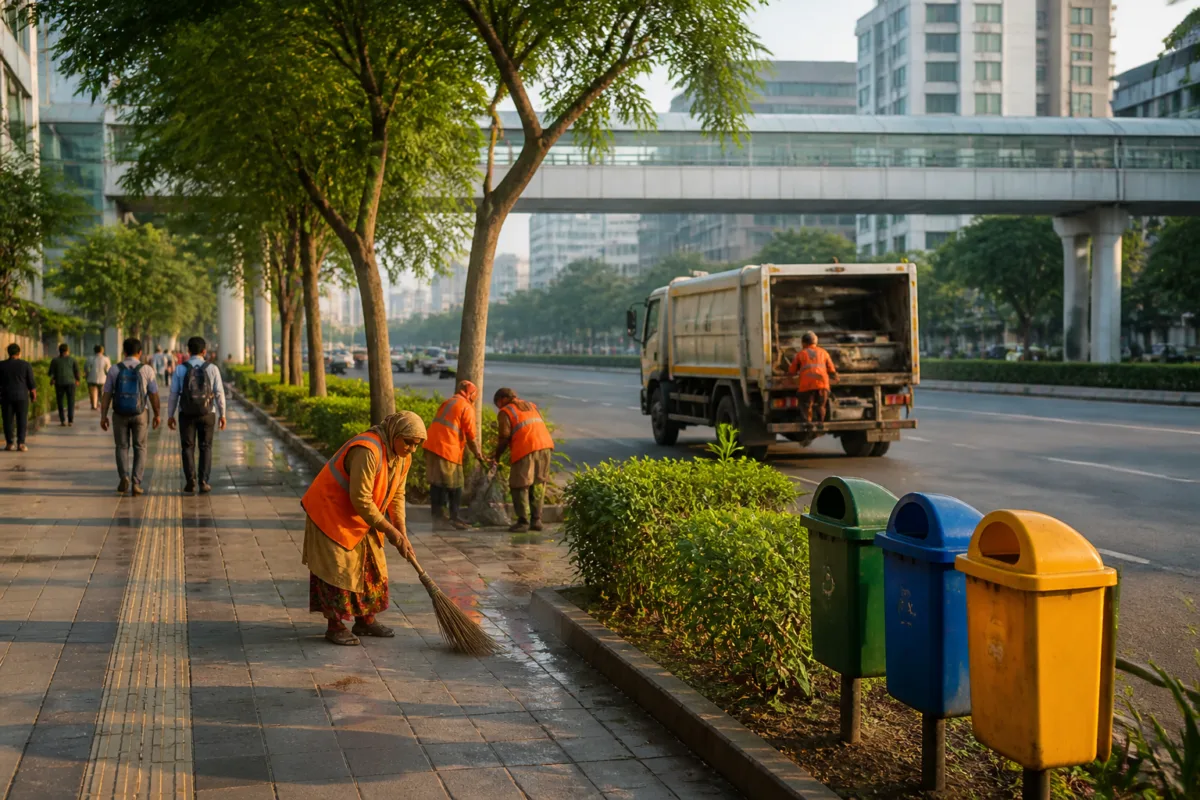
The civic body said it has maintained strict enforcement of solid waste management rules, continuous cleaning of roadsides and skywalks, and targeted sanitation in high-footfall public areas. It also cited citizen feedback through the Swachhata app, the MyNMMC App and the Citizen Grievance Portal. These systems are intended to connect visible cleanliness with administrative response, although the source material does not establish how quickly complaints are resolved or how consistently those outcomes are measured across neighbourhoods.
Technology has also been integrated into the city’s waste operations. The municipal corporation said its integrated command and control centre is used for waste collection and transportation. Segregated waste is processed according to category, while the civic body has operated what it describes as the country’s first textile waste recycling centre. The administration also listed water reuse, plastic-prevention measures and large cleanliness campaigns involving citizens, students and young people among the practices supporting its performance.
Navi Mumbai has additionally retained seven-star “garbage free city” recognition and received “water plus” certification, described in the report as an urban sanitation standard. These designations suggest that the city’s achievement is being presented as broader than street sweeping. It covers the management of solid waste, sanitation systems, reuse and public participation. However, the supplied report does not provide the underlying assessment scores, audit methodology or comparative performance data for these certifications.
This distinction matters because a cleanliness award can summarise a city’s administrative capacity without fully capturing how all residents experience the urban environment. Vashi resident Charanjit Singh pointed to the city’s greenery as a major strength. Yet activist Sudhir Dani disputed the award and alleged that Navi Mumbai is not as clean as projected by the civic administration. Vashi resident Bhavna Bhatia said footpaths in residential and commercial areas remained encroached upon and that repeated complaints had not received an encouraging response.
These contrasting accounts do not by themselves invalidate the award. They do show that city cleanliness has several layers. A municipality may perform strongly in scheduled waste collection and processing while residents continue to encounter blocked footpaths, poorly managed public edges or uneven enforcement. The difference between a city’s measured performance and its lived condition is therefore not necessarily a contradiction; it may reflect the boundaries of the measurement system and the uneven distribution of civic services.
The case also demonstrates why municipal cleanliness depends on institutional coordination rather than only on sanitation workers at street level. Waste must be collected regularly, transported through an organised system, segregated and processed. Rules require enforcement. Public complaints must reach officials and produce a response. High-footfall areas need different cleaning schedules from residential streets, while footpaths and skywalks require attention beyond routine door-to-door collection.
Navi Mumbai’s planned urban form is part of this administrative context. The city’s residents and civic officials associate its cleanliness with greenery and planning, while the complaints about encroachment point to the continuing challenge of maintaining public space after it has been created. A planned city can provide a stronger physical foundation for service delivery, but planning alone does not guarantee that footpaths remain usable, waste remains segregated or public areas are maintained uniformly.
The award also exposes the importance of transparency in city rankings. The detailed ranking list for all urban local bodies had not been released when the report was published. The Brihanmumbai Municipal Corporation’s ranking was therefore not yet publicly available, although Mumbai had stood at 33rd place the previous year. Without the full list and the assessment details, residents can see the outcome but not the complete basis for comparison.
That information gap affects how rankings are interpreted. A city’s position may reflect multiple indicators, but a headline ranking can encourage readers to treat cleanliness as a single, easily observable attribute. The underlying system is more complex. It includes operational performance, documentation, citizen feedback, certification, waste processing and the condition of public spaces. Publishing the full rankings and supporting details would allow residents and other municipalities to understand which areas drove the result and where deficiencies remained.
The Super Swachh League itself places Navi Mumbai among cities that have repeatedly performed at the top level. The city ranked third in the previous cycle, after Indore and Surat, before moving ahead in 2025-26. That upward movement gives the award continuity: it is not presented as a one-year change but as part of a sustained presence in the country’s leading group of large cities.
At the same time, the available evidence does not establish whether the improvement from third to first came from better absolute performance by Navi Mumbai, changes in the performance of other cities, or both. Nor does it provide city-level data on waste volumes, segregation rates, processing capacity, complaint resolution, enforcement actions or cleanliness outcomes by neighbourhood. Those are the figures required to assess whether the ranking reflects broad-based improvement or concentrated success in selected systems and locations.
The comparison with other urban categories reinforces the need for context. Among coastal towns, Ratnagiri was reported as the third cleanest after Puri in Odisha and Alappuzha in Kerala. This places Navi Mumbai’s result within a wider national exercise that compares different urban forms, administrative systems and settlement conditions. However, the supplied material does not provide enough information to compare the categories directly or determine whether the same indicators carry equal weight across them.
For citizens, the immediate significance of the award is practical rather than ceremonial. Clean streets, reliable waste collection, usable footpaths, functioning public sanitation and responsive complaint systems shape daily movement and public health. The civic administration’s own description of its work suggests that these outcomes require continuous maintenance, enforcement and monitoring rather than occasional cleanliness drives.
For municipal governance, Navi Mumbai’s result presents a model built around several linked systems: daily cleaning standards, waste segregation and processing, digital complaint platforms, command-centre monitoring, water reuse, plastic prevention and public participation. The unresolved question is whether these systems deliver consistent outcomes across the whole city. The testimony of residents and the criticism from an activist make that question part of the story rather than an issue that can be settled by the award alone.
Navi Mumbai’s cleanest-city recognition confirms that the municipal corporation has sustained a high position in the national cleanliness competition and improved on its previous ranking. It does not, by itself, answer how evenly services are delivered, how complaints are resolved or how the city performs on every public-space measure. Those answers will depend on the detailed rankings, the assessment evidence and continued scrutiny of conditions on the ground.

