


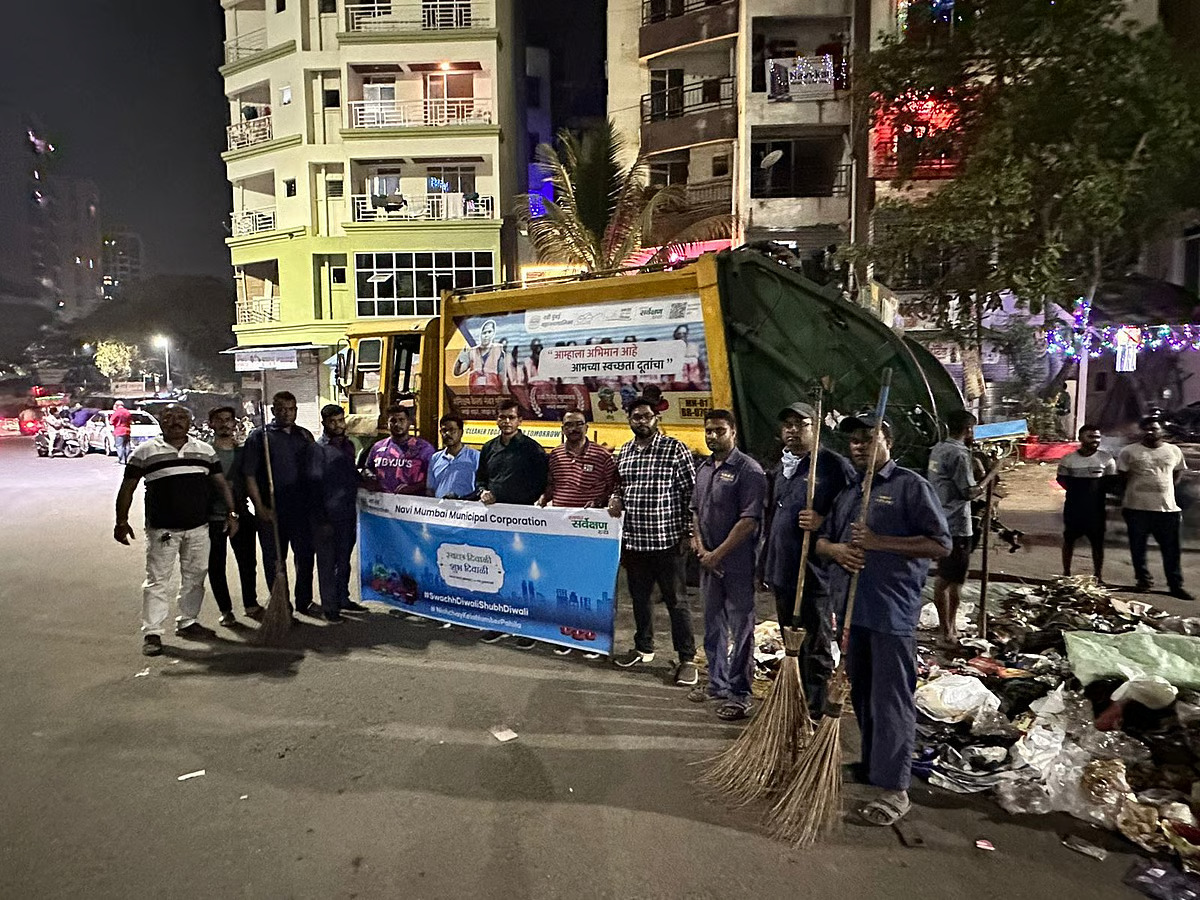
Navi Mumbai’s overnight sanitation drive underscores its growing reputation for disciplined urban management and environmental responsibility. Following India’s triumph over South Africa in the ICC Women’s Cricket World Cup 2025 final, the Navi Mumbai Municipal Corporation (NMMC) swiftly deployed its solid waste management team for an overnight clean-up outside Dr DY Patil Stadium, ensuring the city awoke to spotless streets after a night of celebration.
The large-scale operation, launched minutes after the final whistle, was coordinated by senior municipal officials and executed by more than forty sanitation workers. By dawn, the team had cleared nearly eleven tonnes of waste—plastic bottles, food packaging, and litter left behind by tens of thousands of spectators. The waste was immediately transported to the Turbhe Solid Waste Management Facility, where it was sorted for processing and recycling. According to civic officials, the effort was part of a wider strategy to maintain Navi Mumbai’s consistent ranking among India’s cleanest cities. “Major public events can generate enormous waste volumes within hours,” said a senior official from NMMC’s Solid Waste Department. “Our teams are trained to respond rapidly to minimise environmental impact and uphold hygiene standards in dense urban zones.”
This was not the first such intervention. The corporation had conducted similar overnight drives after previous World Cup matches at the same venue. Officials emphasised that these operations serve as both a logistical necessity and a civic statement—reinforcing the idea that cleanliness and sustainability are integral to the city’s identity. Urban analysts note that Navi Mumbai’s model reflects a shift in how Indian cities are approaching large-event management. Traditionally, post-event clean-ups in major metros have been delayed or sporadic, often leading to sanitation backlogs. By contrast, Navi Mumbai’s approach blends real-time response, decentralised waste processing, and community accountability.
Experts in urban sustainability suggest that this consistency in civic management has broader implications. “When cities institutionalise rapid clean-up mechanisms and responsible waste logistics, they’re effectively investing in resilience,” explained a Mumbai-based urban planner. “It’s not just about optics—it’s about ensuring that infrastructure, public morale, and environmental health remain intact after large gatherings.” As Navi Mumbai continues to expand as a planned city and business hub, such initiatives also highlight the role of urban governance in shaping sustainable, gender-neutral, and inclusive public spaces.
Also Read: BMC Permits Two-Hour Pigeon Feeding At Four Newly Approved City Zones
Navi Mumbai Cleans Up After World Cup Win
