


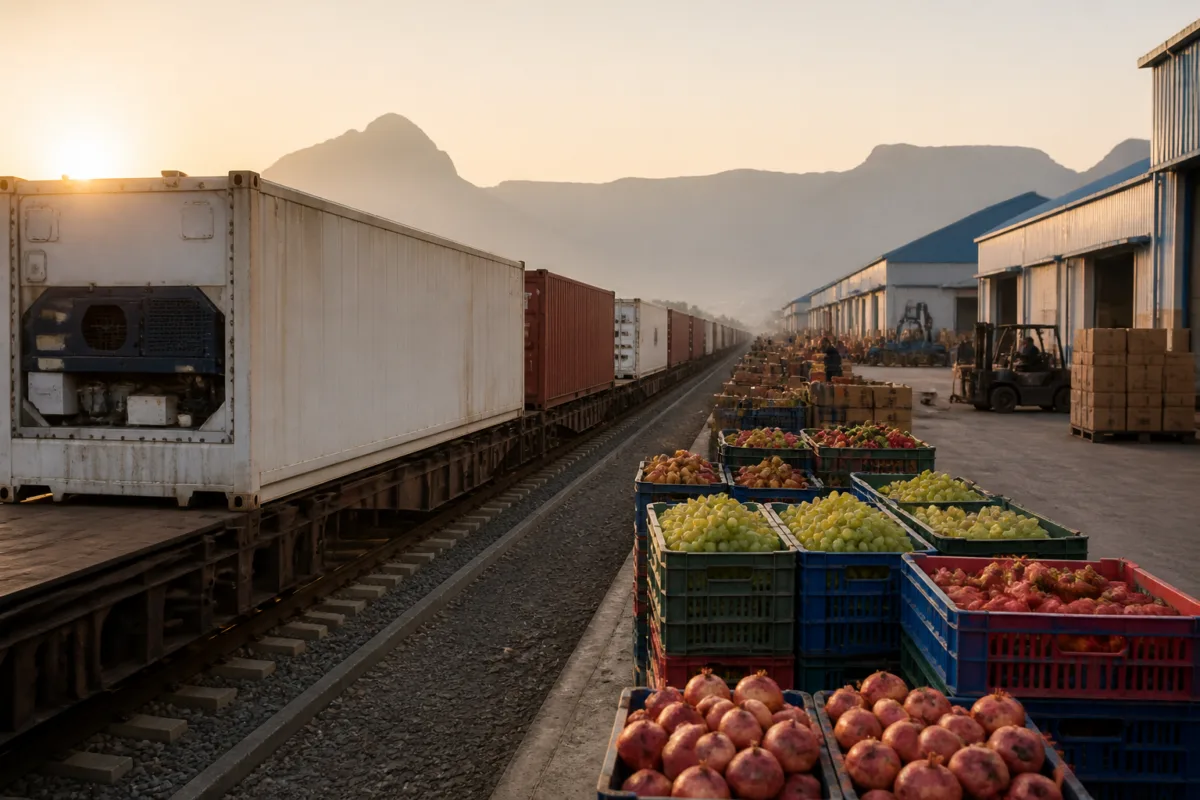
Nashik rail freight could soon provide a direct route for the region’s agricultural and industrial goods to Jawaharlal Nehru Port Authority and Mumbai Port, with the Container Corporation of India examining whether trains can deliver cargo before scheduled vessel departures. The plan is intended to create an alternative to road transport for export-bound goods.
CONCOR, a company under the Ministry of Railways, is exploring new rail freight opportunities in the Nashik division. Narmadeshwar Jha, cluster head of the Indian Railway Traffic Service, shared the information at a recent railway freight and logistics dialogue organised by the Bhusawal division of Central Railway.
The proposed rail movement would draw cargo from both agricultural and industrial centres in the Nashik region. Lasalgaon, Niphad and Dindori are major agricultural production areas, with grapes, onions and pomegranates among the key products. Satpur, Ambad, Sinnar and Igatpuri are important industrial zones producing engineering goods, pumps, motors, vehicle components, machinery and other industrial products.
The logistics plan is linked to the HALCON Integrated Cargo Centre at Janori, near Nashik’s Ozar airport. CONCOR established the facility in collaboration with Hindustan Aeronautics Limited. The centre offers facilities for exports by both sea and air and includes a modern agricultural export and cold-storage facility, known as a packhouse.
According to the report, 39,841 metric tonnes of agricultural goods were transported by containers through HALCON by sea during the financial year that recently ended. The agricultural export and cold-storage facility handled a further 1,703 metric tonnes of cargo. These figures provide an existing base of export-oriented cargo around which a rail-linked logistics service could be developed.
The freight opportunity is not uniform across the year. Agricultural exports are largely seasonal, meaning demand for transport rises during crop and export cycles. Industrial goods, by contrast, can move throughout the year. The assessment presented at the logistics dialogue was that regular industrial cargo could provide a stable, year-round base for rail freight, while agricultural shipments could add volume during their peak seasons.
The current proposal is at the stage of examining whether rail services can connect cargo from the Nashik region to JNPA and Mumbai Port within shipping schedules. The report does not specify a launch date, train frequency, cargo rates or the final operating arrangement. Further development will depend on the freight assessment and coordination between CONCOR, railway authorities, cargo producers and export facilities.

