


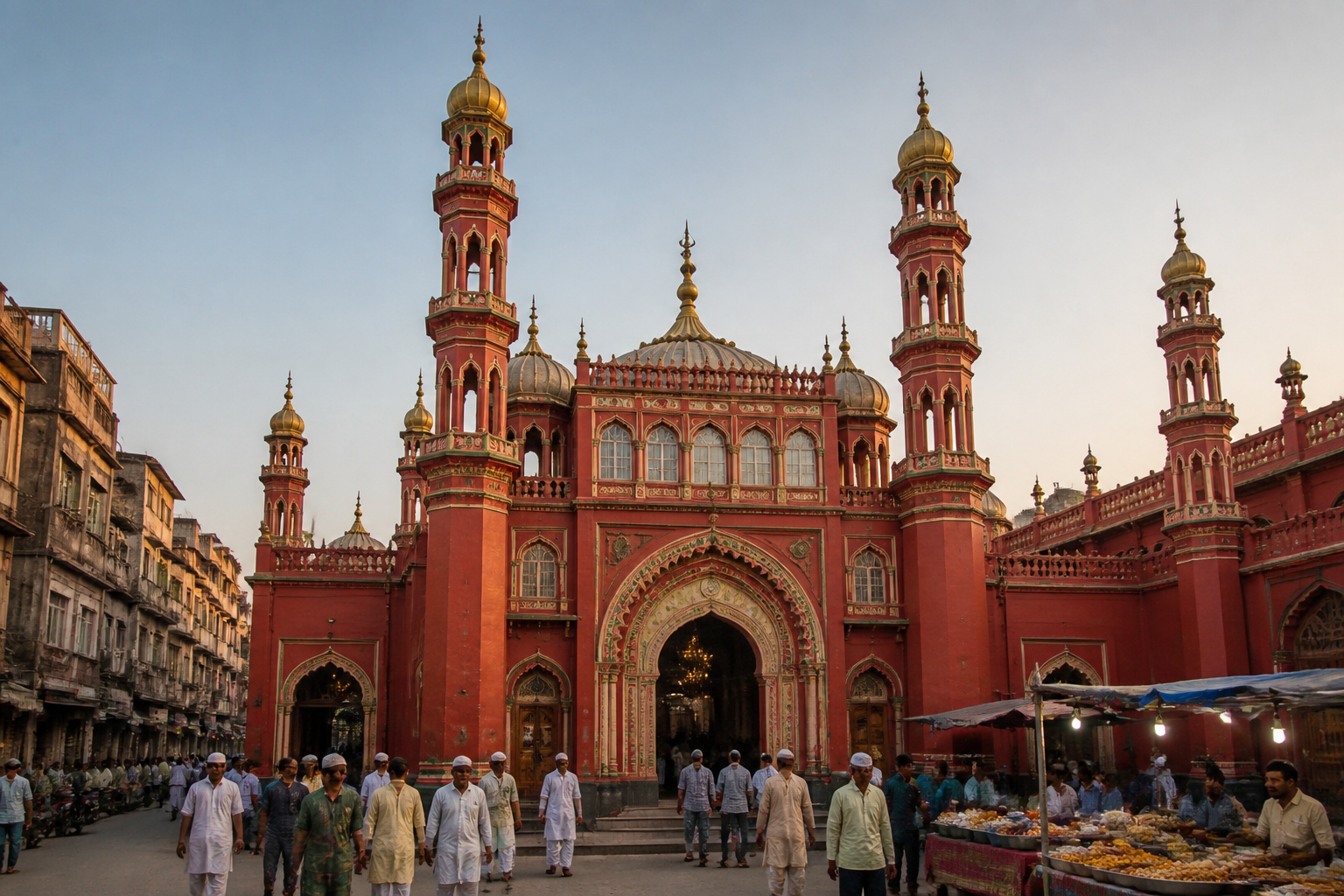
Nakhoda Masjid, Kolkata’s largest mosque on Chitpore Road, has reached its centenary while continuing to preserve religious traditions, community links and an architectural presence that shapes one of the city’s historic commercial districts.
The mosque was built by business tycoon Hazi Zakaria, who was involved in the shipping business, with contributions from Kolkata’s Kutchi Memon community. Its trustees continue to follow traditions associated with Ramadan, including switching on a light at the top of the mosque to signal the beginning of Aftaari, or the breaking of the fast, each evening. The light is also switched on every morning to mark the start of Sehri, when the fast begins.
The mosque remains open to visitors from all faiths during most of the day. Nasser Ebrahim, a trustee, said non-worshippers are restricted from entering for a period around Namaz, but can otherwise walk in and experience the building. The arrangement has helped keep Nakhoda Masjid connected to the wider public beyond its role as a place of worship.
The mosque’s centenary has also renewed attention on the streets around it. Every Eid after Ramadan, the area becomes known for Mughlai food, including kebabs and biryani. In recent years, food vloggers and Instagram users have brought younger visitors, including members of Gen Z, into contact with the mosque’s history, legacy and architectural character.
According to Ebrahim, the present mosque was built after two smaller mosques on the site were demolished. Hazi Zakaria contacted the trustees of both mosques, who agreed to the construction of a larger structure on the land. The exact completion date remains disputed within the community: one view places it in 1926, while another says construction ended in 1930. Ebrahim said the majority opinion is that the mosque was ready in 1926.
The building is distinguished by its bright red terracotta-coloured walls and minarets finished with silver and gold elements. Its scale and appearance have made it a prominent landmark on Chitpore Road, an area shaped by trade, migration, religious institutions and long-standing food and business networks.
The mosque’s history is closely linked to the Kutchi Memon community, which migrated from Gujarat’s Kutch region to Kolkata for trade and business. The community helped build the mosque and continues to serve as its trustee body. Its presence in Kolkata has reduced over time, with around 70 families now living in the city. A community member said many others have moved to Mumbai, Bengaluru or locations outside India.
The Kutchi Memons also run a mosque and a Jamaat Khana, or resting place, on Mumbai’s Mohammed Ali Road. The community operates another mosque in Bengaluru.
Despite reaching 100 years, the trustees do not plan a formal celebration. Ebrahim said the mosque is a place of worship and that its dignity should be preserved. The trustees’ stated wish is for Nakhoda Masjid to continue standing for several more centuries.

