


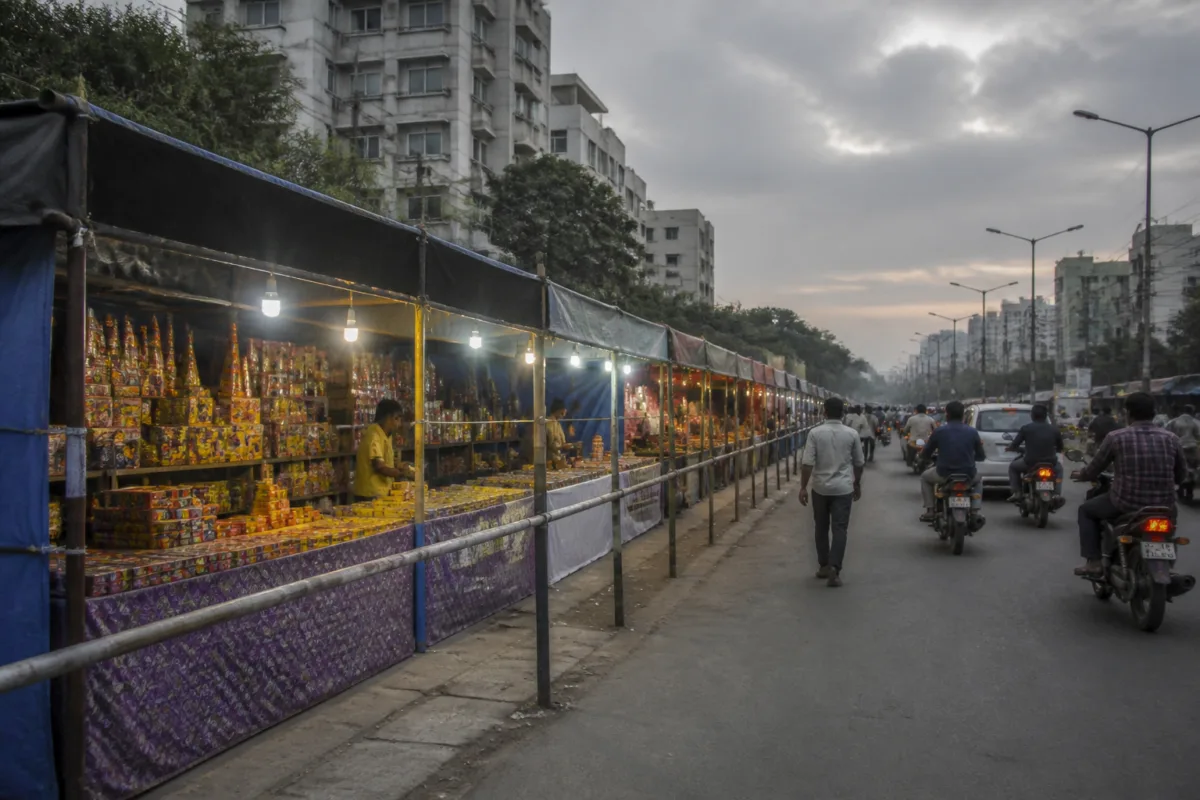
Nagpur’s approval of 831 firecracker shops ahead of Diwali has exposed a problem that extends beyond the number of vendors allowed to operate: the city has rules governing noise, emissions and public-space use, but the available account does not establish how those rules will be monitored on the ground. The Maharashtra Pollution Control Board (MPCB) has issued guidelines after a high court rap, yet the operational chain between issuing a shop permission and checking what happens during the festival remains unclear.
The gap is important because firecracker regulation is not limited to licensing sellers. It involves controlling where crackers are used, when they are burst, how much noise they produce, what emissions they release and whether enforcement agencies can respond quickly to violations. In Nagpur, the municipal fire department has issued no-objection certificates to vendors, while the MPCB says civic bodies, police and other local authorities must assist with enforcement. But MPCB sub-regional officer Hema Deshpande told The Times of India that no separate instructions had been issued to the Nagpur Municipal Corporation or Nagpur city police.
That distinction reveals the institutional problem. A permission system can record applications and certificates, but it does not by itself demonstrate compliance after shops begin operating or once crackers are used across neighbourhoods. The data supplied in the report shows that 1,098 applications were received across nine fire stations. Of these, 831 certificates were issued, 181 applications were rejected and the remainder were not accounted for in the table’s listed categories. The permissions therefore provide a measurable administrative output, but not an equivalent measure of environmental enforcement.
The distribution also shows that the city’s approval burden was uneven. Lakadganj recorded 218 applications and issued 157 certificates, the highest number of approvals among the listed fire stations. Narendra Nagar received 154 applications and issued 128 certificates, while Sakkardara received 147 and issued 123. Sugatnagar received 125 applications and issued 110 certificates. At the other end, Kalamna recorded 33 applications and issued 21 certificates. Gandhipeth issued 54 certificates from 103 applications, while Civil Lines issued 122 from 169 applications. These figures identify where permissions were processed, but they do not show where pollution checks, inspections or enforcement actions took place.
That missing layer is central to the city’s environmental governance. The report states that no checks had reportedly been conducted on the noise levels or chemical composition of crackers sold in Nagpur. The concern is not only whether a product is described as a green cracker, but whether the claimed standards can be verified and whether users comply with the conditions attached to them. Without a documented inspection mechanism, the city can count authorised shops without being able to demonstrate that authorised sales translate into lawful use.
The MPCB guidelines set out several restrictions. Firecrackers are prohibited on major roads, streets, lanes, footpaths and other public places. Their use is also barred within 100 metres of hospitals, educational institutions, government offices and courts, which are treated as silence zones. Noise-producing crackers cannot be burst between 10pm and 6am, and private premises must comply with prescribed noise standards. Organisers of events and processions must install noise-measuring devices at venues. The guidelines also prohibit laser lights, high-intensity electric lighting and beam lights during festive processions.
Each rule creates a different enforcement requirement. The 100-metre restriction requires authorities to identify protected institutions and monitor activity around them. The 10pm to 6am restriction requires time-sensitive policing and a way to record complaints or violations. Noise standards require measurement rather than visual inspection, while event requirements place a specific responsibility on organisers to install monitoring equipment. These are not interchangeable tasks, and the supplied report does not identify a single agency, public dashboard or city-level protocol that coordinates them.
Deshpande said the MPCB head office order clearly assigns enforcement responsibility to civic bodies and the police. She also said strict action would be taken with the assistance of the municipal corporation, police and other local bodies, while emphasising that environmental protection is the responsibility of every citizen. The statement establishes a broad enforcement arrangement, but it leaves unanswered how responsibilities are divided between departments, who receives complaints, how measurements are recorded and what happens after a violation is identified.
The municipal fire department’s role is more clearly visible at the licensing stage. It charges vendors ₹1,000 as an environmental fee and ₹3,000 towards safety measures when issuing no-objection certificates. Those charges connect the permission process to environmental and safety obligations, but the report does not establish whether the money is ring-fenced for inspections, monitoring equipment, enforcement personnel or other implementation needs. Nor does it state how many inspections were planned or completed after certificates were issued.
This is where the city’s firecracker policy intersects with public health. Experts cited in the report say firecrackers release fine particulate matter and potentially harmful substances, including lead, barium, strontium, copper compounds and cadmium. Exposure risks are particularly relevant for children, senior citizens and people with respiratory ailments. The public-health concern is therefore shaped by both intensity and duration: the rules seek to control sound and location, while the composition and volume of emissions affect the quality of air residents breathe.
The report also places firecracker enforcement alongside Nagpur’s unresolved dust-control problem. Measures introduced two years ago require construction sites to install green nets and sprinkle water to suppress dust. Vehicles transporting garbage and construction and demolition waste must be covered, and dust-prone areas require preventive measures. The civic body’s public health engineering department was tasked with enforcement. Yet dust pollution reportedly remains a concern ahead of Diwali, raising questions about whether the same administrative capacity available for routine environmental enforcement can handle a short, high-intensity period of festive pollution.
The comparison matters because Diwali-related air pollution is not generated by one source alone. Firecracker emissions occur alongside dust from construction activity, uncovered waste and construction-and-demolition transport. The supplied material does not quantify the contribution of each source, so it cannot establish which source is dominant in Nagpur. It does, however, show that the city is managing multiple pollution-control obligations through different departments and rules, with questions remaining about implementation.
The shop data provides a useful indicator of scale. Of the 1,098 applications recorded, 831 certificates were issued and 181 were rejected. That means the city had to process a large number of applications before the festival, while also dealing with public-space restrictions, silence zones, timing rules and product standards. The data does not show how many vendors operated in areas close to protected institutions, roads or residential clusters. It also does not indicate whether rejected applicants attempted to sell crackers through informal channels.
Those omissions are not minor administrative details. They determine whether enforcement is preventive or merely reactive. If authorities know where shops are located and where public use is prohibited, they can plan inspections and deploy staff before violations occur. If monitoring begins only after complaints, enforcement may be uneven, especially in dense neighbourhoods where residents may not know which agency to contact. The report does not establish which of these models Nagpur has adopted.
The legal framework cited by the MPCB includes the Noise Pollution (Regulation and Control) Rules, 2000, the Environment (Protection) Act, 1986, the Bharatiya Nyaya Sanhita, 2023, and the Explosives Act, 1884, as applicable. This gives authorities multiple legal routes for action, but a broad legal framework is effective only when field-level responsibilities, evidence collection and follow-up procedures are clear. A noise reading, a product test, a location violation and a breach of operating hours may require different forms of documentation and different institutional responses.
Nagpur’s case therefore highlights a recurring urban governance pattern: approvals are easier to count than compliance. The city can publish the number of applications received, certificates issued and applications rejected. It is harder to show how many inspections were conducted, how many noise measurements were taken, how many violations were recorded, how quickly agencies responded and whether penalties changed behaviour. Those are the indicators that would allow residents to judge whether the rules function beyond paper.
The evidence currently confirms three things. First, Nagpur has approved a substantial number of firecracker shops and has a defined permission process. Second, the MPCB has prescribed detailed restrictions on location, timing, noise, emissions and festive lighting. Third, the available report identifies uncertainty over the operational mechanism for enforcing those restrictions, including the absence of separate instructions to the civic body and police as cited by the MPCB officer. What remains unestablished is the scale of actual violations and the number of inspections or enforcement actions undertaken. The next meaningful measure of the policy will therefore be not only how many shops received permission, but whether the city can document what happened after permission was granted.

