


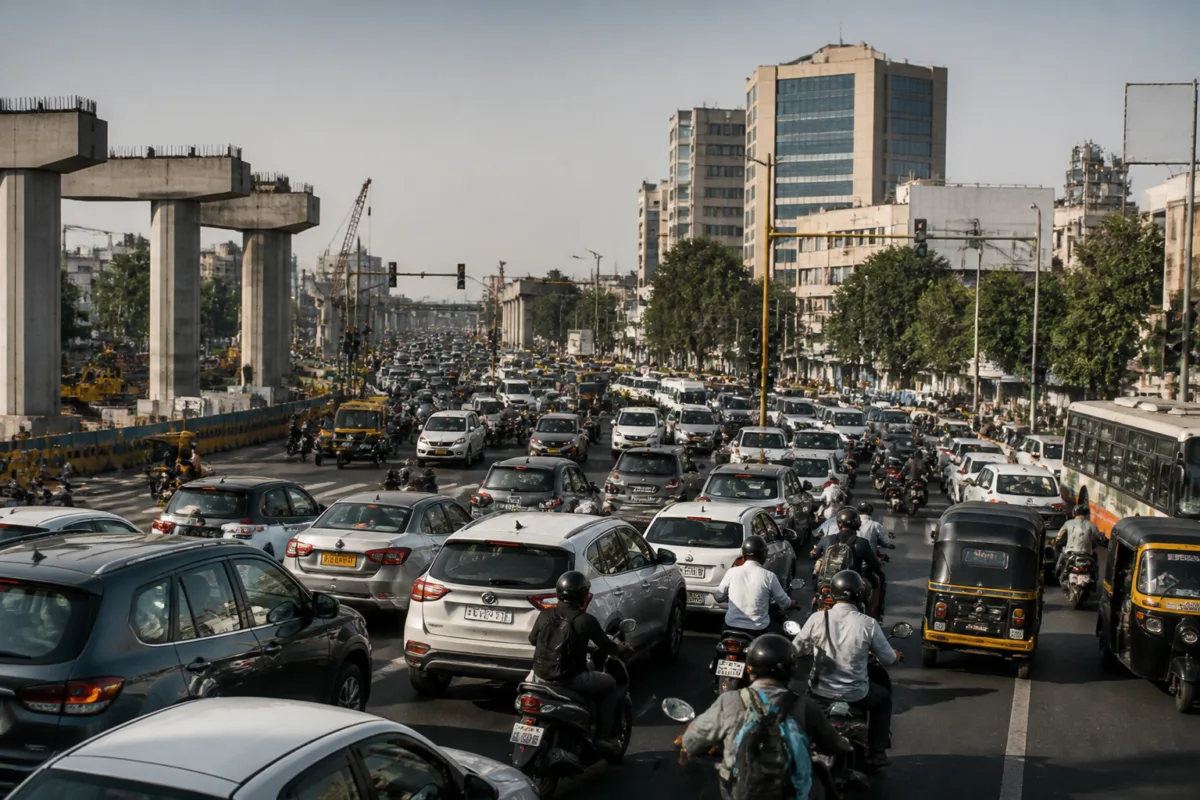
Nagpur traffic congestion is no longer only a peak-hour inconvenience. The city’s vehicle population has reached 32.42 lakh, while registrations across its three Regional Transport Offices have risen by nearly 86% in six years. The figures point to a structural challenge: road expansion and new flyovers may improve movement at selected locations, but they have not stopped the number of vehicles using the city’s streets from growing faster than available road space.
The data reported from the City, Rural and East RTOs shows that Nagpur’s vehicle count is distributed across a wide administrative geography. City RTO, or MH-31, accounts for 15.08 lakh vehicles, followed by Rural RTO, or MH-40, with 9.19 lakh, and East RTO, or MH-49, with 7.83 lakh. Together, these figures form the basis of the 32.42-lakh total and show that congestion cannot be understood only through the capacity of a few central roads or major junctions.
The sharper signal lies in the pace of new registrations. In financial year 2020-21, the three RTOs together registered 94,286 vehicles. That figure rose to 1,75,282 in 2025-26, an increase of nearly 86%. East RTO registrations increased from 38,272 to 70,673 during the same period, while City RTO registrations more than doubled from 16,790 to 35,492. Rural RTO registrations also rose substantially, from 39,224 to 69,117.
The trend has continued into the current financial year covered by the report. During the first six months of 2026-27, the three RTOs recorded 86,648 registrations. That works out to approximately 475 new vehicles entering the registration system every day. The number is not a direct measure of how many vehicles are simultaneously present on Nagpur’s roads, but it does show the speed at which the city’s registered vehicle base is being replenished and expanded.
That distinction matters for urban planning. Registration data captures vehicles assigned to Nagpur district, whereas daily traffic reflects movement across administrative boundaries. The report notes that vehicles registered in neighbouring districts and other states also use Nagpur’s roads. Residents who have moved to the city for employment, education and business, along with regular visitors, add to the daily volume. As a result, the road network is responding not only to local vehicle ownership but also to the city’s role as a destination and regional centre.
## Nagpur traffic congestion and the limits of road expansion
Nagpur’s older reputation as a city with wide roads and relatively smooth traffic was based on a lower level of vehicle pressure. That advantage is being eroded as growth in registrations is combined with construction activity, inadequate parking and increased movement through commercial stretches. Traffic jams are now reported on major roads and at busy junctions, including outside the most concentrated peak periods.
This is the central institutional problem revealed by the figures. Road capacity is generally planned and delivered as a physical asset: a widened carriageway, a flyover, a junction improvement or a new connection. Vehicle growth, however, is continuous. When the number of private vehicles rises faster than the effective capacity of the network, an infrastructure intervention can improve one bottleneck while shifting pressure to another location or delaying the point at which congestion becomes visible.
The report does not establish that every new road project has failed. It records that flyovers and wider roads have improved connectivity at several locations. The evidence instead shows that these gains are being placed under continuing pressure by the addition of vehicles. The question for transport governance is therefore not whether Nagpur needs better roads, but whether road construction alone can keep pace with the demand being generated by private vehicle ownership.
Deputy Commissioner of Police (Traffic) Aditya Mirkhelkar identified the increase in vehicles as one of the main reasons for traffic jams. He also cited migration, infrastructure works and the lack of proper parking. Mirkhelkar said traffic in Nagpur remained better than in other cities of a similar size, but added that better traffic management and increased public transport use could ease congestion.
His comments place the issue across several departments rather than within the traffic police alone. The traffic police can regulate junctions, manage diversions and enforce rules, but it does not control the pace of vehicle registration, the design of new developments, the supply and pricing of parking, or the quality and reach of public transport. Congestion is therefore partly a road-management issue and partly a coordination issue between transport, municipal, planning and enforcement institutions.
## A city being asked to absorb more movement
The RTO numbers also reveal the difference between mobility demand and mobility supply. New registrations indicate that households and businesses continue to acquire vehicles. The reasons may include the need to reach workplaces, schools and commercial areas, or the absence of a sufficiently convenient alternative. The supplied evidence does not establish the individual reason behind each purchase, but the aggregate trend shows that private vehicles remain a significant part of how people access the city.
At the same time, the report identifies public transport as part of the response. It does not provide ridership figures, route coverage, service frequency or mode-share data, so it cannot establish how effectively public transport currently competes with private vehicles. It does, however, record the traffic police’s view that greater public transport use could help ease congestion. That makes public transport a central policy variable, even though the available material does not quantify its present impact.
Parking is another capacity issue that is often treated separately from traffic flow. The report identifies a lack of proper parking as one of the factors behind the problem. Vehicles searching for parking, stopping along commercial roads or occupying limited kerb space can reduce the usable width of a carriageway. In that situation, a road may be physically wide but functionally narrower than its design suggests. Enforcement and parking management can therefore affect traffic conditions without adding a single lane.
Infrastructure works create a further temporary and sometimes recurring constraint. Construction activity can reduce road space, alter routes and slow movement even when the completed project is intended to improve connectivity. When works take place alongside rapid vehicle growth, the system has to absorb both short-term disruption and long-term demand. The report does not specify the projects or their duration, but it includes ongoing infrastructure works among the factors contributing to congestion.
## The administrative test ahead
Nagpur’s immediate challenge is to connect registration trends with operational decisions. The three RTOs provide a clear measure of how quickly the vehicle base is growing, while traffic authorities observe the consequences on roads and junctions. A more complete mobility response would require these signals to be considered together with parking conditions, public transport use, road works and movement from outside the district. The available report does not indicate whether such an integrated monitoring system is currently in place.
The geography of registrations also matters. City, Rural and East RTO areas do not represent identical travel patterns or road conditions. A rise in registrations in one jurisdiction may generate trips across another, while vehicles registered outside the district may contribute to congestion without appearing in local registration totals. Planning based only on the location of registration could therefore miss the routes and destinations where road pressure is actually experienced.
The 475-vehicle daily average offers a useful measure of momentum, but it should not be read as a daily increase in active traffic. Vehicles may be used at different frequencies, may travel outside the city, or may replace older vehicles. Even with those qualifications, the underlying direction is clear: more vehicles are being added to a network already experiencing congestion across major roads, busy junctions and commercial stretches.
The larger urban question is whether Nagpur can preserve mobility by continually adding road capacity or whether it must manage demand across several modes. The evidence supplied in the report supports a cautious conclusion. Road improvements have delivered local connectivity benefits, but the growth of the vehicle population, combined with parking shortages, migration, infrastructure works and limited public transport use, is creating a problem that cannot be measured only by the width of roads.
Nagpur traffic congestion is therefore best understood as a coordination challenge. The latest RTO figures confirm the scale and speed of vehicle growth; the traffic police’s assessment identifies the pressure points; and the reported conditions on roads show the citizen-facing result. What remains unestablished in the available material is how much congestion is attributable to each factor and whether existing public transport and parking measures are keeping pace. Those are the indicators that will determine whether the city’s next mobility gains come from more construction or from better management of how people and vehicles use the urban road network.

