


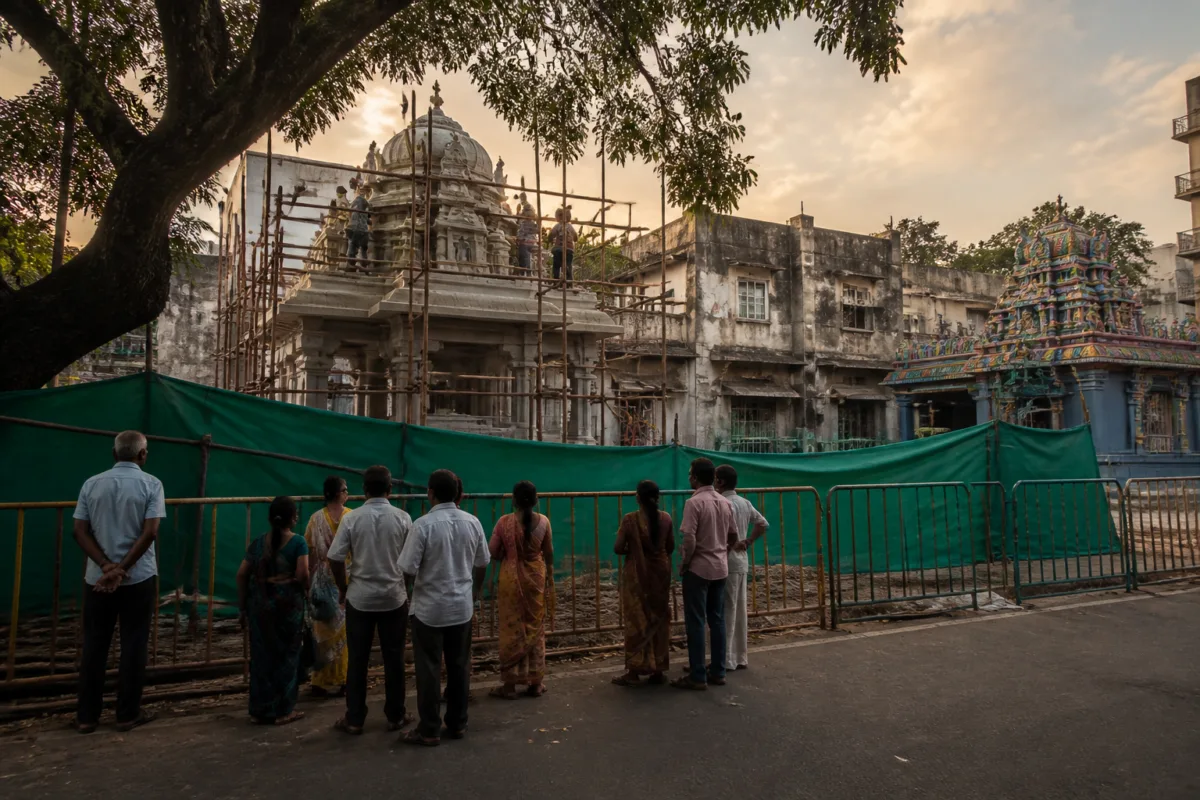
The Mylapore Sai Baba temple dispute is no longer only a contest over the administration of a religious institution. Interim reports placed before the Madras High Court have turned it into a broader case study in how urban land, charitable funds, construction decisions and membership-based governance can become entangled when institutional controls weaken. The reports concern the All India Sai Samaj (AISS), which manages the popular Sai Baba temple in Chennai’s Mylapore, and identify alleged financial and administrative irregularities under a former executive committee.
The allegations remain subject to the court’s consideration and have not been finally established. But the material already before the court is significant because the Samaj controls a sizeable urban property, operates a public-facing place of worship and has historically been associated with educational and community activity. The dispute therefore raises questions that extend beyond the internal management of a religious body: who authorises the use of institutional land, how are donations protected, and what approvals are required when a prominent urban site is demolished or rebuilt?
The AISS was founded by Narasimhaswamy, an advocate from Salem district who established the temple in 1941 on eight grounds of land. The Samaj purchased another eight grounds of adjoining land in 1956, and established Sai Vidyalaya on the adjoining property in 1967. The temple’s daily practices also developed a distinctive institutional identity, incorporating Quranic verses alongside Hindu religious ceremonies. Over time, the temple’s popularity increased donations and contributions, while its landholding became an important part of its institutional base.
The administration began facing disputes around 2000, according to the report. Two devotees, R. Hariharan and G. Balakrishnan, approached the Madras High Court in 2001, and the case remains pending before a Division Bench. The dispute later intensified around the control of the Samaj’s general body and executive committee. The reports allege that the membership fell from 5,600 to 522, with only about 50 active members, and that relatives, friends and loyalists of the management were inducted into membership and electoral rolls. In the 2024 election, only 40 members voted, including 15 relatives of K. Thangaraj, who took over the administration after the death of his uncle, Karunakaran, in 2020.
That membership history is central to the institutional question. A society registered under the Societies Registration Act depends on its governing documents, membership rolls and internal elections to establish legitimacy. If the effective electorate becomes much smaller than the historical membership, control over the institution can be concentrated among a limited group. The court-appointed reports allege precisely such a pattern, but the final legal assessment will depend on the evidence and proceedings before the court.
In August 2025, retired High Court judge P.N. Prakash submitted a report examining the Samaj’s affairs. On August 29, 2025, the court dissolved the erstwhile executive committee and constituted an Interim Administration Board comprising Justices K.N. Basha and P.N. Prakash. The board has since submitted eight interim reports. The reports, according to the article, have been incorporated into orders issued by the court from time to time.
Among the most consequential allegations is a ₹15-crore loan obtained from Union Bank of India in May 2023 by mortgaging Samaj land. The board has alleged that the borrowing was undertaken without the required authorisation from the executive committee or general body and without the court’s permission. It has also alleged that false information was provided to the bank. The loan reportedly created a monthly equated monthly instalment liability of ₹25 lakh for the Samaj.
The issue is not simply the size of the borrowing. Mortgaging land held by a public-facing institution can alter the institution’s financial exposure and constrain future use of its property. Where the land is part of a long-established temple complex, the decision also affects the physical and cultural continuity of the site. The reports’ focus on authorisation is therefore a question of institutional process as much as a question of repayment.
A second major issue concerns the ₹23.91-crore construction of a kalyana mandapam after Sai Vidyalaya was demolished in 2019. The construction was allegedly undertaken without the necessary approvals. The reports also question the use of devotees’ funds for real estate-related activity, including the purchase of land at Acharapakkam for ₹3.72 crore and the construction of a guest house there at a cost of ₹2.92 crore. Acharapakkam is around 100 kilometres from Chennai, placing the transaction outside the immediate urban setting in which the temple operates.
These transactions illustrate how an institution’s property strategy can move away from its visible public function. A temple in a dense city neighbourhood may generate regular donations because of daily access and local footfall, while land purchases outside the city and construction of a remote guest house create different financial and administrative obligations. The available reports do not establish whether those projects were legally permissible or financially justified; they record allegations that the court-appointed board has asked the court to examine.
The reports also cite an unexplained write-off of ₹1.35 crore and the purchase of ghee worth ₹98 lakh in the 2024-25 financial year from R.R. Enterprises, owned by Thangaraj’s wife. Such related-party transactions are particularly important in an institution funded by devotees because they raise questions about disclosure, conflict management and the separation of personal and institutional interests. The source material does not state the final finding on these transactions, and they remain allegations in a pending matter.
The most visible built-environment issue is the demolition of the temple’s main sanctum sanctorum. According to an interim report, an earthmover was used in the early hours of September 18, 2024, without a structural stability certificate or approval from the Samaj’s general body, executive committee or the Greater Chennai Corporation. The report alleged that the demolition was carried out clandestinely to facilitate construction of a new temple and for the monetary gain of individuals. It also said the alleged act could attract provisions of the Tamil Nadu Public Property (Prevention of Destruction and Loss) Act, 1982.
The alleged demolition matters because construction control in a city is not limited to private buildings. A religious structure may have a distinct ownership and management framework, but work affecting its physical form can still raise questions involving structural safety, municipal permissions and public access. The reports identify the absence of a structural stability certificate and Greater Chennai Corporation approval as part of the dispute. Whether those allegations are proved is for the appropriate proceedings, but the episode demonstrates the administrative risks created when reconstruction begins before the governing and statutory permissions are settled.
The dispute also had an operational consequence for devotees. Following the demolition, the main marble deity was kept under lock in a separate premises and was inaccessible to devotees for more than a year-and-a-half, according to a source associated with the new administration. The source said that visitor numbers and hundial collections declined, with monthly donations falling from around ₹80 lakh to less than ₹30 lakh. These figures are attributed to the source and are not presented in the article as independently audited accounts.
The reported decline is important to the financial picture described by the board. The Samaj was simultaneously facing alleged repayment and interest obligations on the bank loan, expenditure on the mandapam and Acharapakkam property, and the costs associated with reconstruction. A fall in donations would reduce operating liquidity at precisely the point when the institution’s commitments were expanding. The available material does not provide audited statements showing the full effect on the Samaj’s finances, but it identifies the pressures that the interim administration is dealing with.
The reconstruction now has a different administrative basis. Justice P.N. Prakash declined to comment on the previous administration because the matter is sub judice, but said that a devotee had donated all the required funds and undertaken to complete the temple. He said the reconstruction was being carried out by best-in-class vendors and contractors and that the temple should be completed by March 2027. Thangaraj declined to comment, saying the matter was pending in court and that the allegations would become clear after the final order.
The court’s intervention has therefore shifted the immediate focus from contested internal control to supervised administration and reconstruction. Yet the larger question remains unresolved: how should long-established societies managing valuable urban land and substantial public donations be held accountable when their governing bodies become disputed? The Mylapore case shows that internal membership rules, property decisions, bank borrowing, construction approvals and daily public access can all become part of one governance failure.
The evidence presently confirms the existence of a prolonged dispute, eight interim reports, court intervention and a set of serious allegations concerning finance, membership, land, construction and demolition. It does not establish the final culpability of the former administrators or the legal status of every transaction. Those questions await the court’s proceedings. The next concrete milestone identified in the material is the proposed completion of the reconstructed temple by March 2027, alongside the court’s eventual consideration of the reports and the alleged violations.

