


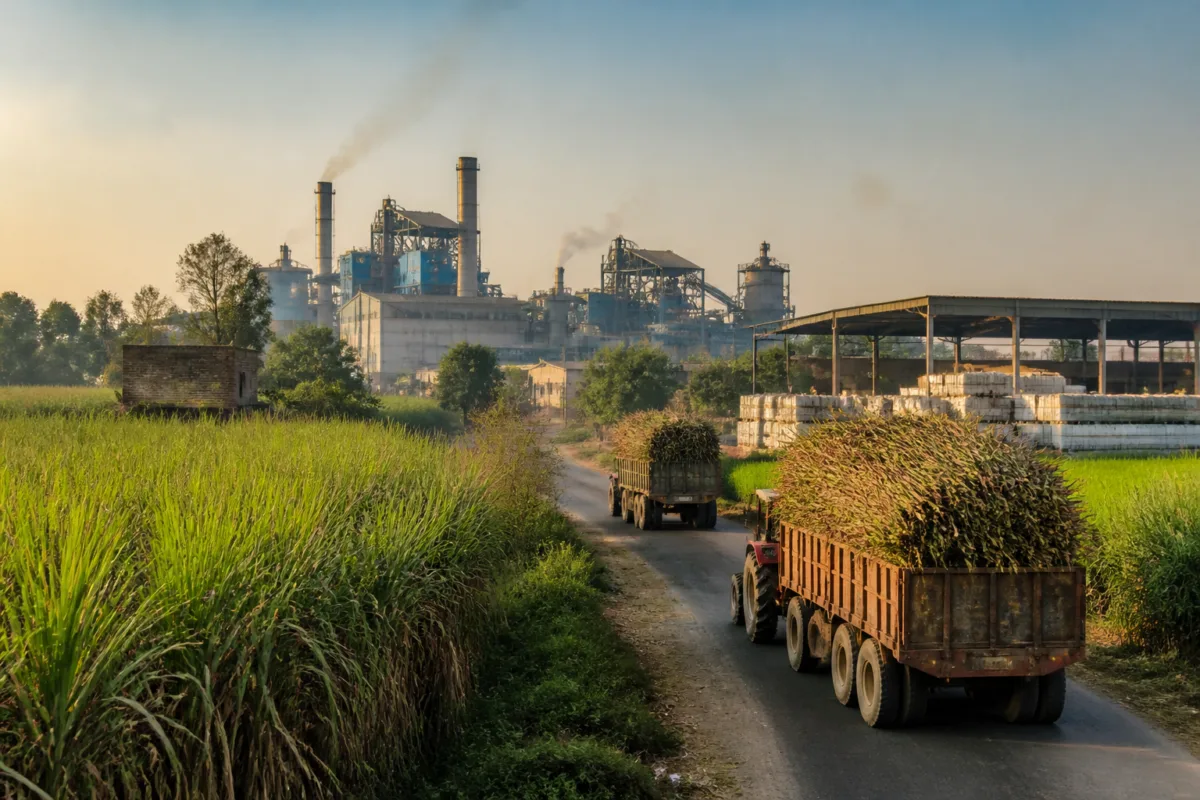
Muzaffarnagar’s move beyond sugar is being presented as a wider transition from raw agricultural production to a more integrated rural-industrial economy. The district’s established sugarcane base remains central, but the emerging model depends on whether processing, logistics, energy generation, storage and small enterprise can develop around it rather than leaving the district’s agricultural value to be captured elsewhere.
The Times of India report describes Muzaffarnagar as a district whose economic identity has traditionally been built around sugarcane fields, sugar mills and the network of farmers, transporters, labourers, equipment suppliers and traders connected to them. Over the past nine years, according to the report, policy and investment attention has increasingly moved towards agro-processing, value addition, rural infrastructure and new industrial activity.
That shift matters because agriculture in districts such as Muzaffarnagar is not only a matter of farm output. It also determines the location and quality of employment, the demand for roads and logistics, the viability of small towns and the relationship between villages and industrial centres. When crops leave an area in an unprocessed form, much of the value associated with grading, packaging, storage, manufacturing and marketing is generated elsewhere. The stated ambition in Muzaffarnagar is to retain more of those activities within the district.
The report places sugarcane at the centre of this transition. Western Uttar Pradesh’s fertile alluvial soil, irrigation facilities and agro-climatic conditions have supported large-scale sugarcane production. Sugar mills have consequently created a regular connection between farms and industry, with cane procurement supporting agricultural incomes while supplying raw material to processing units.
That relationship also produces a wider rural economy. Sugar mills generate direct employment and demand for transport, machinery maintenance, packaging, engineering and other services. The economic importance of the sector therefore cannot be measured only by the volume of sugar produced. Its performance affects a network of linked activities that connect farms to factories and factories to markets.
The policy challenge is that a sugar-led economy remains exposed to the performance of a single dominant crop and its principal product. The report says the state government has sought to strengthen the existing sugar economy through measures focused on timely payment of cane dues, mill operations, digital systems, procurement monitoring and payment transparency. These interventions are intended to improve institutional oversight within a chain that affects both farmer incomes and industrial cash flows.
However, the more significant change described in the report is the attempt to create additional value from the same agricultural base. Ethanol production from sugarcane and molasses is identified as one of the most important examples. For sugar mills, ethanol can provide another revenue stream alongside conventional sugar. It also links the district’s agricultural economy to the national effort to reduce dependence on imported fossil fuels.
The importance of this model is its use of multiple outputs. Molasses can supply distilleries and ethanol production, bagasse can support cogeneration of electricity, and press mud also has economic value. In this arrangement, a sugar mill is not simply a factory producing one commodity. It becomes a broader bio-resource and agro-processing centre whose revenues may come from several connected products.
That diversification can reduce the sector’s dependence on sugar prices, although the supplied report does not provide financial data or evidence measuring the scale of that effect in Muzaffarnagar. It does establish the underlying industrial logic: the closer a district can move from raw material to multiple processed outputs, the greater the possibility of retaining economic activity locally.
The same logic extends beyond sugarcane. The report identifies wheat, rice, vegetables, fruits, oilseeds and other crops as part of Muzaffarnagar’s agricultural base. Processing and packaging infrastructure could allow these products to move from local markets into higher-value domestic and national supply chains.
This is where infrastructure becomes an economic issue rather than merely a transport issue. Grading, sorting, packaging, warehousing, cold storage, transportation and marketing all require physical facilities and reliable connections. Without them, producers and small businesses may have limited ability to preserve quality, manage timing or reach distant buyers. With them, agricultural activity can support a wider set of non-farm jobs and enterprise opportunities.
The report links this opportunity to government programmes supporting food processing, micro and small enterprises, cold-chain infrastructure, warehousing and modern marketing. It also refers to the PM Formalisation of Micro Food Processing Enterprises programme, which is intended to help small food businesses improve technology, packaging and market identity. The supplied material does not specify the number of units supported or the investment generated in Muzaffarnagar, but it identifies formalisation and market access as important parts of the proposed transition.
This focus on micro, small and medium enterprises is significant for the geography of employment. Large industrial facilities can anchor a local economy, but they cannot by themselves provide all the activities required across the value chain. Smaller enterprises can operate in villages and small towns in areas such as processing, storage, packaging, equipment services and transport. Their expansion can create non-farm employment close to agricultural production and potentially reduce the need for workers to move to larger cities for every kind of opportunity.
That outcome, however, depends on more than the availability of raw material. Formal registration, credit, skills, technology and market access determine whether small units remain viable and whether they can meet the quality and volume requirements of larger buyers. The report presents government initiatives in these areas as part of the district’s changing economic environment, but it does not provide evidence on how widely these benefits have reached local enterprises.
Muzaffarnagar’s location is another part of the development proposition. The district lies between major economic centres of western Uttar Pradesh and the National Capital Region, giving it a logistical advantage, according to the report. Improved road connectivity can reduce the time and cost involved in moving crops and processed products. Digital infrastructure can help businesses access wider markets, while warehousing, cold storage and modern logistics can provide the support needed to manage agricultural goods after harvest.
The institutional question is whether these elements will develop as a connected system. A road by itself does not create an agro-processing hub. Nor does a processing unit automatically create a stable market for farmers. The transition requires coordination between agricultural production, procurement, industrial operations, enterprise finance, storage, transport and marketing. The report’s description of Muzaffarnagar’s policy direction suggests that this linkage, rather than any single project, is the central development objective.
It also places the district within a broader shift in how agriculture is viewed in Uttar Pradesh. Instead of treating farming primarily as the production of raw material, the policy approach described by the report treats it as the starting point of a chain involving manufacturing, energy, logistics and entrepreneurship. This has implications for district planning because economic infrastructure must serve both farms and factories, as well as the settlements and workers that depend on them.
The transition also raises questions about resilience. A diversified processing economy may have more than one source of revenue, but the supplied material does not establish whether Muzaffarnagar has already achieved that diversification or is still at an early stage. It also does not provide data on employment, processing capacity, the number of operational enterprises, farmer incomes, storage capacity or the value of goods retained locally. Those are the indicators that would show whether the district’s changing narrative has translated into measurable structural change.
The evidence available in the report does confirm the components of the proposed model. Sugarcane remains the backbone. Ethanol and other by-products create possible additional industrial uses. Other crops offer a wider raw-material base. MSMEs can support decentralised processing and employment. Roads, digital connectivity, warehouses and cold storage are necessary to connect production to markets. Each component addresses a different weakness in a raw-produce economy, but their combined performance will determine whether the district can move beyond its traditional industrial identity.
For citizens, the significance of this shift lies in where value and employment are created. If more processing, packaging, logistics and manufacturing occur within the district, agricultural growth can have a broader impact on villages and small towns. If infrastructure and enterprise support remain uneven, the district may continue to produce raw material while higher-value activities take place elsewhere.
Muzaffarnagar’s agro-processing push therefore represents a test of rural industrialisation rather than a simple change in the profile of its sugar mills. The supplied evidence points to a more diversified direction, but the next assessment will depend on concrete measures of investment, enterprise growth, farmer linkages, jobs and processing capacity. Until those outcomes are documented, the district is best understood as being in transition: moving from a sugar-centred economy towards a broader agro-industrial system whose success will depend on infrastructure and institutional coordination.

