


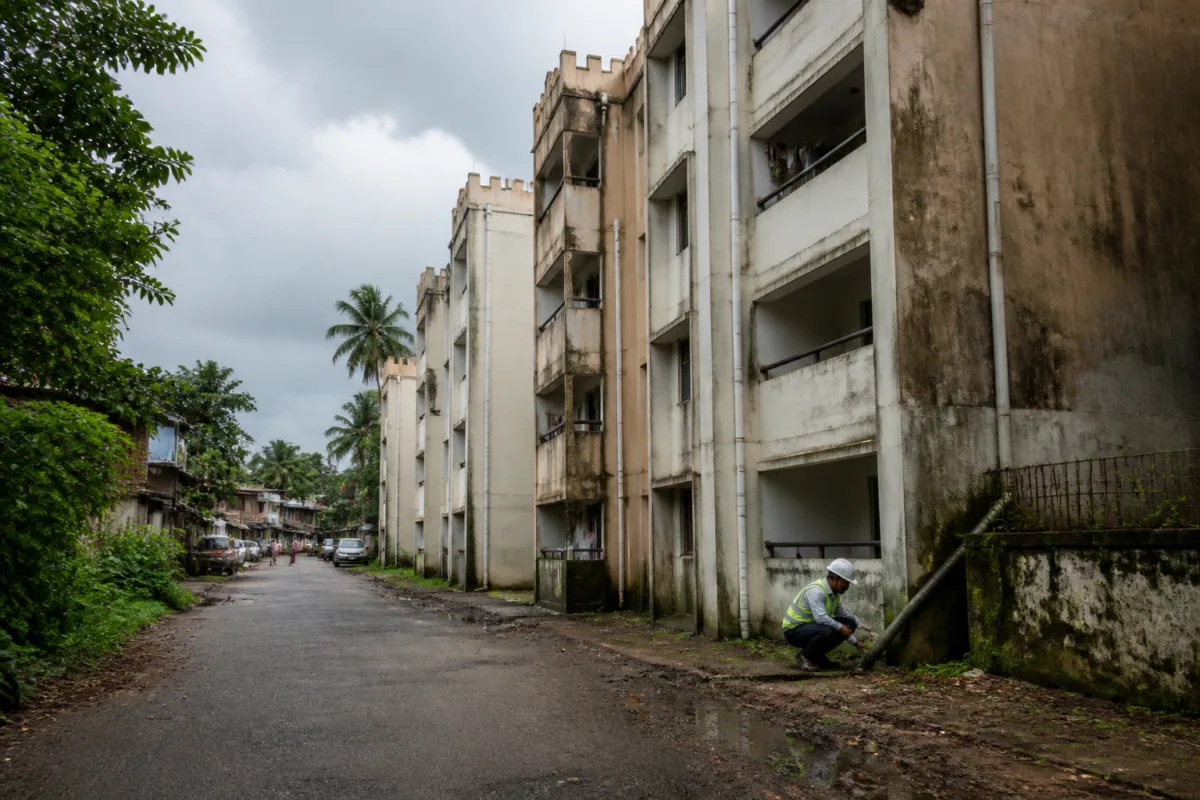
An audit report on the Mundamveli flat complex built to rehabilitate residents of P&D Colony has identified a chain of failures that extends from contractor selection and financial approvals to structural design changes, construction quality and oversight. The findings place the Greater Kochi Development Authority, or GCDA, at the centre of questions about how a public housing project was planned, funded and supervised.
The project was brought under the LIFE Mission for the rehabilitation of P&D Colony residents, while the GCDA constructed the flat complex at Mundamveli. According to the report published by Kerala Kaumudi, the audit department found several actions questionable and said they required explanations. The report also questioned why the LIFE Mission was removed from responsibility for the project, leaving the GCDA to assume the liabilities.
That institutional shift is important because responsibility determines who controls design decisions, procurement, payments, quality checks and responses to defects. The audit department has asked the GCDA to state its position on the alleged violation of the tripartite agreement associated with the project. The supplied report does not provide the GCDA’s response or indicate whether disciplinary or legal action has followed the findings.
The audit findings describe a procurement process in which the appointment of TDLCS as the contracting company allegedly involved an irregular move. Clauses 10 and 12 of the agreement reportedly referred to an accredited agency, but the wording was changed to “construction agency”. The audit described the change as suspicious. It also said the contractor’s financial strength was not assessed and that a bank guarantee was not obtained.
These are not minor administrative details. Contractor screening and performance security are basic safeguards in public construction. Financial assessment is intended to establish whether a contractor can complete the work, while a bank guarantee gives the public authority a mechanism to protect itself if contractual obligations are not met. The report’s account suggests that both safeguards were either absent or inadequate in this case.
The financial decisions identified in the audit raise a separate set of concerns. A fixed deposit of Rs 2.48 crore was reportedly withdrawn to provide an advance to the contracting company. The report said this was done on the chairman’s instructions despite opposition from the GCDA secretary. It further stated that Rs 3.65 crore was withdrawn from fixed deposits and paid to the contractor before their maturity, resulting in an interest loss.
The timing of that withdrawal is central to the audit’s concern. The GCDA reportedly had Rs 99 crore in the treasury and Rs 18 crore in the bank when the fixed deposits were prematurely withdrawn. The report therefore raises questions not only about the payment itself but also about treasury management, the authority for overriding an internal objection and the rationale for using funds in a way that caused avoidable interest loss.
The audit also questioned how technical decisions were made. A technical committee had approved a ring-type steel reinforcement design for piling on 4 February 2021. That design was later changed to a helical-type steel reinforcement design at the contractor’s request, according to the report. The change was allegedly made without obtaining the technical committee’s approval and without revising the estimate.
Design changes during construction are not automatically improper. They can be required by site conditions, engineering assessments or changes in construction methods. But a change to the reinforcement design requires a documented approval trail, technical justification and corresponding revision of cost and scope where necessary. The audit’s concern is that the prescribed institutional process was not followed or was not adequately documented.
The report also points to uncertainty in the way construction defects were investigated. External agencies were appointed to study deficiencies in the construction, even though the GCDA had its own engineering department. The audit questioned why the authority’s engineering wing was bypassed. In July 2024, a leakage was identified, but the technical committee reportedly issued different recommendations at different times to address it.
Leakage in a housing complex can affect residents’ daily use of homes, maintenance costs and confidence in the building’s construction. In this case, the audit linked the leakage issue to wider doubts about the technical preparation of the project, including the preparation of the estimate and the design of the septic tank. The report does not establish the precise engineering cause of the leakage, the number of affected flats or whether permanent repairs have been completed.
The quality-control concerns are equally significant. The audit said the GCDA received several complaints about poor-quality construction materials but failed to discharge its responsibility to examine them. It also questioned why the contractor was not blacklisted. The report further alleged that another company had already been engaged before the first company withdrew, suggesting that the transition between contractors may not have followed a transparent sequence.
Taken together, the allegations show a project in which different control layers appear to have weakened at the same time. Procurement safeguards were questioned during contractor selection. Financial safeguards were challenged by advance payments, premature fixed-deposit withdrawals and the absence of a bank guarantee. Technical safeguards were questioned after a reinforcement design was changed without reported committee approval. Quality safeguards were questioned after complaints about materials were allegedly not examined.
This is the larger urban issue behind the Mundamveli audit. Public housing is not delivered only through the construction of buildings. It depends on a chain of institutions that must remain accountable from beneficiary selection and project design to contracting, payment certification, engineering inspection, defect correction and long-term maintenance. A failure at one stage can create problems at the next; a failure across several stages can leave residents with buildings that are formally completed but operationally unreliable.
The project also illustrates the difference between administrative responsibility and public accountability. The audit report says the LIFE Mission was excluded from the project’s responsibility while the GCDA assumed the liabilities. However, the supplied material does not explain the formal reasons for that arrangement or identify the terms of the tripartite agreement in full. Those documents would be necessary to establish how responsibilities were divided and whether the alleged deviations altered the obligations of each party.
The available figures show the scale of the financial decisions under review: Rs 2.48 crore linked to an advance payment, Rs 3.65 crore withdrawn from fixed deposits before maturity, and available balances of Rs 99 crore in the treasury and Rs 18 crore in the bank. These numbers do not by themselves prove financial misconduct. They do, however, explain why the audit has focused on authorisation, timing, interest loss and the decision-making hierarchy within the GCDA.
The same distinction applies to the technical findings. The reported change from a ring-type to a helical-type piling reinforcement design does not, on the supplied evidence alone, establish that the final design was unsafe. What it establishes is that the audit questioned the absence of approval and estimate revision. The next step in assessing the engineering implications would be to examine the approved drawings, revised calculations, site records, quality-test results and completion certificates.
For residents and public agencies, the unresolved questions are practical. Were the reported material-quality complaints investigated? What repairs were ordered after the July 2024 leakage? Which agency is responsible for future defects? Was the contractor paid for incomplete work, and if so, on what certification? Why was no bank guarantee obtained? Did the GCDA initiate recovery, disciplinary proceedings or blacklisting after the concerns emerged?
The audit report turns the Mundamveli flats into more than a construction-defect story. It presents a picture of institutional controls that may have failed to work together: the contracting process, financial approvals, technical review, quality inspection and accountability for defects. The report’s findings require responses from the GCDA and clarification of the LIFE Mission’s role, the tripartite agreement and the status of corrective action.
What the evidence confirms is that the project faced serious audit scrutiny across several stages of delivery. What remains unresolved in the supplied material is whether the alleged lapses caused specific financial loss beyond the reported interest loss, whether the flats meet the required structural and quality standards, and what remedies have been implemented. Those answers will determine whether the Mundamveli project becomes a case of corrected administrative failure or a continuing liability for the residents it was intended to rehabilitate.

