


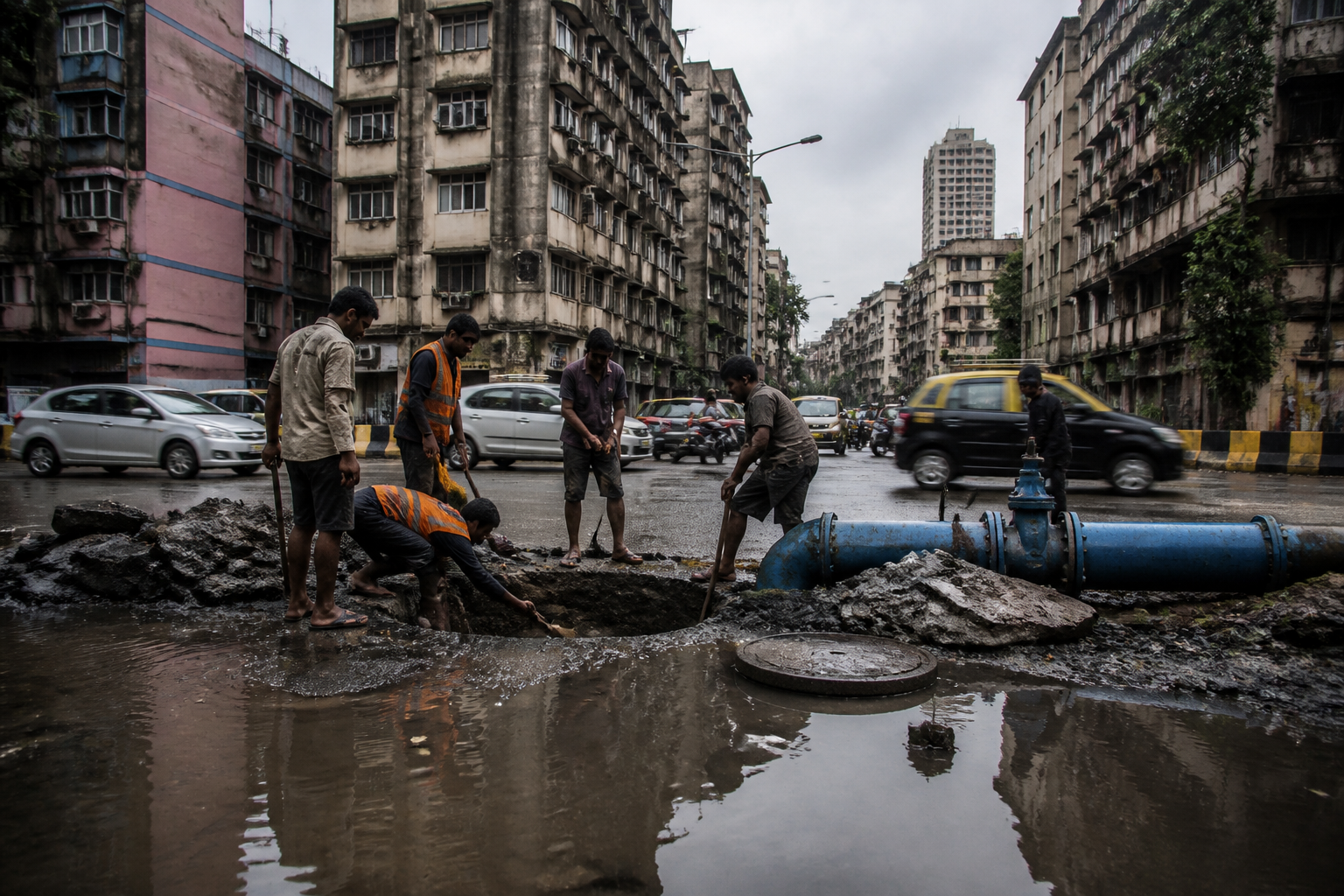
Mumbai’s water system is losing or failing to account for 34% of the supply delivered to the city, according to a presentation made by the Brihanmumbai Municipal Corporation (BMC) to its standing committee. The unaccounted water is attributed to pipeline leakage, water theft and errors in billing and metering, adding pressure to the city’s supplies at a time when a 10% water cut is in force.
The BMC’s disclosure concerns non-revenue water, the portion of water supplied into a distribution network that does not generate corresponding revenue for the civic body. The administration said that reducing this gap is now one of its major challenges, particularly as Mumbai’s existing reservoirs are under increasing pressure from population growth and uncertain rainfall patterns.
Mumbai receives water from seven reservoirs: Upper Vaitarna, Modak Sagar, Tansa, Middle Vaitarna, Bhatsa, Vihar and Tulsi. The civic administration stated that around 4,100 million litres per day (MLD) is supplied to the city, while Mumbai’s daily requirement is approximately 4,600 MLD. The gap between supply and demand has made the efficiency of the existing distribution network as important as the search for new sources.
The presentation also indicated that around 4,800 MLD is lifted from the reservoirs each day, while approximately 4,100 MLD reaches citizens. A substantial portion of the remaining volume is lost through leakage, theft or defective metering, according to the administration. On the figures disclosed, the BMC has set a target of saving about 400 MLD by reducing this non-revenue water.
The issue is unfolding even though the seven reservoirs are reported to be 97% full. The civic administration said the stored water must last until August next year, with the El Niño effect adding to the uncertainty around future rainfall and replenishment. The BMC has warned that if the current 10% water cut is withdrawn, the available stock could last only until around May.
The disclosure places the city’s water challenge on two fronts. Mumbai is planning additional sources, including the Gargai dam, a desalination project and the reuse of treated wastewater. At the same time, a significant share of the water already entering the system is not being accounted for through the distribution and billing network. The figures presented to the standing committee therefore connect reservoir planning with the condition and management of the pipes, meters and supply connections serving the city.
For residents, the immediate effect remains the ongoing 10% cut, while the longer-term question is whether the BMC can recover water from the existing network quickly enough to reduce pressure on the reservoirs. The administration’s 400 MLD saving target will depend on addressing the specific sources identified in its presentation: physical leakage, unauthorised use and metering or billing deficiencies.
The BMC presented the information to the standing committee as part of its review of Mumbai’s water supply. The next steps identified by the administration include efforts to control non-revenue water while pursuing new supply projects and wastewater reuse.
