


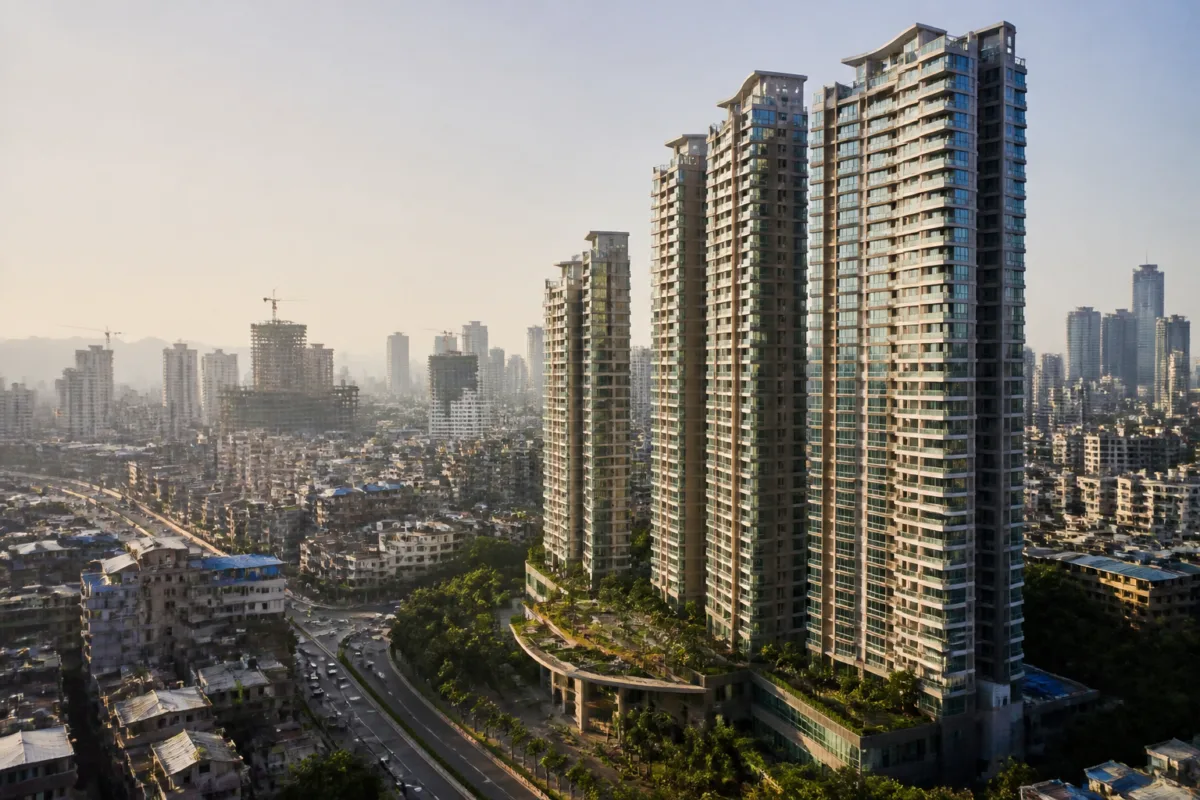
Mumbai’s housing market is not slowing in a uniform way. The latest data cited by Liases Foras shows that while sales in the sub-Rs 2 crore segment are losing momentum, homes priced above Rs 2 crore continue to gain share. That divergence is reshaping the city’s residential market: premium housing remains resilient even as the segment serving a much larger pool of households faces weaker demand.
By the end of the September quarter, 32,437 residential units had been recorded in Mumbai’s BMC areas during 2026, according to the report. Industry participants expect the festive season to support transactions in the final quarter, but the available data suggests that the market is operating close to its upper limit on overall volume. The more important change is taking place beneath that headline number, in the distribution of sales across price bands.
The sub-Rs 2 crore category has historically contributed a large share of Mumbai’s residential transactions. At the market’s 2024 peak, this segment accounted for roughly 30,000 units. It contracted by around 8% in 2025, according to Liases Foras, and has remained weak through 2026. About 16,904 units have been recorded in the segment so far this year, pointing to a materially slower pace than the 2024 high.
That performance matters because the sub-Rs 2 crore category is the part of the market most closely connected to the city’s broad housing demand. A slowdown here does not necessarily mean that Mumbai has stopped attracting buyers. It suggests that the price at which homes are being offered, and the ability of households to absorb those prices, are becoming more decisive factors in whether demand converts into a sale.
A market divided by purchasing power
The contrast with higher-priced housing is stark. Properties above Rs 2 crore have continued to show growth and did not record the same decline in the September quarter of 2026, the report said. Liases Foras attributed this resilience to the continued activity of affluent end-users and investors, who are less sensitive to borrowing conditions and short-term economic volatility than buyers in lower price bands.
This creates a two-speed housing market. In one part, households are weighing elevated prices more cautiously, with affordability constraints and buyer fatigue limiting transactions. In the other, buyers continue to purchase homes at prices that are far beyond the reach of most of the city’s residential demand. Overall sales figures can therefore appear stable even while the market becomes less accessible to a wider section of residents.
The data does not establish that every buyer in the premium segment is an investor or that all sub-Rs 2 crore buyers are end-users. It does, however, show that the two segments are responding differently to the same market conditions. The distinction is important for interpreting Mumbai’s housing cycle: a stable or expanding premium market cannot automatically be treated as evidence of broad-based housing health.
The changing composition of demand also affects the type of housing that developers have an incentive to build. When premium homes continue to sell while lower-priced units move more slowly, market signals favour projects and configurations aimed at higher purchasing power. The supplied data does not provide project-level information on new launches, unsold inventory or developers’ land strategies, but the sales pattern indicates that price segmentation is becoming central to the city’s housing story.
the rise of the ultra-luxury segment
Registration data from the Inspector General of Registration reinforces the strength of the top end. Transactions above Rs 10 crore have risen steadily over the past three years, with no year recording a decline in this bracket, according to the figures cited in the report.
The distribution of these deals is also revealing. The Rs 10 crore to Rs 20 crore band accounts for close to 74% of transactions above Rs 10 crore. Around 15% are in the Rs 20 crore to Rs 30 crore range, about 9% fall between Rs 30 crore and Rs 50 crore, and approximately 2% are between Rs 50 crore and Rs 100 crore. Roughly 1% exceed Rs 100 crore, with 11 such transactions recorded.
This breakdown shows that Mumbai’s ultra-luxury market is not being sustained only by occasional trophy purchases. Its main base is the Rs 10 crore to Rs 20 crore segment, where repeated activity provides greater depth than the small number of transactions above Rs 100 crore. The presence of marquee deals attracts attention, but the larger structural signal lies in the concentration of demand just below that level.
The registration data also illustrates why headline sales in a premium market must be read carefully. A small number of very high-value transactions can contribute substantially to the value of property registered without representing a large number of households. Unit volumes, ticket sizes and the distribution of buyers therefore describe different aspects of the market and should not be treated as interchangeable indicators.
Investor money and the post-pandemic cycle
Pankaj Kapoor, managing director of Liases Foras, said luxury housing had experienced particularly strong growth over the four to five years following the pandemic but now appeared to be approaching a plateau. His assessment connects the premium housing cycle to another part of the economy: gains in financial markets and the redeployment of realised equity-market proceeds into real estate.
Kapoor said some buyers had monetised equity gains and invested in property partly to optimise capital-gains tax outcomes. He also said the stock market had corrected by about 15% from its peak, reducing the pool of investors with large realised gains and potentially weakening one source of demand for premium housing.
These comments are an attributed industry assessment, not a complete explanation of all luxury transactions. The report does not provide a breakdown of purchases by end-users, investors, funding source or tax treatment. It does show, however, that the premium segment’s recent expansion cannot be understood only through traditional housing demand. Financial-market performance and the availability of investible gains have also formed part of the demand environment described by Liases Foras.
That connection makes the segment vulnerable to a change in the conditions that supported it. If the post-pandemic period brought unusually strong financial gains and reinvestment capacity, the continuation of that pace cannot be assumed. Kapoor expects luxury demand to moderate in Greater Mumbai and other major Indian markets, although the supplied report does not provide a separate forecast range or a projected volume for the slowdown.
What the numbers say about affordability
The clearest evidence of affordability pressure is not a collapse in total registrations but the weaker performance of the lower-priced segment. The sub-Rs 2 crore category fell by around 8% in 2025 from its earlier level and has recorded about 16,904 units in 2026 so far, compared with roughly 30,000 units at the 2024 peak. The figures indicate a lower run rate at a time when prices remain elevated.
The data does not specify how much of the decline is due to prices, mortgage costs, income growth, employment conditions, supply mix or buyer expectations. Liases Foras identified affordability constraints and buyer fatigue as the most pronounced pressures in the entry and mid-market segments. Those explanations should therefore be understood as the agency’s assessment rather than as a fully disaggregated causal study.
Even with that limitation, the pattern has a direct urban implication. Mumbai’s housing challenge is not simply whether the city is recording transactions. It is whether the homes being transacted correspond to the purchasing capacity of the households that need to live and work in the metropolitan region. A market can remain active, and even record strong luxury growth, while becoming progressively less representative of ordinary housing demand.
The supplied report does not state whether the 32,437 units recorded in BMC areas include a particular mix of new and resale homes, nor does it provide the average or median transaction value. It also does not establish how many households have shifted to peripheral locations, rental housing or smaller units because of price pressures. Those gaps limit what can be concluded about the full housing burden, but they do not erase the visible split between price categories.
The policy and planning challenge
Mumbai’s housing policy operates within a market where demand is increasingly differentiated by purchasing power. The figures cited in the report place the affordability problem in the sub-Rs 2 crore segment, while the strongest growth appears in homes priced above Rs 2 crore and in transactions exceeding Rs 10 crore. This creates a policy challenge that cannot be measured through aggregate market activity alone.
For public authorities and planners, the relevant question is not only how many units are registered but also what price bands are being delivered, where they are located and which households can access them. The supplied material does not identify specific government schemes, zoning interventions, development-control provisions or public funding measures linked to these price categories. It therefore cannot establish which policy instrument is responsible for the current market split.
It does establish the institutional importance of registration data and market research. Liases Foras provides the segmentation and interpretation of sales, while figures from the Inspector General of Registration track high-value transactions. Together, they offer a more detailed view than a single citywide sales number, but they still leave important questions about supply, occupancy, household incomes and access to finance.
The distinction between BMC areas and Greater Mumbai also matters. The report discusses 2026 unit registrations in BMC areas, while Kapoor’s assessment of future luxury demand refers to Greater Mumbai and other major Indian markets. These geographies should not be treated as identical. Comparisons between them would require additional data that is not included in the source material.
Mumbai’s housing market is therefore showing resilience at the top and stress in the broader middle and entry segments. The immediate evidence supports three conclusions: overall volumes have limited room for further growth; homes below Rs 2 crore are moving at a weaker pace than at the 2024 peak; and premium demand, particularly between Rs 10 crore and Rs 20 crore, has remained unusually strong.
What remains uncertain is whether the luxury segment can sustain its recent expansion once the financial-market gains and post-pandemic conditions that supported part of its demand begin to fade. The next phase of the market will be defined not only by the number of homes sold but by whether premium resilience continues to offset weakening affordability-led demand in the rest of the city.

