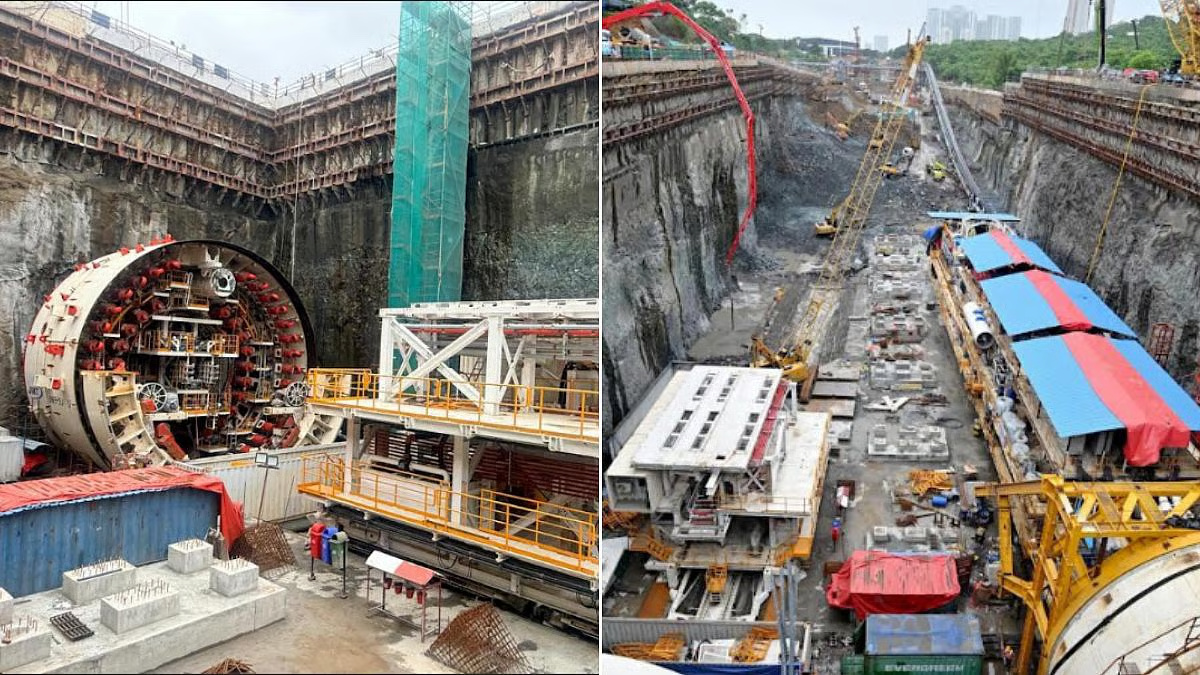
Mumbai Goregaon Mulund Link Road begins major tunnelling
Mumbai’s Goregaon-Mulund Link Road has entered a critical construction stage with the first tunnel boring machine beginning excavation beneath Sanjay Gandhi National Park. The work covers one of two three-lane tunnels linking Goregaon East with Mulund West, creating a new underground east-west corridor intended to reduce pressure on Mumbai’s congested surface roads. The tunnelling forms part of Phase 3(B) of the 12.2-km Goregaon-Mulund Link Road project. The twin tunnels will run between Dadasaheb Phalke Chitranagari in Goregaon East and Amar Nagar in Mulund West, with each tunnel extending about 5.3 km. The first machine, named Tulsi, began excavation on August 17 and had completed nine metres of boring by August 26, according to the civic body.
For Mumbai commuters, the significance extends beyond another road project. The link is planned to connect the Western Express Highway with the Eastern Express Highway, creating a more direct route between the city’s western and eastern suburbs. Officials expect the corridor to reduce journey times, ease traffic on existing arterial roads and improve movement for emergency services and commercial vehicles once operational. The project is targeted for completion by February 2029. The engineering challenge is equally important. Much of the tunnel alignment passes below the environmentally sensitive Sanjay Gandhi National Park, making surface-level construction particularly disruptive. Earth Pressure Balance technology is being used for the main excavation, while cross passages will be constructed through the New Austrian Tunnelling Method. The wider tunnel package includes 17 cross passages, 720 metres of twin-box tunnels and 600 metres of approach roads.
The environmental dimension will remain a key test as excavation progresses. Earlier clearance documentation required assessment of ecological, geological and hydrological conditions, including groundwater movement around the Tulsi and Vihar reservoirs. Minimising surface disturbance therefore matters not only for biodiversity but also for the water catchments and wider urban ecosystem associated with the national park. Project oversight has also intensified. During a site inspection on August 26, a senior civic projects official reviewed excavation methods, safety arrangements, construction quality and machinery performance. Assembly of the second TBM was reported to be about 70% complete, with testing planned before its expected deployment.
The next phase will determine whether the project can maintain construction speed without compromising worker safety, geological monitoring or environmental safeguards. For residents, the real measure of the Goregaon-Mulund Link Road will ultimately be whether underground capacity translates into more reliable journeys while keeping the ecological costs of expansion tightly controlled.