


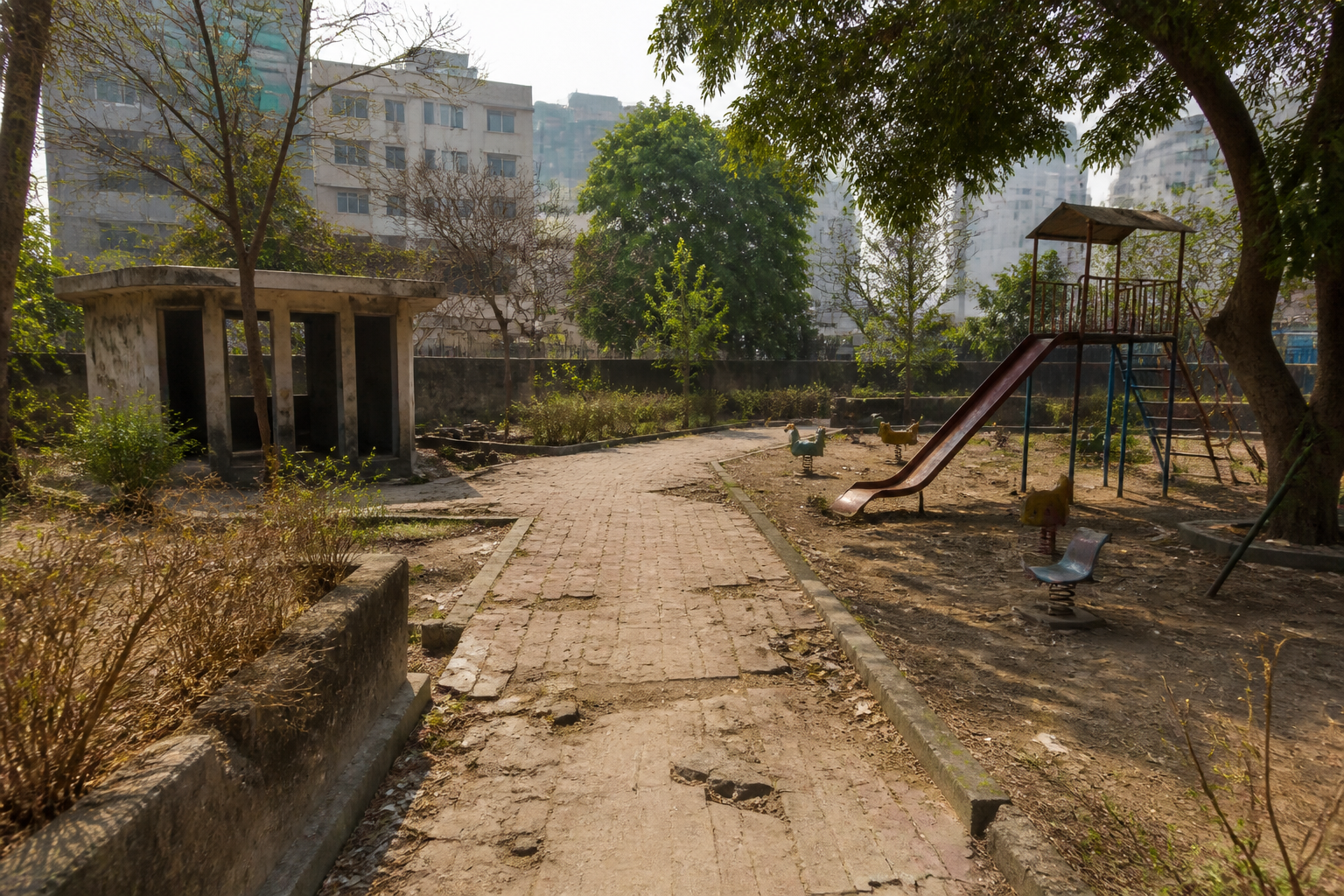
Mumbai’s struggle with heat and poor air quality is exposing a deeper weakness in the way the city funds and maintains its public open spaces. BMC records cited by The Indian Express show that as many as 200 gardens and open spaces require construction or repairs, but the work has not been taken up because of a funding shortfall. At the same time, the budget for the civic body’s garden and tree department has fallen sharply, even as the city’s demand for accessible green space continues to grow.
The immediate numbers describe more than a maintenance backlog. They show how open spaces are positioned within Mumbai’s urban spending priorities. The department responsible for developing and maintaining the city’s green cover has received a final allocation of Rs 68 crore for the current financial year. That is substantially below the Rs 200 crore proposed earlier in the year and less than the Rs 180.83 crore earmarked for the department in 2023-24. BMC data cited in the report indicates that the allocation has fallen by 62 per cent over the past three years.
The gap between identified requirements and available funding is even wider. BMC records contain around 210 requests from elected representatives for new gardens, recreational grounds and playgrounds across Mumbai. A technical assessment found that basic work in many of these spaces would require Rs 250 crore. A civic official told The Indian Express that the department had received requests involving work worth Rs 710 crore, although several requests were considered non-feasible or could not be executed immediately. The assessed basic requirement alone is more than three times the department’s current allocation.
This is partly because creating and maintaining an open space is not a single activity. According to officials quoted in the report, a land parcel first has to be transferred to the BMC by the collector’s office or the land and revenue department. The soil may then need to be made fertile for grass plantation. The site also requires furniture, gyms, play equipment and compound walls. At current rates, building a new garden from scratch costs between Rs 25 crore and Rs 30 crore, while basic repairs cost between Rs 4 crore and Rs 5 crore.
Those costs help explain why a relatively modest departmental budget can quickly become inadequate. They also indicate that the problem is not limited to landscaping. A garden requires land administration, civil works, equipment procurement, maintenance contracts and ongoing public management. Delays in any one of these stages can leave a site unusable even when the land itself is available.
The condition of existing spaces shows the consequences of the backlog. A civic official said that some gardens had not received repair work for a decade. In the latest survey cited by the report, recreational grounds were found with broken walkways, stolen apparatus and defunct toilets. Some spaces were encroached upon or shut to the public. These are not merely aesthetic defects. Broken paths can reduce access for older residents and people with disabilities, while unusable toilets and damaged play equipment affect whether families can safely use a public facility.
The locations identified by officials also point to an uneven distribution of urban amenity. Many of the affected gardens are in M East, including Govandi and Deonar; M West, including Chembur; S, including Kanjurmarg and Bhandup; L, including Kurla; and K North, including Jogeshwari. The report notes that many of these areas house middle-class populations. The available evidence does not establish that these wards have the city’s lowest provision of open space, but the concentration of repair needs demonstrates that access depends not only on whether a garden exists on paper. It also depends on whether it is open, maintained and usable.
The funding decision reflects a broader competition within the BMC’s capital budget. Five infrastructure projects accounted for 42 per cent of overall capital expenditure, according to budget documents cited in the report. They include the wastewater treatment facility, the road concretisation programme, the Mumbai Coastal Road North project between Versova and Dahisar, the Goregaon-Mulund Link Road project and the water conveyance tunnel project.
These projects address major infrastructure needs and involve large financial commitments. But their dominance in capital spending means that smaller, distributed public assets can struggle to secure funding. A garden is rarely treated as a citywide network in the same way as a road, tunnel or sewage plant. Its benefits are spread across neighbourhoods and are experienced through everyday use rather than through a single major construction milestone. That can make maintenance easier to defer, even when the cumulative effect of neglect is substantial.
The BMC’s own explanation, as reported, is that part of the garden department’s allocation was routed towards infrastructure works. Ganesh Khankar, leader of the house and a BJP corporator, acknowledged the shortfall and said discussions were under way to increase the allocation to the gardens department by 25 to 30 per cent in the current year and correct it further next year. The statement indicates that the allocation remains subject to administrative and political negotiation rather than being protected through a clearly established maintenance requirement.
Requests from elected representatives illustrate another institutional weakness. Congress corporator and group leader Ashraf Azmi wrote in June seeking repairs to six gardens in Kurla but did not receive a response. In a follow-up letter in September, he described poor jogging tracks, collapsing walls and dilapidated play equipment. Shiv Sena (UBT) corporator Sachin Padwal also sought an upgrade to a garden in Kalachowky and was yet to receive a response, according to the report.
These cases suggest that the pipeline from local demand to civic action is not transparent to residents. A request may be made, assessed, classified as feasible or non-feasible, and then delayed because of funding or competing priorities. Without publicly available information on the status of each site, residents cannot easily distinguish between a technical constraint, a budget decision and an administrative delay.
The urban significance of the issue is amplified by Mumbai’s limited supply of open space. Civic records cited in the report put the city’s open-space ratio at 0.87 square metre per person. The Union Ministry of Housing and Urban Affairs has recommended 10 to 12 square metres per person in the Urban and Regional Development Plans Formulation and Implementation guidelines. The report also cites a World Health Organisation recommendation of nine square metres per person.
The comparison does not by itself establish that every part of Mumbai must meet a uniform numerical standard. Mumbai’s land constraints and topography make the creation of new open space difficult. Municipal Commissioner Ashwini Bhide said the city has around 30 to 32 lakh trees when trees in Aarey forest are included, with approximately two lakh trees along roads. She also said that the quantity of green cover was relatively adequate when considered against the city’s landmass and topography, but that equitable distribution remained an issue.
That distinction is central. A city can possess a substantial number of trees while still leaving residents with inadequate access to maintained public spaces. Trees, gardens, playgrounds and recreational grounds perform related but different functions. A roadside tree contributes shade and environmental value, while a functioning neighbourhood garden provides space for walking, play and social use. Counting one cannot substitute for measuring the availability and condition of the other.
The BMC has also turned to outside participation for some large open-space projects. Earlier this year, it awarded the work of developing and maintaining a 70-hectare stretch adjoining the coastal road to the Reliance group. The Mahalaxmi Racecourse, taken over by the BMC in 2024, was also reported to be likely to be developed and maintained by a private entity through a corporate social responsibility initiative.
Urban planner and researcher Hussain Indorewala argued that the small municipal allocation for open spaces pointed towards their privatisation. He said that universal access could be restricted in such arrangements, meaning that residents who are denied access effectively remain without an open space. His statement is an attributed concern rather than proof that access has already been restricted at the cited sites. However, it identifies the institutional question created when public land is maintained through private entities: whether the city measures success through investment and physical improvement, or through guaranteed, equitable and affordable public use.
The evidence in the report therefore points to three connected problems. First, Mumbai has a large and expensive maintenance backlog. Second, open-space funding is vulnerable when capital priorities shift towards major infrastructure projects. Third, the city’s green-space challenge is one of distribution and usability as much as aggregate supply.
The next step is not simply to announce more gardens. It is to clarify how existing requests are assessed, funded and prioritised, and how residents can track the progress of repairs. The BMC’s proposal to increase the department’s allocation by 25 to 30 per cent will indicate whether the administration treats the present shortfall as a temporary budget adjustment or as a structural gap. Until then, the city’s response to heat and pollution will continue to depend not only on how much green cover Mumbai has, but on whether its public open spaces are maintained well enough for residents to use them.
