


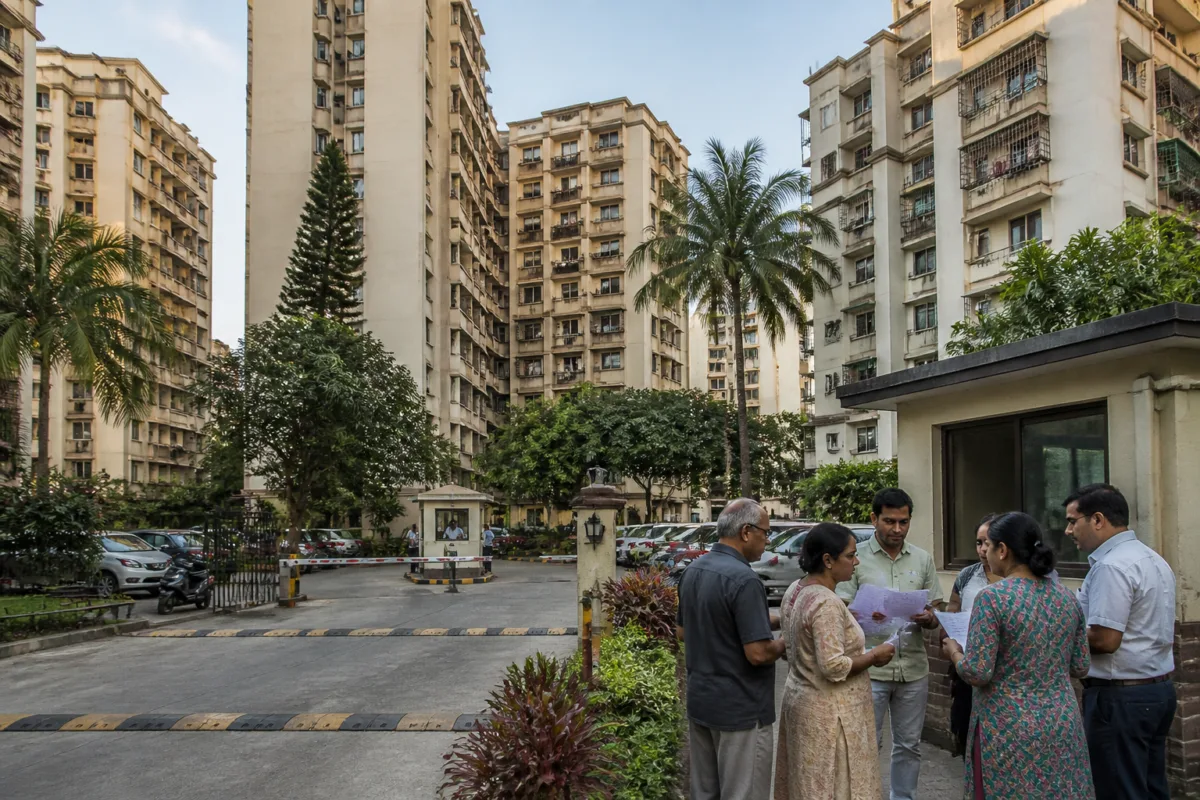
The Maharashtra State Co-operative Appellate Court has stayed a nearly fourfold increase in monthly maintenance charges imposed on two flats in Aurum Tower Co-operative Housing Society in Goregaon West, holding that contributions must be calculated flat-wise rather than wing-wise under the model bye-laws.
The court directed the society to keep in abeyance its March 27, 2022, annual general meeting resolution and the subsequent circular that introduced revised charges from July 1, 2022. It also ordered a recalculation by an independent chartered accountant, consideration of members’ objections and uniform application of the revised rates across all four wings.
The appeal was filed by society members Ramawadh Devnandan Jayaswal, 71, and his son Nishit Jayaswal, 44. They challenged a February 23, 2026, order of Co-operative Court No. 4, Mumbai, which had rejected their plea for interim relief. The appellate order was passed by court president S.S. Sapatnekar.
The dispute concerned two flats in the society’s D wing. Their monthly maintenance was increased from ₹7,867 per flat to ₹27,166 and ₹29,266, respectively. The members argued that the increase was arbitrary and disproportionately high compared with charges in the other wings.
According to the report, Aurum Tower has four wings: A, B, C and D, with 82, 55, 76 and two flats, respectively. The society maintained that the revised charges reflected the actual expenses of each wing. It said the March 2022 annual general meeting had authorised a wing-wise recalculation, which was verified by a chartered accountant and approved by the managing committee.
The appellate court, however, found that the annual general meeting had authorised a process rather than conclusively adopted the revised charges. That process included appointing an independent chartered accountant, displaying the calculations on the notice board, inviting objections and finalising the rates after considering those objections. The court found that the society had not produced a subsequent general body resolution adopting the revised charges or evidence that the objections had been discussed and resolved.
The court also noted that the society had not established that the revision had been approved at an earlier annual general meeting held on September 30, 2018. It held that Model Bye-laws 65, 66 and 67 require maintenance contributions to be calculated for individual flats or units, rather than imposed on a wing-wise basis.
The figures cited in the proceedings showed the impact of the disputed method. The calculation placed before the court indicated monthly charges of ₹2,529 per flat in A wing, ₹2,643 in B wing and ₹2,357 in C wing, compared with ₹21,180 per flat in D wing under the disputed calculation. Because D wing had only two flats, the court found that allocating its expenses across only those units imposed an excessive burden on their owners.
The society also relied on D wing’s separate water and electricity connections and separate lift to justify the higher charges. The court rejected that explanation, noting that the wing had been constructed by the developer in accordance with the approved plan and that members could not be held responsible for the facilities provided there.
The order does not prevent a housing society from revising maintenance charges. Instead, it emphasises that such revisions must follow the applicable bye-laws, the approved decision-making process and an opportunity for members to raise objections. The court further held that a majority-backed resolution cannot, by itself, justify an arbitrary or unreasonable financial burden on minority members.
For residents of co-operative housing societies, the ruling highlights the importance of transparent calculations, documented general body approval and consistent billing principles. In the Aurum Tower case, the next stated step is for the charges to be independently recalculated and for the members’ objections to be considered before revised rates are finalised.

