


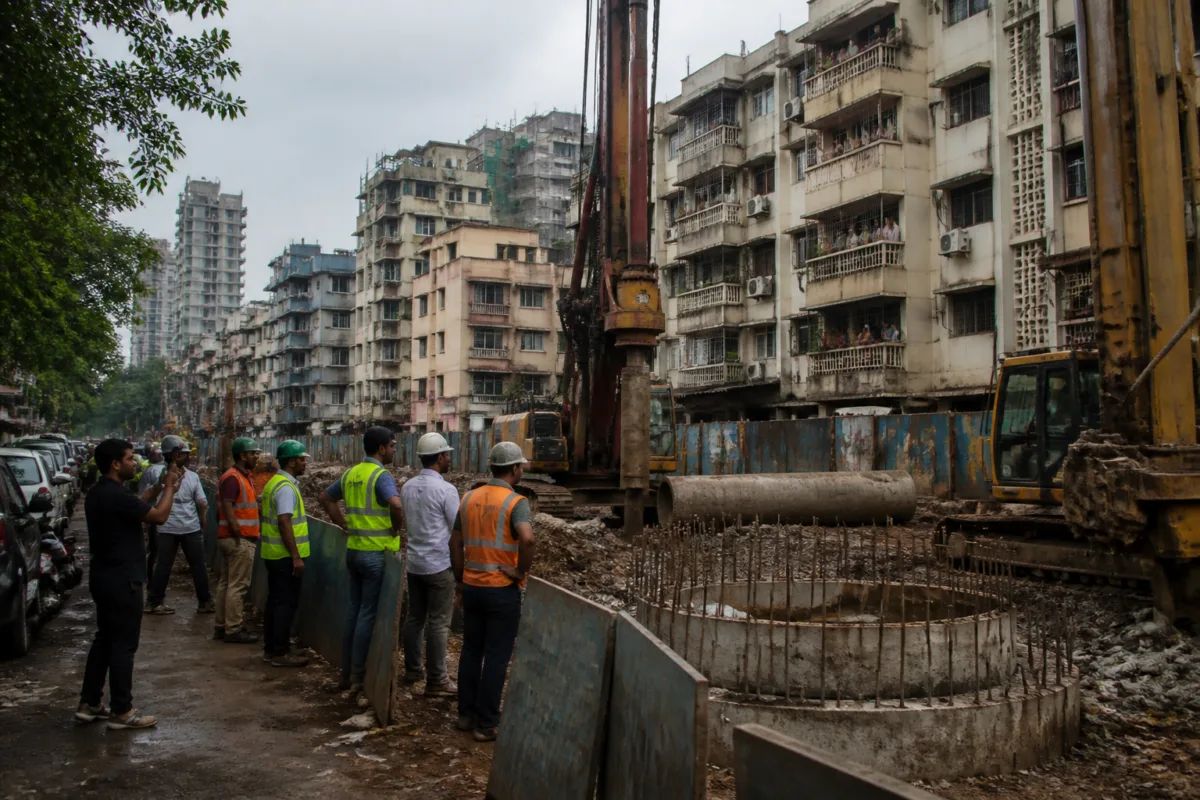
The Bombay High Court has directed authorities to routinely monitor noise levels at construction sites across Mumbai and stop work wherever prescribed limits are breached, putting the Brihanmumbai Municipal Corporation, police and district authorities under direct scrutiny.
A division bench of Chief Justice MC Tripathi and Justice Advait Sethna said monitoring could not be limited to a single building and that construction activity across the city must be assessed to ensure residents are not inconvenienced by noise pollution. The court was hearing a petition filed by Ashok Pathare, a resident of Shreyas Apartment on Mogul Lane in Mahim West, against construction on an adjoining plot by Yashodhan Tower LLP.
The petition concerns a site where an old building was demolished in February and piling work began on July 24. Police panchnama readings recorded on September 15 showed noise levels exceeding 100 decibels. The BMC issued a stop-work notice on September 22, but withdrew it on October 1, citing air-pollution mitigation measures. According to the report, the civic body issued a fresh stop-work notice on October 30, and construction had remained suspended since then.
The court was told that the police had issued a show-cause notice to the developer and that the Maharashtra Pollution Control Board had issued a caution notice. The judges, however, stressed that official notices and warnings had to result in effective enforcement rather than remain on paper.
The bench said the BMC should not permit construction unless developers submitted a categorical undertaking on affidavit that they would comply with noise-pollution norms and would not cause air pollution. The court clarified that it was not ordering a blanket halt to construction across Mumbai. Instead, it directed authorities to ensure that noise levels at construction sites remained within prescribed limits and said work must stop if those limits were crossed.
The court also directed officials to monitor construction sites routinely on a zonal basis. It warned that officials would be held accountable if noise levels did not come down, placing responsibility not only on developers but also on the agencies responsible for enforcement.
The case highlights the difficulty of regulating construction impacts in densely built neighbourhoods, where multiple projects can operate close to occupied residential buildings. Senior advocate Anil Sakhare, appearing for the developer, told the court that the project was a self-redevelopment scheme and that 14 other construction projects were under way within a 200-metre radius. He said the developer would file the undertaking sought by the court.
The court ordered that further construction could be permitted only after authorities were satisfied with the undertaking. It will review the matter every three weeks, while officials are expected to carry out zonal monitoring and take action when construction noise exceeds the prescribed threshold.

