


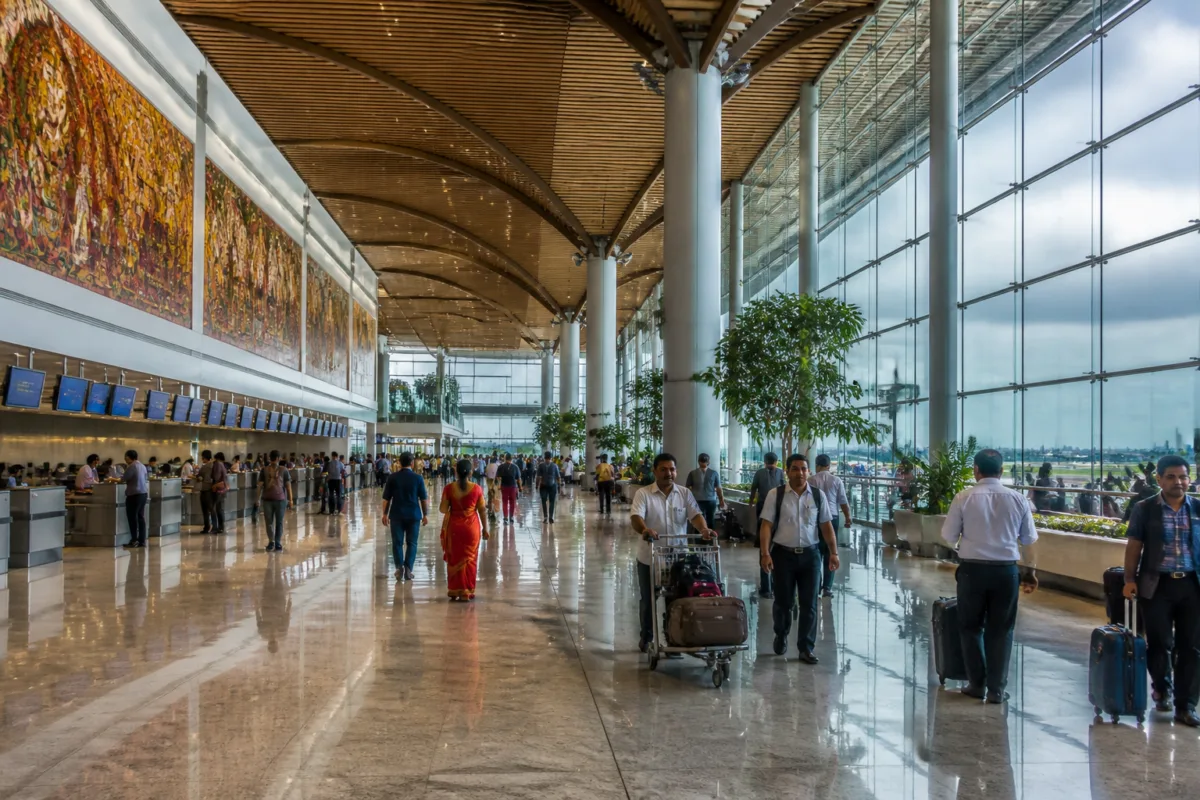
Mumbai airport’s proposed Terminal 1 redevelopment will increase its annual passenger handling capacity from 15 million to 20 million and add substantially more check-in, security, boarding and baggage facilities, according to the architectural vision shared by Chhatrapati Shivaji Maharaj International Airport (CSMIA).
The airport presented artistic impressions of the proposed replacement terminal during a meeting with the Airport Airline Operators Committee. CSMIA said the images represent the architectural vision for the project and are not a definitive preview of the final design.
The redevelopment is planned for the existing T1, which was commissioned in 1964. According to the airport’s redevelopment brief, independent audits conducted by Structwel in 2017 and IIT Bombay in 2024 identified significant safety and structural vulnerabilities in the ageing terminal.
The proposed terminal is planned as a larger, passenger-focused facility with a sweeping departure entrance, a naturally lit check-in hall, local art murals, indoor greenery, premium lounges and glass facades overlooking the runways. The arrival kerbside is envisioned as an open artistic space featuring a large flamingo sculpture intended to reflect Mumbai’s natural biodiversity.
The capacity increase represents a proposed rise of about 33 per cent, from 15 million passengers per annum to 20 million. The number of check-in counters is expected to increase from 74 to 109. Security screening infrastructure is planned to expand to 15 passenger lanes and five transfer lanes.
The redevelopment brief also proposes increasing contact stands—where passengers can board aircraft directly from the terminal—from seven to 25. The number of baggage reclaim belts is planned to rise from five to 11, while 12 e-gates are included in the proposed infrastructure.
CSMIA plans to carry out the transition in phases to minimise disruption to airport operations and domestic passenger traffic. An interim capacity measure is scheduled to come from the G3 North-West Pier expansion at Terminal 2, which is expected to become operational by March 2029 and accommodate domestic traffic during the transition.
The replacement Terminal 1 is targeted for completion by December 2030. Once the redevelopment and associated expansion plans are completed, Mumbai airport’s overall passenger handling capacity is expected to reach 65 million passengers per annum.
The project’s immediate significance lies in how the airport intends to replace an ageing terminal while continuing to serve passengers through a phased operating plan. The airport said the proposed design places safety, modern infrastructure, passenger experience and Mumbai’s cultural identity at the centre of the redevelopment. Further implementation details will be established as the phased construction and associated expansion plans progress.

