


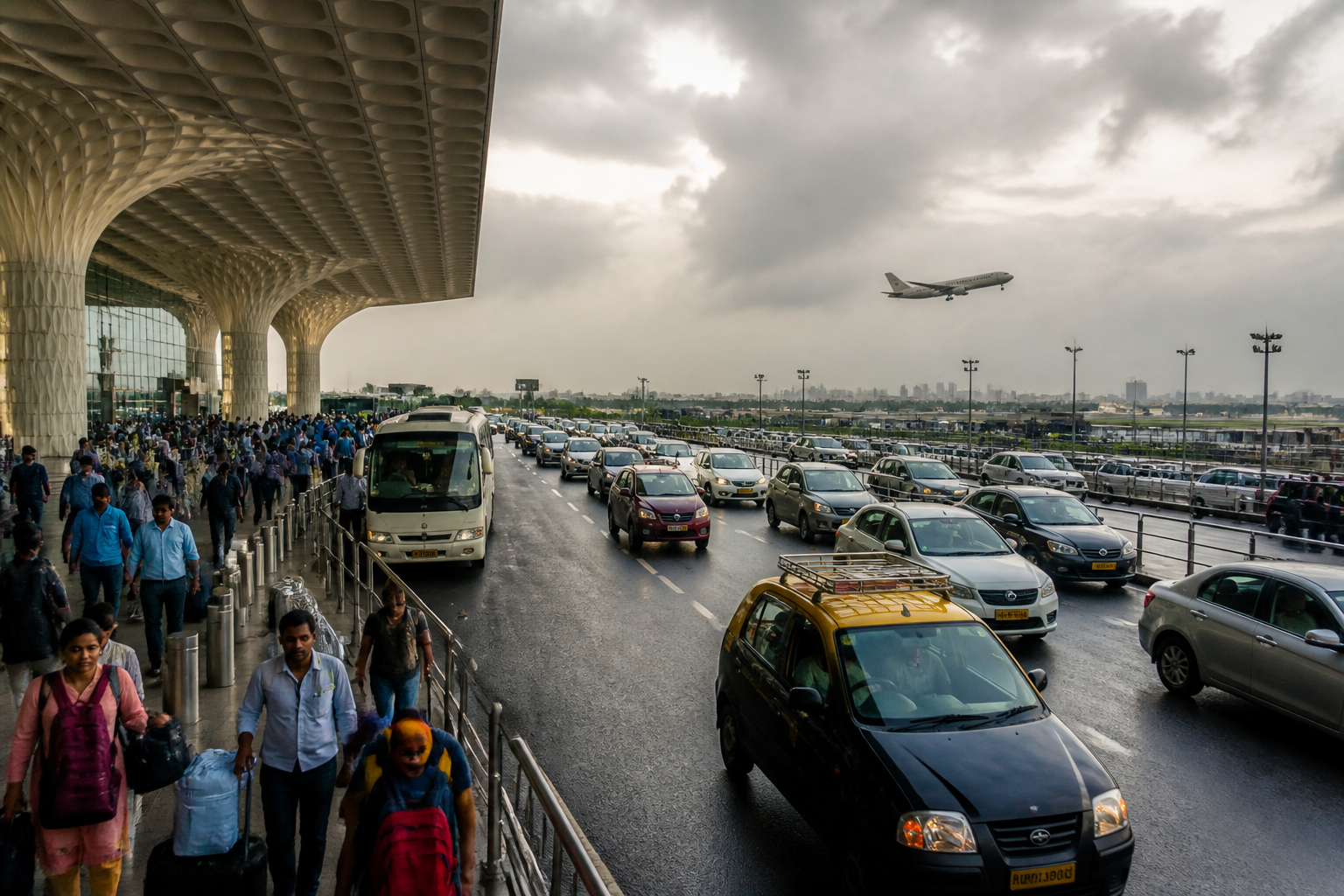
Mumbai’s planned redevelopment of Terminal 1 is more than an airport construction project. It will test whether the Mumbai Metropolitan Region can shift millions of passenger journeys between two airports without transferring congestion from runways and terminals to roads connecting Mumbai and Navi Mumbai.
Mumbai International Airport Limited, which operates Chhatrapati Shivaji Maharaj International Airport, is preparing to begin demolition of the northern section of Terminal 1-B from 15 January 2027. The transition plan will move parts of the air traffic currently handled at T1 to Terminal 2 at Sahar and to Navi Mumbai International Airport in phases.
The plan, as reported by Navbharat Times – Mumbai, follows a letter dated 13 August from MIAL Chief Airport Officer Vishnu Mohan Jha to Civil Aviation Secretary Sameer Kumar Sinha. MIAL has sought a joint transition group chaired by the Civil Aviation Secretary to coordinate airlines, airport operators and other stakeholders and reduce disruption for passengers.
The immediate challenge is not only where aircraft will land or take off. It is how passengers will reach the airport assigned to their flight. Travellers whose services move to Navi Mumbai may face longer road journeys, higher transport costs and greater exposure to peak-hour congestion. The effect will vary according to their starting point, mode of transport and the time of travel, but the shift will alter the geography of air travel across the region.
MIAL’s proposed schedule shows how the airport transition is being designed around capacity constraints. From 1 October, at least one-third of all international air traffic movements are planned to shift to Navi Mumbai International Airport. From 25 October, at least one-third of the air traffic movements currently handled at T1 are planned to move to T2. MIAL has said airlines will receive about three and a half months of transition support before demolition begins.
The numbers involved make this a major metropolitan reorganisation. The report says Mumbai airport is expected to handle about 5.5 crore passengers during the winter period, with approximately one-fifth potentially using Navi Mumbai airport. Of the roughly 1.5 crore passengers associated with T1 in Santacruz East, flights carrying about 1 crore passengers could move to Navi Mumbai by the end of October. The remaining roughly 50 lakh passengers are expected to be accommodated at T2.
That redistribution would place additional pressure on T2, whose passenger-handling capacity is expected to rise from about 4 crore to 4.5 crore passengers. The source report does not provide details of the infrastructure or operational measures behind that increase. It does, however, state that MIAL is in discussions with domestic and international airlines about the partial transfer of flights between T1, T2 and Navi Mumbai.
The first operational changes have already begun. Akasa Air shifted its domestic operations from T1 to T2 from 1 August. This indicates that the transition is not a single closure-day event but a sequence of airline-level decisions before the demolition programme starts. For passengers, that makes checking the terminal and airport assigned to a booking increasingly important as the transition progresses.
The airport plan also reflects a long-standing capacity problem at Mumbai’s existing facility. Terminal 1 is about 80 years old, and parts of it have already been demolished. Its current passenger-handling capacity is reported at approximately 1.5 crore, while T2’s capacity is about 4 crore. The phased redevelopment is intended to allow construction while limiting disruption to airline operations and passenger movement.
There is a second constraint beneath the terminal numbers. The report states that all flights landing at Mumbai airport currently use a single operational runway before passengers are directed to T1 or T2. If a portion of traffic moves to Navi Mumbai, the immediate benefit may be less pressure on the existing airport’s airside and terminal systems. The source report says this could reduce aircraft holding time before landing and waiting time before pushback, while improving punctuality.
This is the operational logic of the plan: separate demand across facilities so that the older airport can function with less crowding while T1 is rebuilt. But the benefit at the airport may create a new coordination burden outside it. A passenger transfer that is straightforward on an airport map can become significantly more complicated when it involves a cross-city road journey, especially during peak traffic periods.
The change will also affect how airlines and passengers understand Mumbai as an aviation market. The city will increasingly operate through a multi-airport system in which the airport named in a ticket is not a minor terminal detail but a central part of the journey. The report says most general aviation flights, including private and charter operations, may also move to Navi Mumbai in the coming months, adding another layer to the redistribution.
The institutional structure is therefore as important as the construction programme. MIAL operates Mumbai’s existing airport, while Navi Mumbai International Airport is becoming part of the region’s passenger network. Airlines must coordinate schedules and terminal assignments, the Civil Aviation Ministry must oversee the transition, and passengers must receive clear information before reaching the wrong airport. MIAL’s request for a joint transition group indicates that the operator sees coordination as a necessary part of the redevelopment rather than an issue that can be left to individual airlines.
The reported plan also raises a question about how airport capacity is measured. A terminal may have a stated passenger-handling capacity, but the passenger experience depends on the relationship between terminals, runways, airline schedules, road access and information systems. Increasing T2’s expected capacity to 4.5 crore passengers may help absorb displaced traffic, but it does not by itself resolve the journey between a passenger’s home and the airport. Similarly, shifting traffic to Navi Mumbai can reduce pressure at the existing airport while increasing demand on the Mumbai–Navi Mumbai corridor.
The available information establishes the scale and direction of the transition, but not every implementation detail. The report does not specify the airlines or routes that will move to Navi Mumbai, the transport arrangements planned for affected passengers, or the final timetable for each airline. It also does not establish how road congestion or additional travel costs will be managed. Those details will determine how disruptive the transition feels on the ground.
For now, the confirmed trajectory is clear. At least one-third of international air traffic movements are planned to shift to Navi Mumbai from 1 October, at least one-third of T1’s air traffic movements are planned to move to T2 from 25 October, and demolition of the northern section of T1-B is scheduled to begin on 15 January 2027. The redevelopment may eventually modernise an ageing terminal and ease pressure at Mumbai airport. In the transition period, however, its success will depend on whether airport capacity planning is matched by metropolitan transport coordination.
