


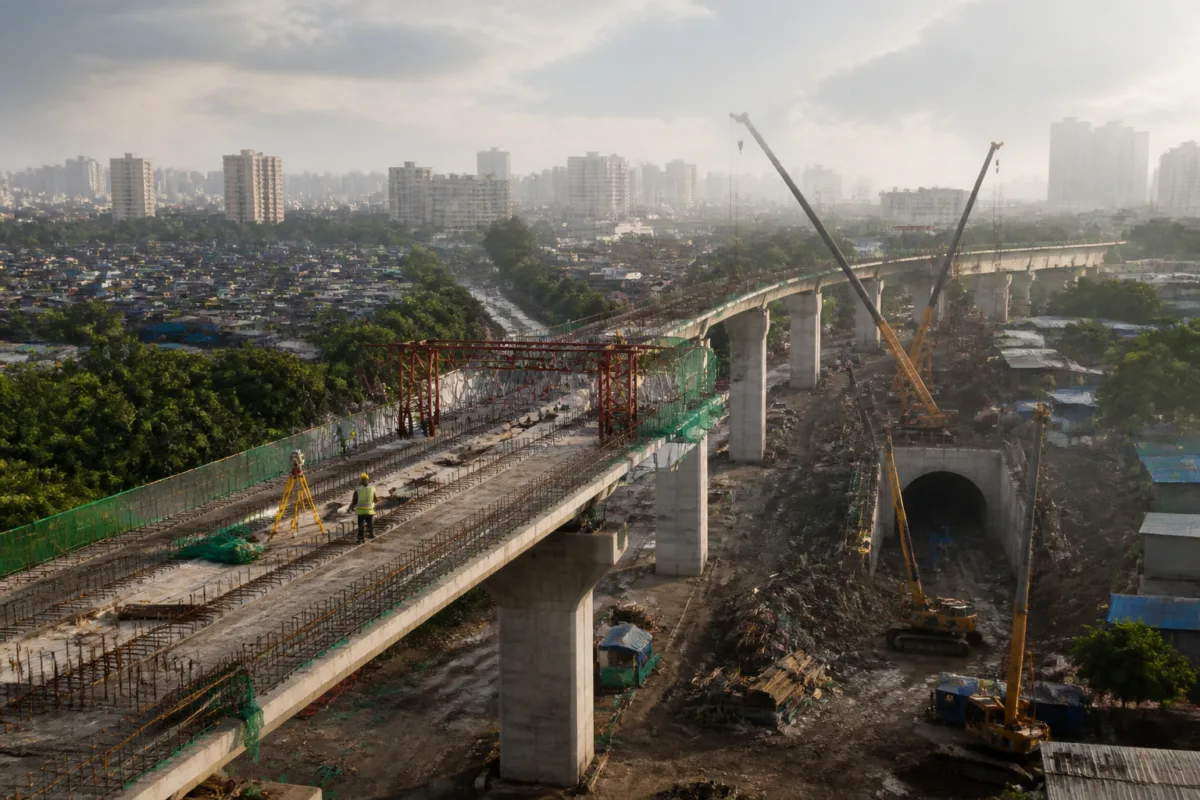
The cost of the Mumbai-Ahmedabad High-Speed Rail Corridor Project has risen from Rs 1.08 trillion to Rs 2.03 trillion, according to a report by Indian Infrastructure. The 508.17-km corridor is being developed across Maharashtra and Gujarat by the National High Speed Rail Corporation Limited (NHSRCL).
The revised figure represents an increase of Rs 0.95 trillion over the earlier cost estimate, taking the project close to twice its original estimated cost. The report said that overall expenditure had reached Rs 927.61 billion by March 2026.
The corridor is being implemented through NHSRCL, a special purpose vehicle incorporated by the Ministry of Railways and the governments of Maharashtra and Gujarat. The equity structure gives the Ministry of Railways a 50 per cent stake, while Maharashtra and Gujarat hold 25 per cent each.
The project is the first corridor being explored for the Indian Railways’ bullet train programme. Its scope includes a 21-km tunnel between Mumbai and Thane, of which a 7-km section is planned below the sea. This tunnel is a significant component of the corridor’s urban and engineering footprint, given its connection between the Mumbai metropolitan region and the wider high-speed rail alignment.
The available report does not specify the factors behind the increase from Rs 1.08 trillion to Rs 2.03 trillion, nor does it provide a revised completion schedule or a project-wise breakdown of the additional expenditure. Those details will be important for assessing how the higher cost is distributed across land, civil works, tunnelling, systems, rolling stock and other components.
With nearly Rs 927.61 billion already spent by March 2026, the escalation places renewed focus on cost monitoring and transparent reporting for a major public transport investment. Further official documentation would be required to establish the reasons for the revised estimate and its implications for the project’s remaining expenditure.

