


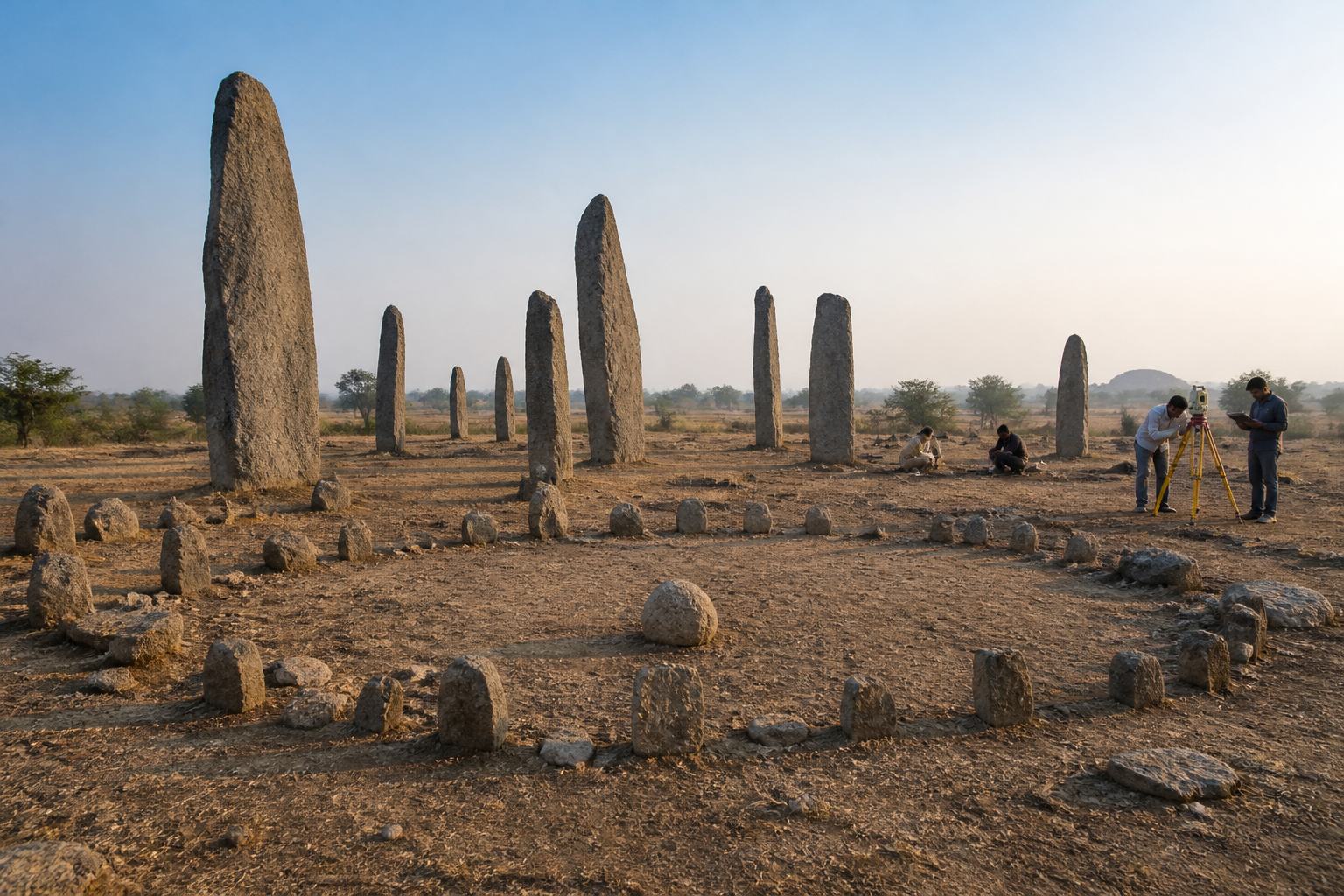
The Telangana heritage department has invited tenders to excavate the Mudumal Megalithic Menhirs in Narayanpet district, a 3,000- to 3,500-year-old site whose scientific investigation could support its bid for final UNESCO World Heritage recognition.
The excavation is estimated to cost ₹39.97 lakh and must be completed within four months. The contractor selected through the tender process will be required to have previous experience in archaeological excavation. The work is expected to begin in the second week of November.
Located in Mudumal village, the site is locally known as Niluralla Thimappa and has already been included on UNESCO’s tentative list of World Heritage Sites. It contains about 80 menhirs, or upright stones, measuring between three and five metres in height, along with thousands of alignment stones that are between 1 and 1.5 metres tall.
The site was originally spread across about 80 acres and also includes megalithic stone circles. According to the report, some of the menhirs and boulders are arranged in rows aligned with the rising and setting sun during solstices and equinoxes. Cup marks on some stones are said to depict constellations including Ursa Major, also known as the Saptarshi Mandala, and Leo.
Officials said the arrangement could make Mudumal one of the region’s oldest astronomical observatories. The excavation is intended to provide scientific evidence to establish the site’s outstanding universal value, a requirement for moving from UNESCO’s tentative listing towards final recognition.
The work will be undertaken by experts from the heritage department along with scientists from the National Geophysical Research Institute. The involvement of geophysical researchers indicates that the project will examine the site beyond the visible stone structures, although the supplied report does not specify the full range of survey methods to be used.
Following the excavation, DNA samples from the site are planned to be sent to the Council of Scientific and Industrial Research-Centre for Cellular and Molecular Biology to investigate the identity and ancestry of the people associated with the site. Samples will also be sent to Beta Labs in the United States for Carbon-14 testing, which is used to estimate the age of burial remains.
The project therefore links three separate stages of heritage recognition: physical excavation, scientific dating and the study of ancient communities. The results could help authorities establish how the menhirs, alignment stones and burial features were used, although the report does not state what findings the excavation is expected to produce.
The tender process will determine the agency responsible for the excavation, while the heritage department and its scientific partners will oversee the investigation. The immediate milestones are the appointment of an experienced archaeological contractor, the expected start of work in November and completion of the excavation within four months.

