


The MSEDCL solar pump case in Nagpur is not only a dispute over a delayed agricultural connection. It is a record of how a public utility can continue holding a citizen’s money, maintain an application in its system and still leave the promised infrastructure undelivered for years. An Additional District Consumer Disputes Redressal Commission has now ordered Maharashtra State Electricity Distribution Company Limited to install the pump within 60 days and pay Rs 35,000 in compensation and litigation costs.
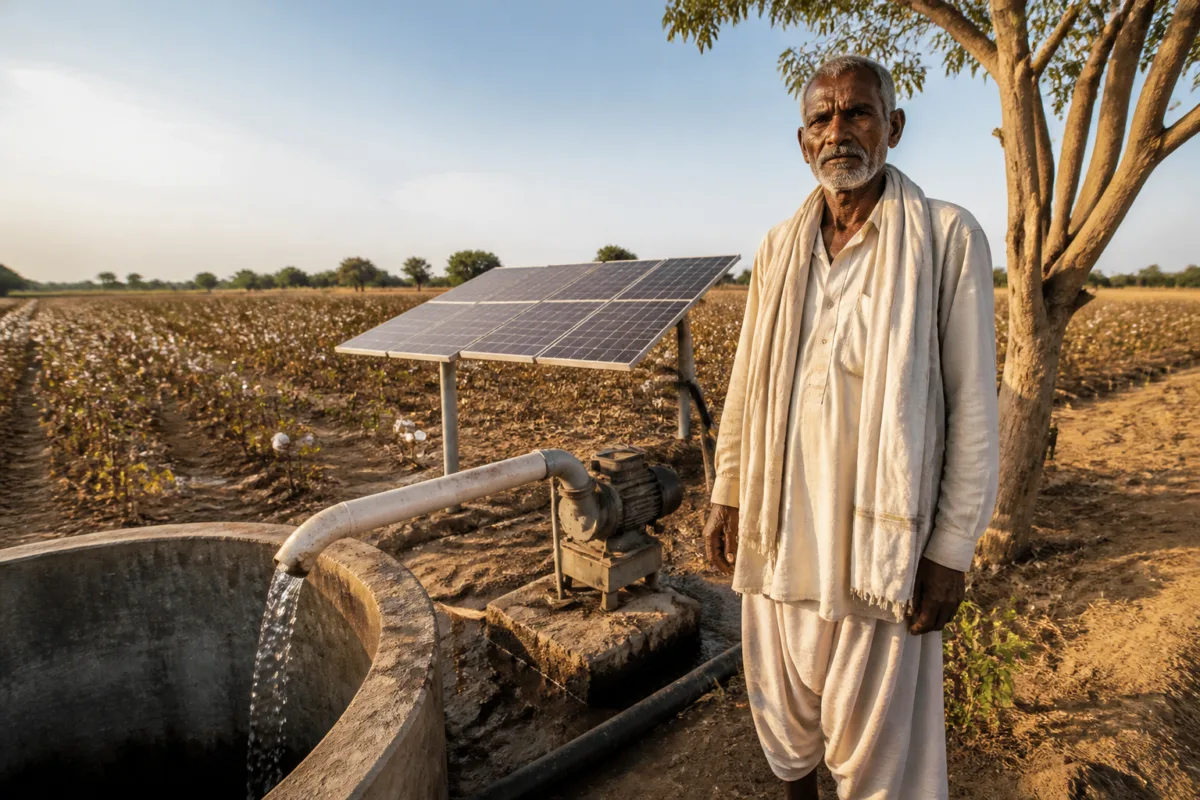
The order concerns a 69-year-old farmer from Parshivani tehsil in Nagpur district. He applied for a 3 HP solar agricultural pump for a well on his 1.83-hectare farm at Mauza Dundakhairi. After MSEDCL issued a demand note, he deposited Rs 16,560 on July 10, 2019. The pump was not installed despite repeated follow-ups. The farmer sent a legal notice in January 2021 and approached the consumer commission in February that year.
The case therefore extends well beyond a routine delay in service. A solar pump is a small piece of infrastructure, but for a farm it is connected to the ability to draw water from a well and operate irrigation systems. The commission’s order does not establish that every crop loss claimed by the farmer was caused by the missing connection. It does, however, establish that the utility had accepted payment and failed to provide the service within a reasonable period.
The commission found MSEDCL guilty of deficiency in service under the Consumer Protection Act, 2019. It directed the utility to install the pump without charging the farmer anything beyond the Rs 16,560 already deposited. It separately ordered MSEDCL to pay Rs 25,000 for mental harassment and Rs 10,000 towards litigation costs within 30 days. If the utility fails to comply, interest at 9% per annum will apply to the compensation and costs.
The most consequential part of the order concerns the competing accounts of what happened to the application. MSEDCL argued that the farmer had submitted letters in December 2019 and September 2020 saying he no longer wanted a solar pump and instead sought a regular three-phase electricity connection. The farmer denied this, saying he did not know English and that utility staff had misused his signature to create the letters. He also alleged that he was pressured to withdraw his complaint.
The commission did not accept the utility’s account as sufficient to justify the prolonged delay. It identified contradictions in MSEDCL’s own records. Although the utility claimed that the farmer had opted out of the solar scheme in December 2019, it accepted his online selection of Tata Power Solar Limited as the vendor in May 2020. It also conducted a joint site inspection in September 2020.
Those actions mattered because they suggested that the application remained active in the utility’s workflow. The commission observed that if the farmer had genuinely withdrawn from the scheme, MSEDCL should have refunded his deposit and closed the application. Instead, the utility’s subsequent conduct indicated that it continued to treat the application as live. That gap between the written explanation and the administrative trail became central to the finding against MSEDCL.
This is the institutional problem revealed by the case: responsibility does not end when an applicant pays a demand note. A service-delivery system must also show what happened next. It must record whether a connection was approved, whether a vendor was selected, whether a site inspection took place, whether installation was scheduled, and whether an application was formally cancelled or refunded. In the Nagpur case, the records described by the commission appear to have contained these steps without producing the promised outcome.
For citizens, the practical difficulty is that such administrative processes are rarely experienced as a single transaction. The applicant may deal with a utility office, an online portal, field staff and a private vendor. Each interaction can create a different record, while the citizen remains responsible for proving that the original request was not withdrawn or abandoned. The commission’s observations show how important consistency is between these records, particularly when the applicant disputes the authenticity or meaning of documents attributed to him.
The language issue also adds a layer of vulnerability. The farmer told the commission that he did not know English and alleged that his signature had been misused. The supplied account does not establish whether the letters were fabricated, but the allegation highlights a basic administrative requirement: a document used to alter or terminate a citizen’s service request must be clearly understood and reliably authenticated. The commission’s concern arose not from the language allegation alone, but from the contradiction between the claimed withdrawal and the utility’s later actions.
The farmer sought Rs 24.93 lakh in damages for losses that he attributed to the drying up of his cotton crops in 2019 and 2020. The commission rejected that part of the claim. It found the projected yield of 20 quintals per acre speculative and unsupported by independent evidence showing that the crop failure was solely due to the absence of an electricity connection.
That distinction is important. The order recognises a service failure without automatically accepting every consequential loss claimed by the complainant. The commission separated what could be established from what could not. The delayed installation, retained deposit and administrative contradictions were assessable within the consumer complaint. The full value of lost crops required stronger evidence linking the agricultural outcome exclusively to the missing pump.
The result creates two different accountability thresholds. MSEDCL has been held responsible for failing to deliver a paid-for service and for the resulting harassment and litigation burden. At the same time, the farmer was required to substantiate the wider economic damage he claimed. The decision therefore offers neither a blanket award for all losses nor an escape from responsibility for the underlying delay.
The case also shows how consumer forums can become an accountability route for public utility services. The farmer first pursued the utility through follow-ups and a legal notice before approaching the commission. The commission’s intervention converted a prolonged service dispute into a direction with a defined installation deadline, a compensation amount and a financial consequence for non-compliance.
That route does not erase the delay. The farmer deposited the money in 2019, while the order reported by the Times of India was issued on October 22, after years of dispute. The 60-day installation window is therefore not the original service timeline but a remedial deadline imposed after the failure had already occurred. The difference is significant for infrastructure administration: a later order can require delivery, but it cannot restore the time during which the promised asset was unavailable.
The institutional chain in this case is also worth noting. MSEDCL was the utility responsible for processing the agricultural pump application. Tata Power Solar Limited was selected online as the vendor in May 2020, according to the commission’s account. A joint site inspection followed in September 2020. Yet the supplied material does not state why installation did not proceed after those milestones, who was responsible for the final delay, or whether any internal action was taken against officials or contractors.
That missing explanation is one of the limits of the available record. The commission’s order establishes the deficiency in service and prescribes a remedy, but the report does not provide a broader dataset on pending solar pump applications, installation performance, refund practices or similar complaints against MSEDCL. It would therefore be incorrect to treat this single case as proof of a system-wide failure rate.
It is nevertheless a useful case study because the failure was not presented as a simple absence of infrastructure. The application had moved through several administrative stages. A payment had been accepted, a vendor had been selected and a site inspection had been conducted. The breakdown appears to have occurred in the transition from administrative processing to physical delivery. That transition is often where public infrastructure promises become measurable: not when a scheme is announced, but when the equipment is installed and usable on the ground.
For agricultural households, the distinction between an approved application and an operating pump is decisive. A record showing that a request exists does not provide irrigation. A vendor selection does not provide irrigation. A site inspection does not provide irrigation. The commission’s direction focuses on the final outcome by ordering installation within 60 days and preventing MSEDCL from demanding more than the amount already deposited.
The larger urban and built-environment question is how public service systems manage small infrastructure assets outside dense city boundaries. Rural and peri-urban areas depend on the same qualities expected from urban utilities: transparent applications, traceable payments, coordinated contractors, accurate records and timely remedies. When those systems fail, the impact is experienced not as an abstract administrative error but as a missing connection, a delayed asset and an additional legal burden on the applicant.
The Nagpur order confirms three facts: MSEDCL accepted the farmer’s payment, the promised 3 HP solar pump was not installed within the period at issue, and the commission found the utility’s explanation inconsistent with its subsequent records. It also clarifies what remains unproven: the full value of the farmer’s alleged crop losses and the precise reason the installation did not happen after the application continued to be treated as active. The next defined milestones are MSEDCL’s compliance with the 60-day installation direction and payment of the Rs 35,000 ordered by the commission within 30 days.

