


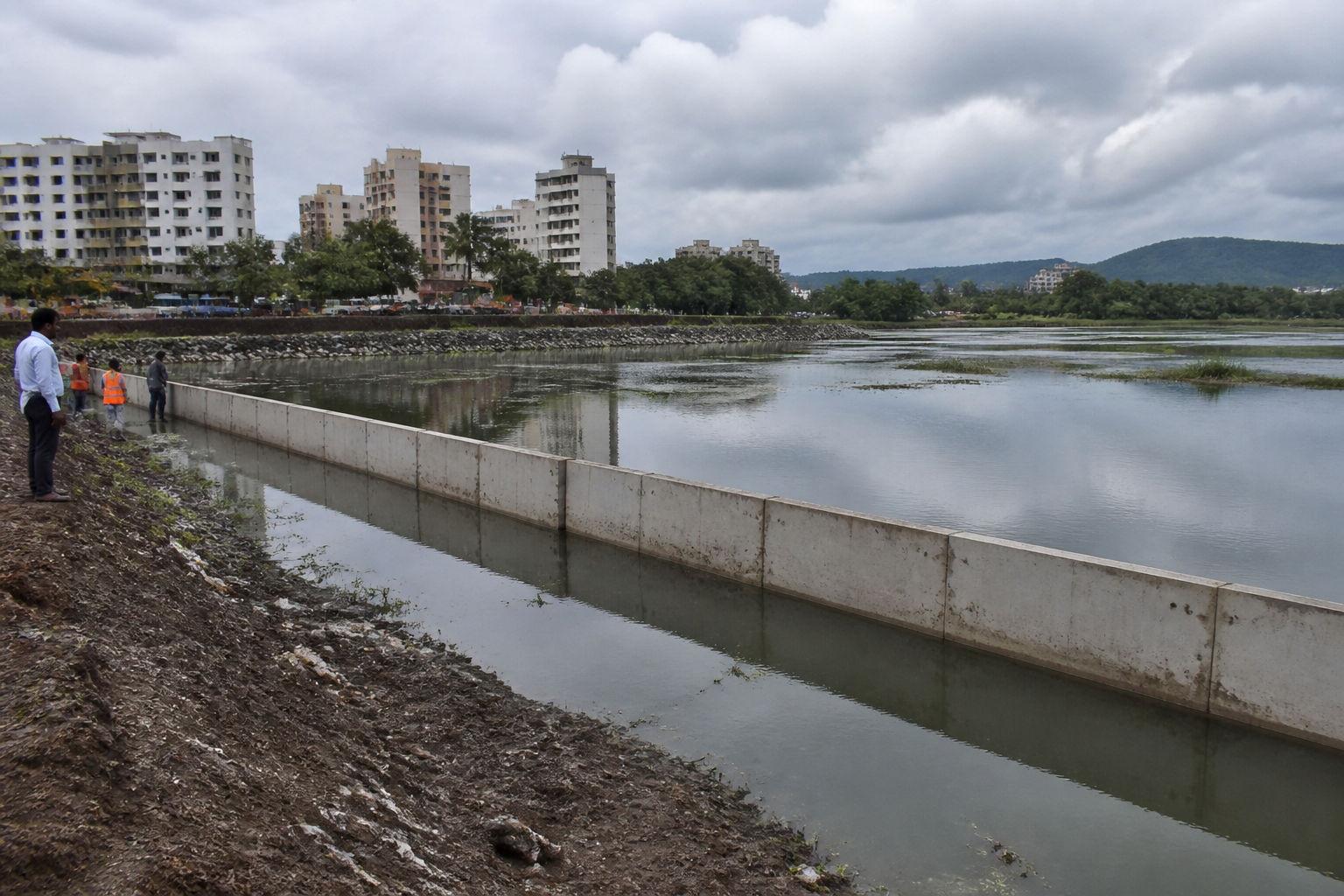
The Mira Bhayandar Municipal Corporation has built a concrete wall inside a natural lake and designated one section as an artificial lake for Ganesh idol immersion, prompting an environmental complaint over the use of the water body for managing plaster-of-Paris and chemically painted idols.
The civic administration has said that idols made from plaster of Paris and coated with chemical colours can be immersed in the separated section. However, environmental activists have objected to creating an artificial immersion facility by dividing an existing natural water body rather than arranging a separate tank or artificial pond.
The complaint was filed by environmentalist and journalist Dheeraj Parab. It alleges that Municipal Commissioner Radhabinod Sharma’s administration has violated guidelines issued by the Bombay High Court, the Maharashtra government and the National Green Tribunal on idol immersion.
Under the court and government guidelines cited in the report, idols below six feet in height are not permitted to be immersed in natural water bodies. Municipal authorities are instead required to provide artificial ponds or tanks for such immersions. The dispute in Mira Bhayandar centres on whether a section of a natural lake can be treated as an artificial facility after being separated by a concrete wall.
The arrangement also raises questions about how the civic body will handle the material remaining after immersion. The complaint alleges that plaster-of-Paris idols and idols covered in chemical colours immersed in natural water bodies last year were not removed and disposed of scientifically. Such material can become a municipal management issue after the festival, particularly where a lake continues to function as a natural water source.
The municipal administration has maintained that measures for idol immersion have been planned within the applicable rules. Commissioner Radhabinod Sharma provided this response while addressing the objections raised over the arrangement.
The issue places two municipal responsibilities in direct focus: providing accessible immersion facilities for residents during the festival and preventing damage to natural water bodies. The reported plan uses an existing lake to meet the first requirement, while the complaint questions whether that approach satisfies the environmental safeguards attached to the second.
The immediate point of contention is the concrete division of the lake and the classification of one side as an artificial lake. Further action will depend on how the civic administration addresses the complaint and demonstrates compliance with the court, state government and National Green Tribunal guidelines.
