


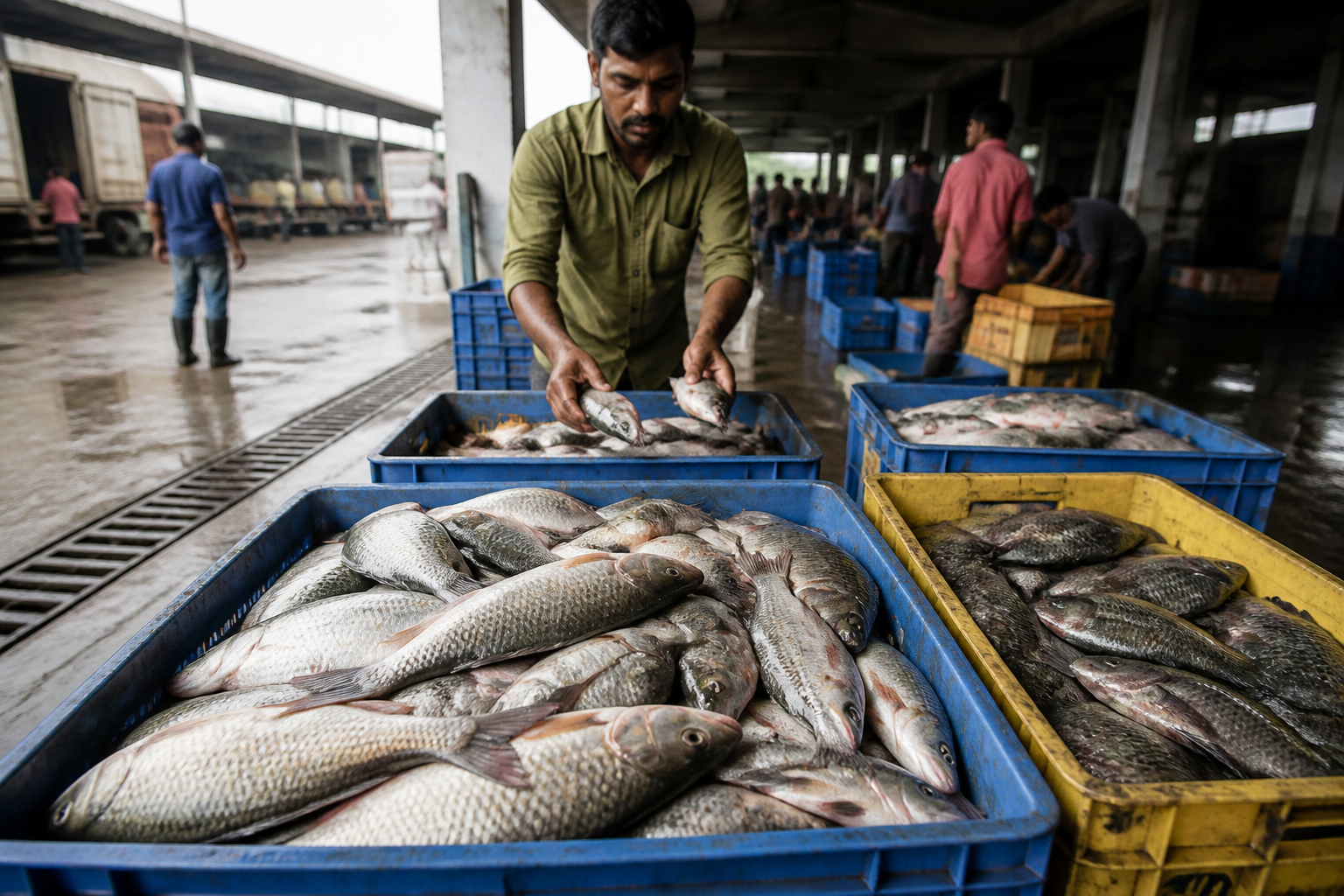
Microplastics in Pune fish are no longer only a question of pollution in distant rivers or oceans. Research by MIT World Peace University (MIT-WPU) has detected fibres, fragments and pellets in samples of Rohu and Tilapia, two freshwater fish commonly consumed in the city. The finding places Pune’s fish supply chain at the centre of a wider urban question: how plastic waste moves through freshwater systems, commercial distribution networks and, potentially, the food chain.
The research is being conducted by Simran Singh, a PhD scholar in MIT-WPU’s Department of Environmental Studies, under the guidance of Dr Soma Mishra. Funded through the university’s Seed Grant, the ongoing study is examining the occurrence, characteristics and possible sources of microplastic contamination in commercially consumed freshwater fish. Its stated objective is to establish baseline scientific data for Pune, a rapidly urbanising city.
That baseline matters because the city’s fish supply is not confined to a single lake, river or local market. The researchers began by mapping the freshwater fish supply chain and surveyed wholesalers and distributors rather than looking only at retail outlets. Pune was divided into four geographical zones, and 26 wholesalers and distributors were interviewed. According to the study, approximately 37-40 tonnes of freshwater fish enter the Pune market every day.
A substantial share of that supply comes from aquaculture systems. Fish also reach Pune from Andhra Pradesh, Gujarat, Ratnagiri, Mumbai and Kolkata, according to the research. This gives the issue a distinctly urban-systems dimension. Contamination detected in fish sold in Pune does not necessarily originate within Pune’s municipal boundary. It may be connected to production systems, water bodies, handling points, transport routes or other stages in an interstate chain that the city depends on but does not fully administer.
The study’s supply-chain approach is therefore significant. A retail-market sample can show what is available to consumers at one point in time. Mapping wholesalers and distributors can help identify how products enter the city and where further investigation may be needed. The researchers are studying contamination sources and food-chain pathways, but the supplied findings do not yet establish a single origin for the particles detected in the fish.
That distinction is important. The presence of microplastics in the samples is the reported finding. The precise implications for human health, and the location or locations where contamination occurred, remain subjects of ongoing investigation. Detailed quantitative analysis and polymer characterisation are still underway. The researchers have also cautioned that a particle count cannot be directly converted into the equivalent number of plastic bottles or other plastic items.
The distinction between particle count and health risk is equally important for public understanding. The study estimates that an individual consuming an average of 250 grams of freshwater fish twice a week over 50 years could potentially ingest between 93,600 and 124,800 microplastic particles. This is a projection based on the detected levels and stated consumption pattern. It is not, by itself, a measure of confirmed harm.
The researchers note that the mass and potential health implications of the particles depend on characteristics including size, polymer composition and associated contaminants. Those details are still being analysed. The available findings therefore point to exposure and a need for further evidence, rather than establishing a direct causal relationship between eating the fish examined and a specific health outcome.
For Pune, the larger significance lies in how several urban systems intersect. Plastic waste management determines how much plastic can enter drains, streams and other freshwater environments. Wastewater management influences what reaches receiving water bodies. Aquaculture and fisheries practices affect the environments in which fish grow. Wholesale and distribution networks connect those production areas to urban consumers. Food-safety oversight is the institutional layer that must interpret evidence about what reaches the market.
These responsibilities are distributed across different institutions and jurisdictions. The MIT-WPU study does not present a new municipal regulation or a confirmed citywide contamination threshold. Instead, it identifies a research problem that crosses administrative boundaries. Pune may be the point of consumption and distribution, while the ecological pathway may extend across states and across multiple stages of the fish supply chain.
That makes the issue more complicated than a conventional market inspection. A market-focused response could identify contaminated samples at the point of sale, but it may not explain whether the particles entered the fish in a production pond, a river, during transport or at another stage. Conversely, action limited to upstream water bodies may not account for handling and distribution conditions inside the city. The value of the ongoing research is its attempt to connect these stages rather than treating them as separate concerns.
The available numbers show the scale of the system being studied. The researchers estimate that 37-40 tonnes of freshwater fish enter Pune every day, and their interviews cover 26 wholesalers and distributors across four geographical zones. These figures do not establish that all fish entering the city contain microplastics, nor do they measure the contamination level of the entire market. They do, however, show why a supply-chain perspective is necessary when the city relies on fish arriving through multiple routes and from several production regions.
Rohu and Tilapia are particularly relevant to the study because they are commonly traded and consumed freshwater species. The research identified fibres, fragments and pellets among the particles found in the samples. These forms are commonly reported in freshwater environments, but the supplied material does not provide a breakdown of the number, size or polymer type of each particle. Without that characterisation, comparisons across locations or a more precise assessment of exposure remain limited.
The study also illustrates the limits of what can be concluded from early findings. A detected particle is evidence of contamination in the examined sample. It is not proof that every fish of the same species, every consignment from a particular state or every retailer in Pune faces the same condition. The research is ongoing, and its final interpretation will depend on the detailed quantitative work and polymer analysis now underway.
The policy landscape raised by the research is correspondingly broad. Plastic waste management is relevant because preventing plastic from entering freshwater environments is part of controlling the contamination pathway. Wastewater management is relevant because urban and industrial water flows can connect human activity to rivers, lakes and aquaculture environments. Freshwater ecosystem conservation is relevant because the condition of the source environment affects both ecological health and the species living within it.
Food safety adds another layer. Any policy response would require evidence that can distinguish between the presence of particles, the level of exposure and the potential consequences associated with different particle characteristics. The researchers’ emphasis on size, polymer composition and associated contaminants indicates why a simple particle count cannot answer every regulatory or health question.
The research received recognition at the National Scientist Round Table Conference, where Singh was awarded the third prize for her poster presentation. Dr Mishra described plastic pollution as becoming a food-chain issue and stressed the need to understand where microplastics originate, how they move through freshwater ecosystems and how they reach fish consumed by people. Her statement reflects the study’s central contribution: shifting attention from plastic as a visible waste problem to plastic as a material that can move through less visible urban and ecological pathways.
For Pune’s institutions, the immediate evidence supports continued investigation rather than a definitive conclusion about the safety of all freshwater fish in the city. The study establishes that microplastics were detected in the freshwater fish samples examined and that the city’s supply chain is large, geographically dispersed and connected to aquaculture and interstate movement. It does not yet identify a single contamination source, quantify the full market-wide prevalence or establish a confirmed human-health effect.
The next important developments are the completion of quantitative analysis and polymer characterisation, along with clearer evidence about the sources and movement of the particles. Until those findings are available, Pune’s microplastic problem is best understood as an emerging food-chain and governance question: one that links plastic disposal, water management, freshwater ecosystems, commercial distribution and the public’s understanding of food safety.

