


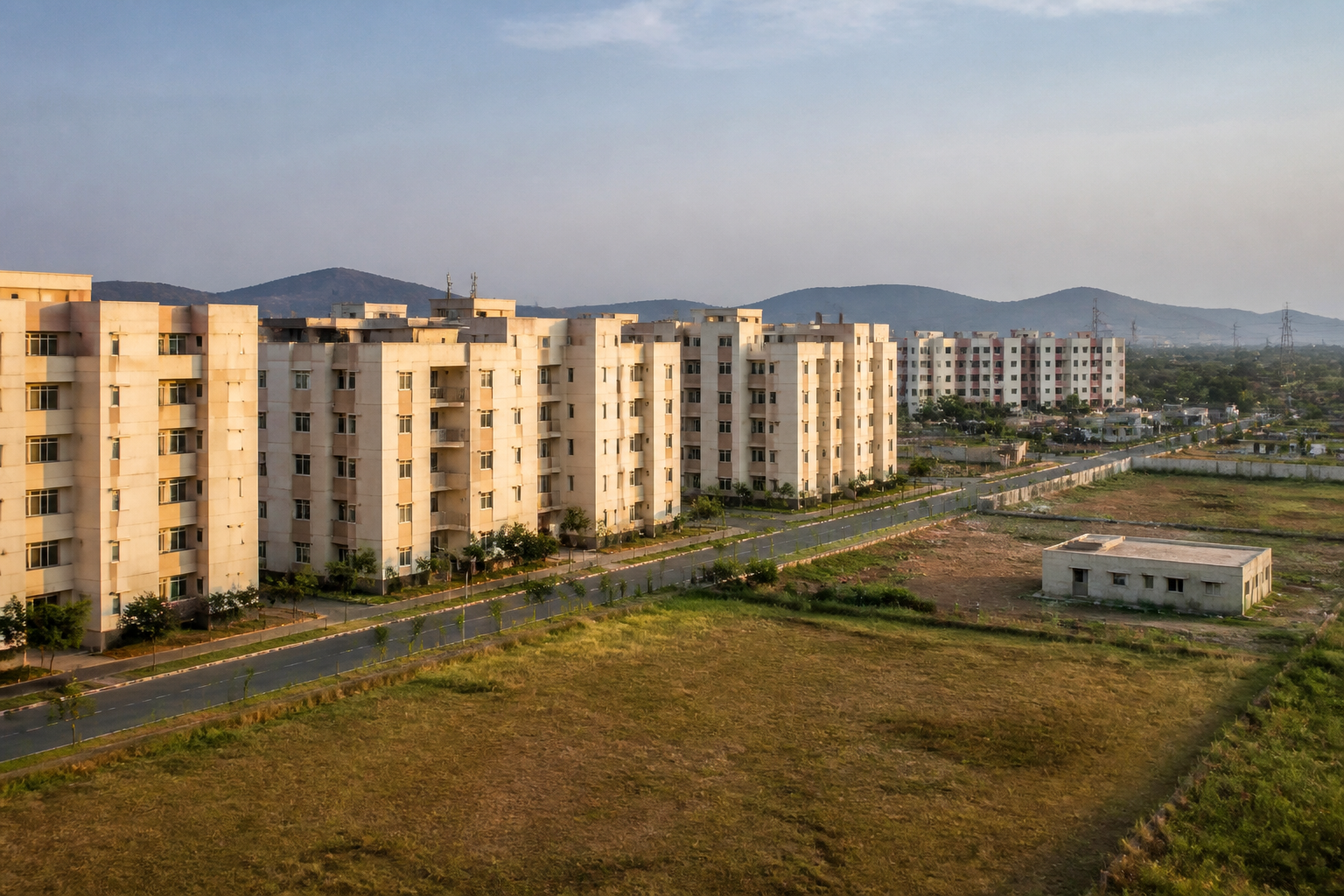
Subheadline: A proposal to offer 6,500 vacant PMAY homes in Khoni-Shirdhon to mill workers now competes with a Forest Department rehabilitation plan, leaving MHADA to resolve a question of priority, affordability and final approval.
Standfirst:
-
MHADA’s proposal to use vacant homes in Khoni and Shirdhon for Mumbai’s mill workers has brought a long-running housing demand into direct conflict with another public need: the rehabilitation of encroachment-affected residents from the Sanjay Gandhi National Park. The Konkan Board has reportedly placed the 6,500-home option before mill-worker organisations after also proposing the properties to the Forest Department. The homes have remained unsold despite multiple lotteries and a first-come, first-served sales process. The immediate question is not only who receives the flats, but how public housing stock is prioritised when demand, affordability, institutional mandates and the financial need to sell vacant homes collide.
The proposal has revived the unresolved question of MHADA girni kamgar housing, but it has not yet produced a final allocation. According to the report, the Maharashtra Housing and Area Development Authority’s Konkan Board has presented approximately 6,500 homes in Khoni and Shirdhon to mill-worker organisations. The organisations have not given final approval, and their response has been mixed.
The homes were constructed under the Pradhan Mantri Awas Yojana, or PMAY, and are understood to have an area of about 350 square feet. More than two lotteries have already been conducted for the properties, but some homes remained unsold. The Konkan Board subsequently offered them through a first-come, first-served process. The continued vacancy has created pressure on the authority to find a buyer or an eligible beneficiary group.
That pressure explains why the same housing stock is now at the centre of two separate proposals. The Forest Department has approached MHADA seeking vacant homes for the rehabilitation of people described in the report as encroachment-affected residents of the Sanjay Gandhi National Park. The Konkan Board has sent the 6,500-home proposal to the department, which would reportedly need to purchase the properties for between ₹1,000 crore and ₹1,100 crore. The Forest Department has not yet given final approval.
At the same time, the Konkan Board has placed the option before representatives of mill workers. The authority’s chief officer, Dr Vishal Rathod, said the board had shared information about the homes and their original prices at a meeting held on Friday. The reported original price is approximately ₹17.5 lakh per home. Rathod said MHADA would try to apply available subsidies and offer the units at a lower price, potentially around ₹9.5 lakh.
That figure is not a confirmed sale price. It is an affordability target that would depend on the application of subsidies and a final decision by the authority and the relevant stakeholders. The distinction matters because the mill-worker organisations have not accepted the proposal. Some groups reportedly favour it, while others do not, and a final decision is expected later.
The dispute is therefore not simply about whether 6,500 homes exist. It is about how an authority should assign homes that have already struggled to find buyers. The properties are vacant, but vacancy by itself does not establish that they are suitable for every potential beneficiary. Location, price, access, eligibility, financing and the willingness of the intended residents to accept the homes all determine whether a housing stock can be converted into actual shelter.
The report does not provide details on the distance between the two locations and Mumbai’s former mill districts, transport connectivity, employment access, social infrastructure or the precise terms under which mill workers would receive the homes. Those gaps are central to understanding why the organisations have responded differently. A lower price may improve affordability, but the final decision would also depend on whether eligible workers consider Khoni and Shirdhon a workable place to live.
The location issue is especially important in a housing programme for former mill workers. Their claim is tied to Mumbai’s industrial history and to a demand for homes arising from the transformation of the city’s mill lands. Yet the available flats are outside the core city areas associated with that history. The supplied report does not establish whether the proposed beneficiaries would receive ownership, occupancy rights or another form of housing entitlement, nor does it explain the financing structure beyond the possible price reduction. Those terms will shape whether the offer is viewed as fulfilment of a housing promise or simply as a discounted sale of unsold stock.
The Forest Department proposal raises a different set of institutional questions. If approved, the department would buy the homes for the rehabilitation of people affected by encroachments in the national park. That would give MHADA a purchaser for a large inventory of vacant homes while linking the transaction to a rehabilitation obligation. But the report makes clear that the department has not granted final approval. The rehabilitation plan, like the mill-worker proposal, remains contingent.
MHADA’s reported position is that the homes need to be sold quickly and that the units will go to whichever party first takes a final decision to purchase them. This approach treats the vacant homes as an immediate inventory and the competing proposals as alternative routes to disposal. It also creates the possibility that the speed of a decision could become a determining factor in the allocation of public housing stock.
That is the central governance tension. Public housing is not only a balance-sheet asset, but it is also a policy instrument. The authority’s concern about unsold homes is understandable from the report: the units have already passed through lotteries and a first-come, first-served sales process without being fully absorbed. However, a rapid sale does not by itself resolve whether the homes are reaching the group for whom the housing policy was intended.
The numbers reveal the scale of the mismatch. More than 100,000 mill workers are described as awaiting a housing solution, while the immediate proposal involves approximately 6,500 homes. Even if all the units were accepted by mill workers, the stock would address only a portion of the stated demand. Conversely, the 6,500 homes represent a substantial rehabilitation package for the Forest Department, with a reported transaction value of ₹1,000 crore to ₹1,100 crore.
The difference between the reported original price and the proposed mill-worker price also shows why the allocation question is financially significant. At approximately ₹17.5 lakh per unit, the total notional value of 6,500 homes would be far higher than the proposed ₹9.5 lakh level. The report does not state the exact subsidy amount, its source, or whether the reduced price would apply uniformly. It also does not establish whether the Forest Department’s reported purchase range includes the same pricing assumptions. These are unresolved parts of the decision.
The episode reflects a recurring problem in urban housing delivery: building homes is not the same as ensuring that homes are occupied by eligible residents. The units in Khoni and Shirdhon have reportedly been offered through more than one sales mechanism, yet vacancies remain. That suggests that demand in aggregate does not automatically translate into demand for a specific project. Housing policy must account for the relationship between price, location, tenure, access and the daily lives of intended residents.
It also illustrates the difficulty of coordinating institutions with different responsibilities. MHADA is dealing with vacant housing stock and the need to sell it. The Forest Department is considering rehabilitation linked to protected-area encroachments. Mill-worker organisations are assessing whether the homes constitute an acceptable housing option for their members. Each institution can view the same 6,500 homes through a different policy lens, and the final outcome will depend on which proposal secures administrative and financial approval first.
The next step is therefore more important than the announcement of the option itself. Mill-worker organisations must decide whether to accept the homes and under what terms. The Forest Department must decide whether to approve the purchase proposal. MHADA must clarify the final price, subsidy structure, eligibility conditions and allocation mechanism. Until those decisions are recorded, the 6,500 homes remain a competing proposal rather than a completed housing settlement.
What the evidence confirms is that MHADA has a sizeable vacant housing inventory, that the homes have not been fully sold through earlier processes, and that two public-policy demands are now competing for the same stock. What remains uncertain is who will receive the homes, at what price, under which tenure arrangement and with what implementation timetable. Those details will determine whether the proposal becomes a meaningful response to the mill workers’ housing claim, a rehabilitation solution for national-park encroachment-affected residents, or another unresolved chapter in Mumbai’s long search for affordable housing.
