


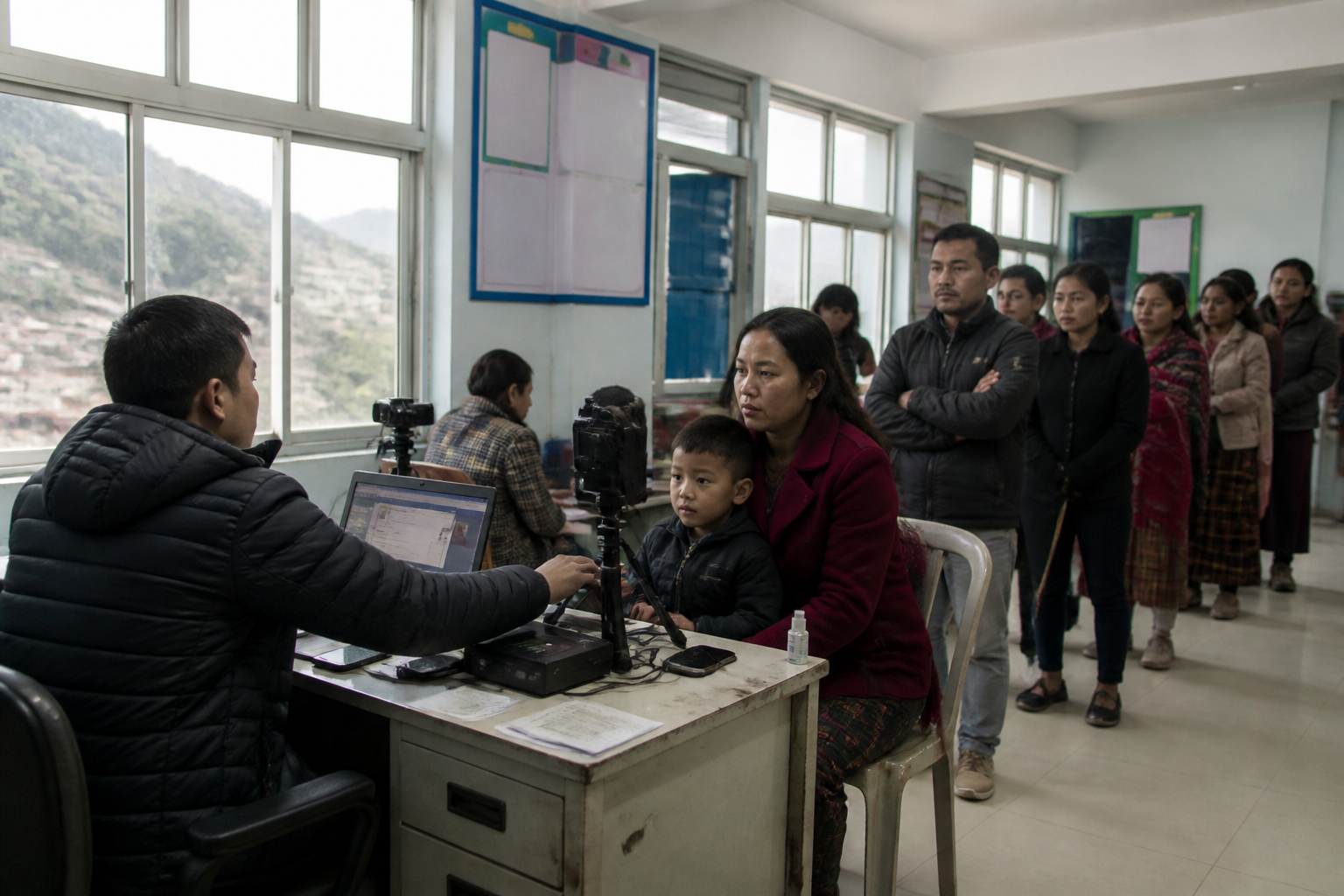
Meghalaya has directed government departments to accelerate Aadhaar enrolment, demographic updates and mandatory biometric updates for children, following a state-level review in Shillong aimed at improving access to public services and reducing authentication-related difficulties.
The state-level Unique Identification Implementation Committee meeting, held on Thursday, brought together the Meghalaya government and the Unique Identification Authority of India (UIDAI) to assess Aadhaar coverage and authentication across the state. Officials identified child enrolment, low-saturation districts and overdue biometric updates as priority areas.
UIDAI deputy director general Ngachan Zimik presented an overview of Meghalaya’s Aadhaar status at the meeting. He reported an upward trend in enrolment, demographic updates and authentication, while also identifying areas that require focused intervention. The meeting called for sustained coordination between state departments and the UIDAI Regional Office in Guwahati.
One priority is to increase Aadhaar enrolment among children aged between zero and five years through Birth Registration Based Aadhaar Enrolment. The process can be undertaken at district hospitals and other health facilities using the child’s Birth Registration Number, allowing enrolment to be linked more closely with birth registration and public health infrastructure.
Officials also called for stronger coverage of Mandatory Biometric Updates, or MBUs, among children. The education department was asked to organise special MBU drives in schools, where students can be identified and supported without requiring families to make separate visits to enrolment centres.
Zimik suggested integrating MBU status with the UDISE+ education data portal. Such integration could help schools identify students whose biometric details are due for updating. According to the meeting’s discussion, timely updates may help students avoid authentication-related problems while accessing government schemes and scholarships or appearing for examinations including NEET, JEE and CUET.
The meeting also reviewed the proposed uses of the new Aadhaar App. Gopajit Das, assistant director at the Press Information Bureau in Meghalaya, said the app includes offline and QR-based verification, biometric lock and unlock facilities, and simplified onboarding for Offline Verification Seeking Entities.
Das said these features could support Aadhaar-based verification in settings such as hotel check-ins, hospitals and age verification. Offline and QR-based functions may be particularly relevant where connectivity is inconsistent, although the meeting’s stated objective was to expand the range of verification options rather than replace existing enrolment and update systems.
Chief secretary Shakil P Ahammed stressed the need for coordinated and time-bound action by all departments in collaboration with UIDAI’s Regional Office in Guwahati. The next phase will focus on addressing the gaps identified during the review, including coverage in low-saturation districts and the timely completion of biometric updates for children.
