


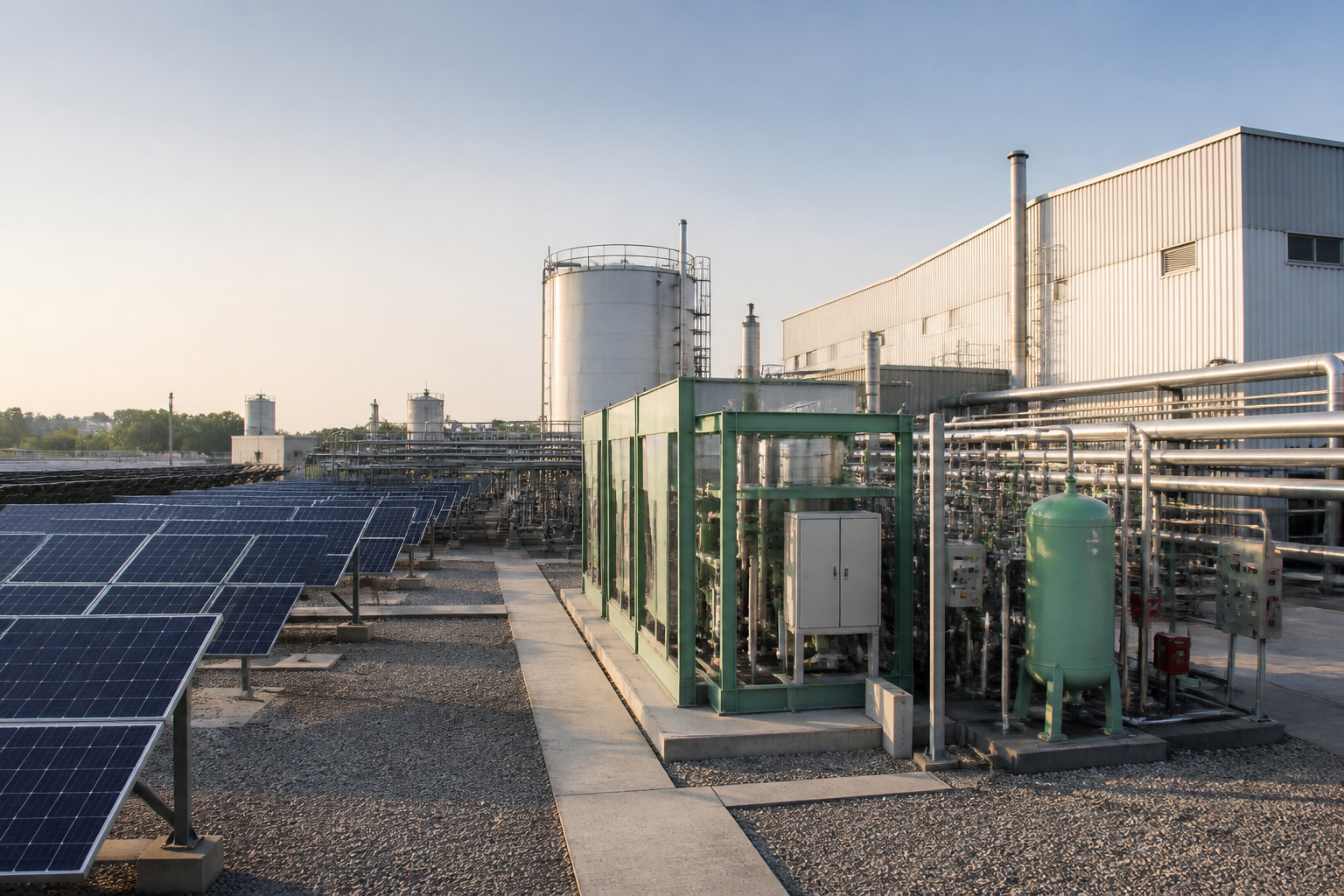
Maruti Suzuki’s commissioning of a 300 kW green hydrogen plant at its Manesar facility is more than a new piece of industrial equipment. It is a pilot for a manufacturing model in which electricity generated on-site, including solar power that might otherwise go unused, is converted into hydrogen, stored and later consumed in factory operations. The experiment places energy flexibility alongside emissions reduction at the centre of a large automobile plant’s transition.
The company has linked the pilot to a longer-term target: reducing the carbon footprint of its manufacturing operations from 6,15,000 tonnes at present to 2,66,000 tonnes in financial year 2030-31. Managing Director and Chief Executive Officer Hisashi Takeuchi said the company would use the learning from the Manesar project to assess a wider adoption of green hydrogen across its manufacturing facilities in Haryana and Gujarat.
That sequence matters. The announcement is not a claim that hydrogen has already transformed Maruti Suzuki’s production system. It is a statement about building operational capability before scaling a technology across multiple sites. The pilot therefore offers a window into the institutional and infrastructure questions that determine whether industrial decarbonisation can move from an individual project to a manufacturing network.
At Manesar, the green hydrogen plant is designed to maximise the use of solar energy generated at the facility. Solar power produced during holidays, when the factory’s direct electricity demand may be lower, is used to generate hydrogen. The hydrogen is then stored and used in manufacturing operations. In this arrangement, electrolysis functions as an energy-conversion and storage mechanism rather than simply as another source of power.
The reported configuration also shows why industrial decarbonisation is unlikely to depend on one technology alone. Maruti Suzuki said it is combining in-house solar plants with renewable-energy procurement from government sources and power purchase agreements with third-party solar and wind providers. It has also begun integrating compressed biogas as process fuel and has commissioned a 1-MWh battery energy storage system at its Kharkhoda facility.
These systems perform different functions. Solar and contracted renewable power provide electricity. A battery can store electricity for later use over an operating cycle. Hydrogen can be produced when renewable electricity is available and consumed later in manufacturing. Biogas and compressed biogas provide another fuel pathway for industrial processes. The company’s stated approach is therefore a portfolio of energy systems rather than a single substitution of fossil fuel with hydrogen.
The Manesar pilot’s specific contribution is to test whether surplus or otherwise underused solar generation can be converted into a storable industrial fuel. The source report does not provide the plant’s expected hydrogen output, the share of factory demand it is intended to meet, or the emissions reduction attributable specifically to the electrolyser. Those details will be important in judging the pilot’s performance, but they are not established in the available announcement.
The company’s broader target gives the pilot a measurable corporate context. Maruti Suzuki has said it aims to lower manufacturing emissions by 3,49,000 tonnes between its present level of 6,15,000 tonnes and the 2,66,000-tonne target for FY 2030-31. The announcement does not break down how much of that reduction is expected from green hydrogen, solar power, biogas, battery storage, renewable procurement or other measures. That distinction matters because the headline technology may represent only one part of the overall emissions strategy.
The next component in the company’s plan is biogas. Maruti Suzuki said it is at an advanced stage of setting up a 10-tonnes-per-day biogas plant at its Kharkhoda facility, with commissioning planned within FY 2026-27. Its board has also approved four compressed biogas projects and earmarked Rs 561 crore for them. The source material does not specify the locations, capacity or commissioning schedules of each of those four projects, so the Manesar hydrogen pilot should be read alongside an expanding but still developing set of energy investments.
The Kharkhoda battery system adds another layer to this transition. The commissioned 1-MWh battery energy storage system is described as part of the company’s efforts to manage cleaner energy in its manufacturing operations. The announcement does not disclose its operating profile or how it is integrated with the plant’s electricity demand. It does, however, establish that Maruti Suzuki is testing storage technologies across more than one facility rather than treating decarbonisation as a single-site intervention.
The policy context is India’s Green Hydrogen Mission, to which Takeuchi explicitly linked the Manesar project. The company also described India’s manufacturing competitiveness as increasingly connected to carbon intensity, alongside cost and quality. That framing places factory emissions within a wider industrial policy question: as manufacturers seek to remain competitive, the energy profile of production can become part of how facilities are evaluated and how companies plan future capacity.
For the public sector, the arrangement described by Maruti Suzuki points to several coordination requirements. Renewable electricity procurement involves government sources, third-party providers and power purchase agreements. On-site generation requires land, electrical infrastructure and operating integration. Hydrogen production requires an electrolyser, water and storage systems, while its use in manufacturing requires suitable process applications and safety arrangements. The supplied material confirms the company’s investments and intentions but does not detail the approvals, water consumption, safety protocols or regulatory processes connected with the Manesar plant.
The company’s plans also extend beyond its own factories. Suzuki Motor Corporation, Maruti Suzuki’s parent entity, is set to establish 10 biogas plants across India in partnership with organisations including the National Dairy Development Board and dairy industry unions. This indicates an interest in linking industrial energy demand with wider feedstock and rural-institutional networks, although the announcement does not provide the locations, capacities or timelines of those plants.
The numerical picture remains limited but significant. The hydrogen pilot has a 300 kW electrolyser. The emissions target moves from 6,15,000 tonnes to 2,66,000 tonnes by FY 2030-31. The Kharkhoda biogas plant is planned at 10 tonnes per day, the battery system has 1 MWh of capacity, and four compressed biogas projects have a combined approved budget of Rs 561 crore. These figures describe the scale and diversity of the intervention, but they do not yet provide a common measure of cost, energy output or emissions avoided.
That gap is central to understanding what happens next. A pilot can demonstrate technical feasibility, but scaling requires evidence on reliability, operating costs, maintenance, safety, energy efficiency and the availability of renewable power. It also requires clarity on the role of hydrogen in the production process: whether it replaces an existing fuel, supports a specific industrial application or mainly absorbs renewable electricity that would otherwise be curtailed or unused.
The Manesar project therefore represents a test of factory-level energy management as much as a test of hydrogen. Its distinctive feature is the proposed connection between solar generation during holidays, electrolysis, storage and subsequent industrial use. If the company scales the model across Haryana and Gujarat, the operational learning will have to travel between facilities with different energy loads, production schedules and infrastructure conditions.
The evidence currently confirms a commissioning, a corporate emissions target and a multi-technology investment programme. It does not yet establish the pilot’s emissions performance or commercial results. Those will depend on future operating data and the company’s decisions on scaling. For now, the project’s importance lies in showing how a major manufacturer is assembling solar, hydrogen, batteries and biogas into a single decarbonisation strategy—and in making the success of that strategy measurable at the factory floor.
