


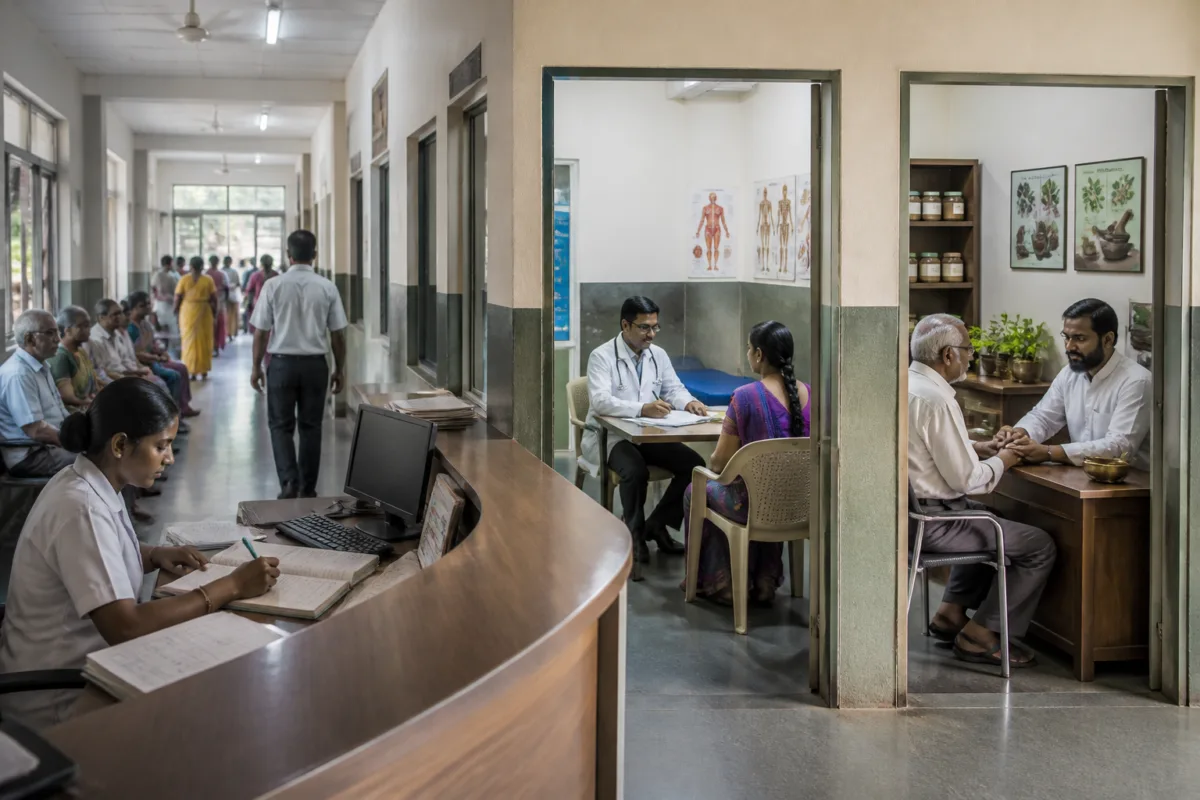
Maharashtra’s plan to integrate AYUSH services into state-run health facilities is not only a question of whether Ayurveda, Yoga and Naturopathy, Unani, Siddha and Homoeopathy will be available alongside modern medicine. It is also a test of how the state defines clinical responsibility when different systems operate within the same public health structure.
The health department has appointed a 12-member committee to prepare a report on integrating AYUSH into modern medical facilities. According to a government resolution reported by the Times of India, the panel has been given two months to frame its recommendations. It is expected to develop treatment protocols for arthritis, hypertension, diabetes and mental health, and to advise the government on pilot “integrated clinics” where patients could access AYUSH and modern medicine under one roof.
That proposed arrangement gives the committee an unusually important role. Its recommendations could influence how patients are assessed, how practitioners refer cases, what treatments can be offered, how records are maintained and who is responsible when care moves between systems. The available material does not establish the final model. It does, however, show that the state is moving from a broad policy idea towards an administrative and clinical framework.
The composition of the committee has become the first point of dispute. The panel consists largely of AYUSH practitioners and government officials. It is chaired by biologist Bhushan Patwardhan, who is affiliated with the Union ministry of AYUSH, and co-chaired by urologist Dr Suresh Patankar. The report said there are no other independent MBBS doctors from medical organisations on the committee.
The Indian Medical Association’s Maharashtra unit has objected to that composition. Its state president, Dr Santosh Kulkarni, said the association had written to the government seeking clarity on what “integrated services” means. The IMA has demanded representation for elected members of the Maharashtra Medical Council and IMA members, arguing that decisions affecting modern medical practice cannot be taken without adequate participation from qualified doctors and professional bodies.
The dispute reveals that “integration” is not a single operational concept. It could mean that AYUSH and modern medicine function side by side in the same facility, with practitioners remaining within their respective fields. It could also be interpreted as simultaneous treatment across systems. The distinction affects prescribing rights, referral pathways, clinical documentation, professional accountability and the management of complications.
The IMA has specifically distinguished between allowing different systems to operate alongside one another and combining them during the same course of treatment. It has asked the government to clarify the scope of practice, prescribing rights, clinical responsibility, referral protocols and accountability before recommendations are adopted.
These are administrative questions, but they are also urban service-delivery questions. State-run hospitals and clinics are shared public institutions where patients may not know which authority is responsible for a diagnosis, prescription or referral. A single facility can simplify access if roles are clearly defined. It can also create confusion if the patient-facing service is unified while professional standards, records and escalation procedures remain separate.
The committee’s proposed work on arthritis, hypertension, diabetes and mental health makes those questions especially relevant. These conditions often require continuing care rather than a one-time intervention. The source material does not provide details of the proposed protocols, the qualifications required for each role, the method for assessing treatment outcomes or the arrangements for referral between practitioners. Those details will determine whether an integrated clinic is simply co-location or a more complex clinical model.
The government’s second resolution adds an institutional dimension. The Directorate of Medical Education and Research and the Directorate of AYUSH have been merged under the name “Commissionerates of Medical Education, Research and AYUSH”. The resolution states that the two offices will operate under the unified name and that official websites, email addresses, stamps, signage and documents are being updated immediately.
A DMER official quoted in the report said the commissioner was already heading both AYUSH and the medical education department, and that the change places them under one umbrella while altering the nomenclature. This suggests that at least part of the move is an administrative consolidation rather than the creation of an entirely new operating structure. The available report does not establish whether the merger changes budgets, staffing, regulatory powers, hospital management or the statutory responsibilities of either directorate.
That distinction matters. Combining offices can reduce duplication in administration, but it does not by itself resolve the professional boundaries that arise when different medical systems work in the same public facility. A unified department may make coordination easier, while clinical decisions could still require separate standards, qualifications and lines of accountability. Whether the new structure improves services will depend on the rules that follow the change in nomenclature.
The government resolution gives the committee two months to submit its report, making that document the next significant milestone. It should clarify whether the proposed clinics will be limited to co-located services, how patients will be referred, which practitioners can prescribe particular treatments and how adverse events will be reviewed. The IMA’s response indicates that these issues are not yet settled.
The reported controversy also shows the limits of treating institutional integration as a matter of administrative design alone. A public clinic is not just a building containing multiple services. It is a chain of decisions connecting diagnosis, treatment, referral, record-keeping and follow-up. If those links are unclear, patients may find it difficult to understand which practitioner is responsible for the overall course of care.
At the same time, the source does not report that the government has finalised a treatment protocol or launched an integrated clinic. The committee has been asked to recommend protocols and pilot projects; the IMA has sought clarification; and the department’s wider restructuring has so far been described by an official as an umbrella arrangement and change in nomenclature. The evidence therefore points to a policy-development stage, not a completed service model.
Maharashtra’s AYUSH integration plan will ultimately be judged by the clarity of the framework it produces. The immediate issues to monitor are the committee’s report, the representation of medical regulators and professional bodies, the definition of integrated services, and the rules governing prescribing, referrals and clinical accountability. Until those details are made public, the central question is not whether the systems will share public facilities, but how safely and transparently that sharing will work.

