


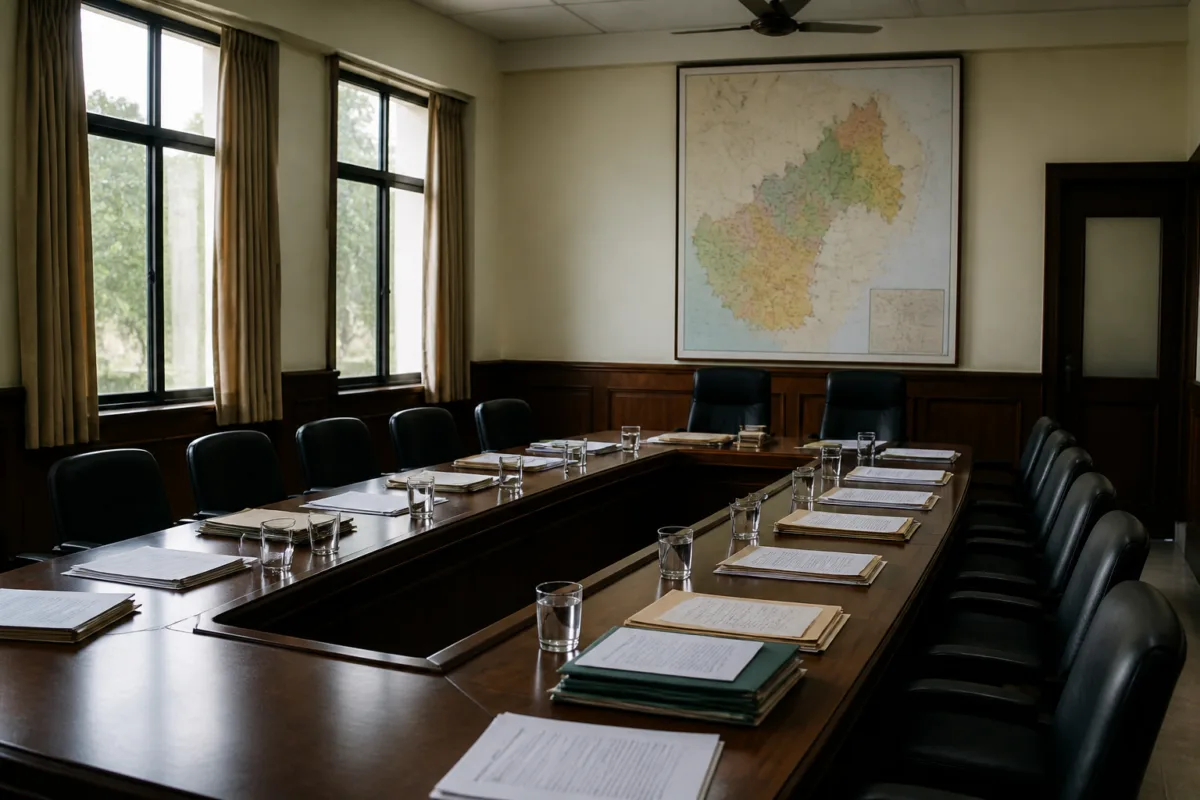
Maharashtra’s Tribal Advisory Council held only four meetings between 1 January 2015 and 30 August 2026, despite a recommendation that such councils meet at least twice a year. The gap is more than an administrative irregularity: it shows how a formal mechanism intended to bring tribal concerns into policymaking can become ineffective when its basic deliberative function is not maintained.
The figures were obtained through the Right to Information process and reported by Loksatta. According to the report, at least 22 meetings were expected during the 11-and-a-half-year period if the recommended schedule had been followed. Instead, the council met four times: its 49th meeting was held on 6 April 2016, the 50th on 11 February 2019, the 51st on 11 October 2023 and the 52nd on 2 July 2026.
The pattern is not one of a council meeting slightly less often than planned. It is a pattern of long interruptions. Nearly three years separated the 49th and 50th meetings. The next meeting came more than four years later, followed by another gap of almost three years. The supplied report does not establish why these meetings were delayed, whether agendas were prepared during the gaps, or how many recommendations were made and acted upon. But the interval itself establishes that the council did not operate as a regular forum during the period examined.
That matters because the council is described as an important advisory body for the welfare of tribal communities and the protection of their constitutional rights. Its stated responsibility is to advise the state government on policy questions connected with tribal development. An advisory institution can influence government only when it has a regular opportunity to examine issues, hear representatives, record concerns and place recommendations before the administration. Long periods without meetings weaken each of those functions.
The institutional design also gives the council a potentially broad representative base. Maharashtra has 26 tribal legislators in the state Assembly and four tribal members of Parliament, according to the report. These 30 elected representatives are ex-officio members of the council. In principle, that creates a platform through which representatives from tribal-majority areas can discuss common concerns and pursue them collectively with the state government.
The absence of regular meetings raises a structural question about representation. Electoral representation and administrative consultation are not the same thing. Legislators may raise constituency-specific matters in the Assembly or Parliament, but a formal advisory council is meant to provide a separate channel for considering tribal issues together. If that channel is convened only intermittently, the system loses the ability to convert dispersed local concerns into a sustained policy discussion.
The report’s comparison between the expected and actual number of meetings is particularly important. The National Commission for Scheduled Tribes has recommended at least two meetings each year. Against that benchmark, four meetings in 11-and-a-half years amount to less than one meeting every two and a half years. The gap is therefore measurable, not merely a matter of perception. The available evidence does not show whether the recommendation is legally binding in every circumstance, but it provides a clear administrative standard against which the council’s functioning can be assessed.
The chronology also shows that the problem continued across different periods rather than being confined to one isolated delay. Meetings took place in 2016, 2019, 2023 and 2026. The most recent meeting, held on 2 July 2026, does not erase the preceding gaps. Nor does the holding of a meeting by itself demonstrate that the council has returned to a regular schedule. The supplied report contains no subsequent calendar, annual timetable or official explanation indicating how continuity will be maintained.
This is where the issue moves beyond the council’s meeting count. Public institutions often appear active because they exist on paper, have defined membership and occasionally convene. Their effectiveness, however, depends on operating routines: meetings must occur at an appropriate frequency, agendas must address the institution’s mandate, records must be available, and recommendations must connect to decisions. The RTI information reported here establishes the first weakness clearly. It does not provide enough evidence to assess the other three.
That distinction is important for reading the story accurately. The reported meeting gaps support a finding of institutional inactivity or irregularity. They do not, on their own, prove that every tribal policy has failed, that every government department ignored tribal concerns, or that no development work took place in tribal areas. The evidence is narrower and more precise: the council, a designated advisory forum, met far less frequently than the recommended schedule during the period covered by the RTI response.
The administrative consequences of such irregularity are also likely to be uneven, but the supplied material does not quantify them. The report does not list pending agenda items, rejected recommendations, delayed schemes, budgetary effects or specific cases in which a council meeting changed a government decision. Those missing details point to the next layer of public accountability. Meeting frequency is a necessary indicator of institutional functioning, but it is not a complete measure of outcomes.
The council’s composition makes that follow-up especially relevant. With 30 ex-officio members from the state’s tribal representation, it is a forum capable of consolidating issues that may otherwise remain divided across departments and districts. The report identifies the opportunity for collective discussion, while also noting that the irregular schedule raises questions about the role played by these elected representatives in pursuing the council’s work. The available account does not attribute responsibility for the delays to any individual member or department, so those questions require documentary examination rather than assumption.
The governance framework implied by the report rests on three linked elements: representation through elected members, consultation through the advisory council, and administrative response by the state government. A breakdown in the middle element can make the overall arrangement less effective even when the other two continue to exist. Representatives may be present, and departments may retain formal responsibility, but without a functioning forum there is no regular institutional moment at which shared concerns are assembled and reviewed.
For citizens in tribal-majority areas, the significance of the issue is therefore indirect but substantial. The meeting calendar is not itself a service-delivery measure. It does not tell residents whether a road was built, a school opened or a welfare benefit reached a household. It does reveal whether one formal route for raising policy concerns was available with reasonable regularity. In regions where administrative access can already be difficult, the reliability of representative institutions becomes part of the wider governance infrastructure.
The numbers supplied in the report provide a concise data story: 22 meetings expected, four held, and 18 not held within the period when the recommended twice-yearly schedule would have produced them. The actual meetings were spread across 2016, 2019, 2023 and 2026, with no annual continuity visible in the reported record. The source does not provide comparable figures for earlier decades, other states, attendance, agenda completion or recommendation follow-up. Those gaps prevent a broader performance comparison, but they do not obscure the central pattern in Maharashtra.
The larger urban and regional governance question is how constitutional and statutory consultation mechanisms function outside headline policy announcements. Development in tribal areas is often discussed through schemes, budgets and infrastructure projects. Yet the institutions that identify priorities, review implementation and communicate local concerns are equally important. When such institutions meet sporadically, the state may still produce policies, but the documented opportunity for structured participation becomes weaker.
The RTI findings therefore establish a serious institutional warning without establishing the full consequences of the council’s inactivity. Maharashtra’s Tribal Advisory Council held four meetings in the period examined, against a recommended minimum that would have required at least 22. The developments that deserve monitoring are the publication of a regular meeting schedule, the council’s agenda and minutes, the recommendations emerging from its meetings, and the government’s recorded response to them. Those documents would show whether the July 2026 meeting marked a return to functioning or remained an isolated event.

