


Maharashtra plans to attract USD 100 billion in infrastructure investment over the next five years, with the state government linking the target to new urban centres, metropolitan transport expansion and the redevelopment of existing cities, Chief Minister Devendra Fadnavis said at the World Mayors’ Forum in Mumbai.
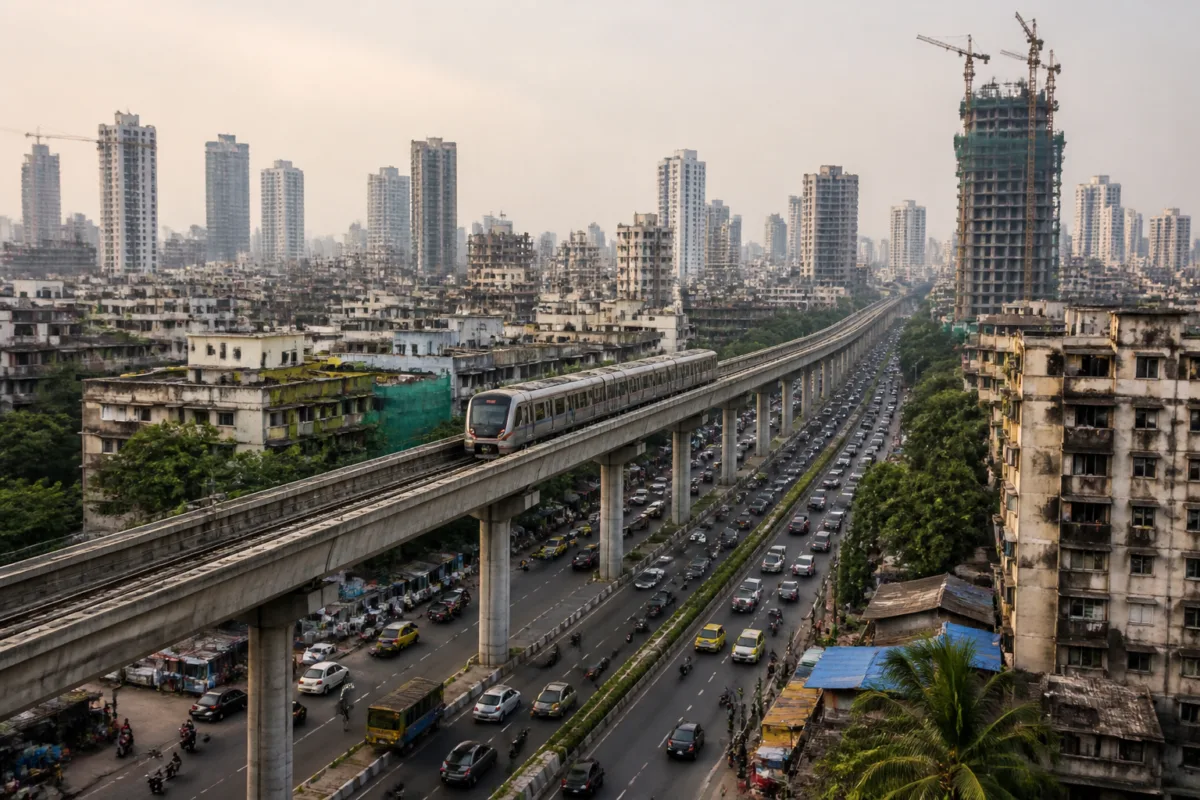
Fadnavis said infrastructure projects worth around USD 50 billion were already being developed across the Mumbai Metropolitan Region (MMR). According to his account, the programme includes a metro network of more than 300 kilometres, roads, flyovers, tunnels, water-supply infrastructure, sewage-treatment facilities and solid-waste management projects.
He identified sustainability, efficient public transport and liveability as the three main pillars of urban development. Fadnavis also said past attempts to restrict urbanisation, combined with inadequate planning, had contributed to unplanned growth, slums, insufficient civic amenities, water shortages and waste-management problems.
The comments were made at the inauguration of the third World Mayors’ Forum, organised in Mumbai to mark the centenary year of the All India Institute of Local Self-Government. Union Minister of State for Housing and Urban Affairs Tokhan Sahu, Himachal Pradesh Public Works Minister Vikramaditya Singh, West Bengal Minister of State Umesh Rai, Mumbai Mayor Ritu Tawde and municipal administrators and mayors from India and abroad attended the event, according to the report.
Fadnavis presented the development of new urban centres as one part of a two-pronged strategy, with the other being the redevelopment and rejuvenation of existing cities and settlements.
He said Third Mumbai was being developed around Navi Mumbai International Airport. The proposed urban centre is expected to include an EduCity, Sports City, MediCity, Innovation City and Global Capability Centre City, with dedicated infrastructure for education, sports, healthcare, innovation and international companies.
Fadnavis said the state planned educational infrastructure for around one lakh students and campuses for 12 international universities in Third Mumbai. He added that seven of these universities had already commenced operations.
The state’s other proposed urban expansion, described by Fadnavis as Fourth Mumbai, is planned between Virar and Vadhavan, where a major port is under construction. He said the area would be connected to Mumbai through the bullet train project and a super expressway, and expressed confidence that Vadhavan Port would become one of the world’s 10 largest ports.
The proposed connectivity would place the Virar-Vadhavan region within a wider transport and logistics network, although the forum remarks did not provide project costs, delivery schedules or details of the agencies responsible for coordinating the different systems.
Fadnavis also referred to the 22-kilometre Atal Setu, saying it had reduced travel time between Mumbai and the Navi Mumbai airport area to around 40 minutes. He added that the journey was expected to take around 30 minutes by the following year.
On the wider demographic context, Fadnavis said more than half of Maharashtra’s population lived in around 400 cities, while the remainder lived in approximately 40,000 villages. He argued that better civic infrastructure and living conditions in urban areas could improve the quality of life of nearly half the state’s population.
He said attracting investment would require financially viable and well-designed projects, adding that global capital was available but cities needed to prepare projects capable of securing it. The remarks place project preparation and municipal capacity alongside funding as key requirements for the state’s investment target.
Dharavi redevelopment was presented as another major component of Mumbai’s urban transformation. Fadnavis said residents would receive homes with essential civic amenities and that the redevelopment could create a commercial hub connected to the Bandra Kurla Complex. He expressed confidence that Dharavi would emerge as a new business hub within 10 years, while also referring to redevelopment and rejuvenation work in other old settlements and buildings.
The chief minister urged mayors and municipal councillors to study governance practices used in cities including Indore, Ahmedabad and Mumbai. He asked the organisers to submit recommendations from the forum to the Maharashtra government for consideration.
The investment target therefore brings together several distinct urban agendas: regional transport, airport and port connectivity, civic utilities, new urban extensions, redevelopment and municipal governance. Its implementation will depend on the preparation of viable projects, coordination across urban jurisdictions and the delivery of the public infrastructure identified in the announcement.

