


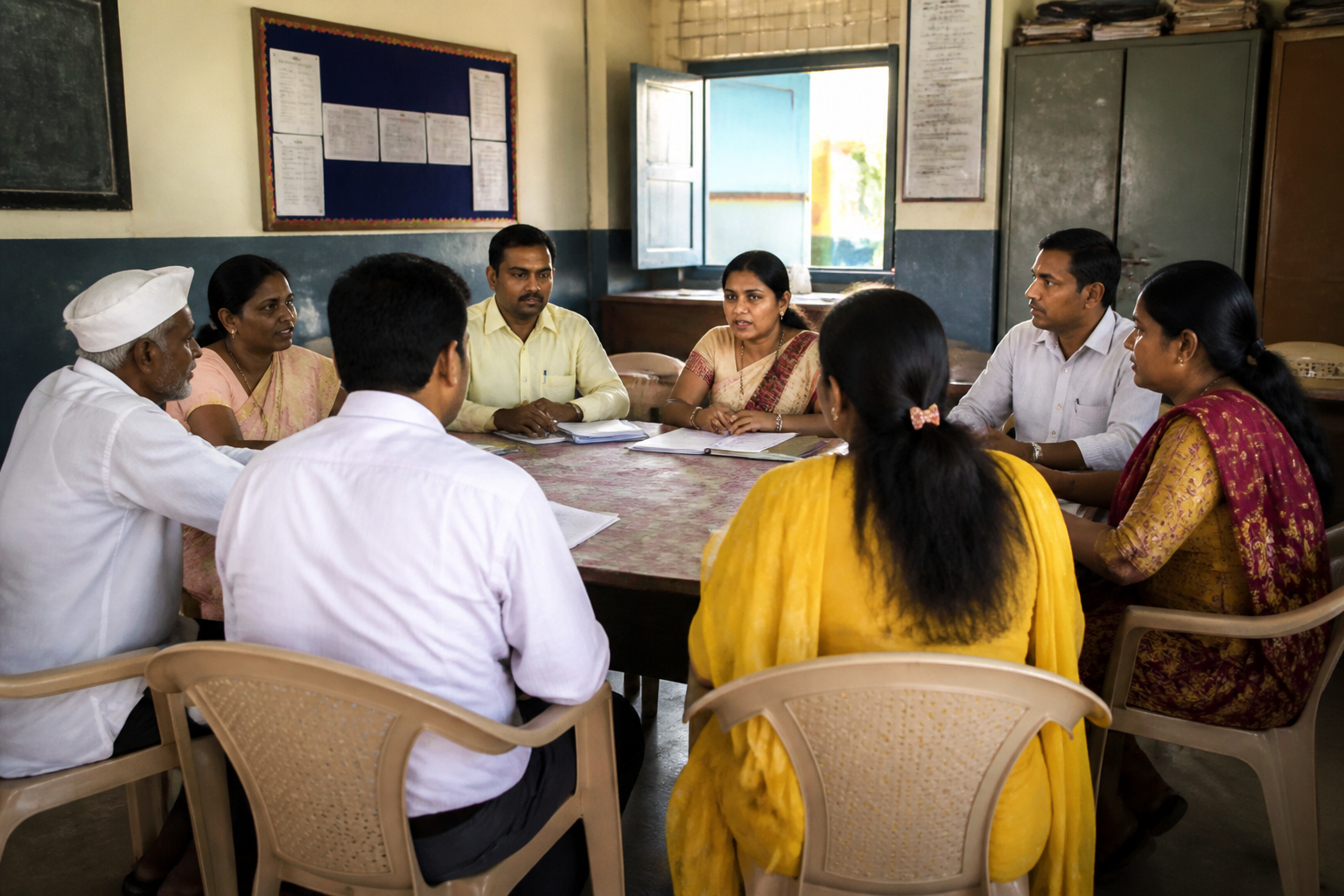
The Maharashtra education department’s decision to train School Management Committee members is presented as an effort to strengthen a formal institution that is meant to connect schools, families and local administration. The announcement by School Education Minister Dada Bhuse is significant not because training itself is unusual, but because it acknowledges a basic governance problem: committees created to participate in school development do not function uniformly across the state.
According to the report, some School Management Committees, or SMCs, work actively while others exist largely in name. The proposed training is intended to explain their powers, responsibilities and role in monitoring school facilities and student learning. It will also address how members can take school-related problems to the relevant local administration. The department plans to begin the training from next month, although the report does not specify the number of members to be trained, the delivery model, the responsible agencies or the expected completion date.
That distinction matters. Creating a committee and enabling it to exercise meaningful oversight are different administrative tasks. An SMC may formally exist, but its effectiveness depends on whether members understand what they can monitor, whether school authorities provide information, whether complaints move through a defined process and whether local officials respond. The minister’s comments place these operational questions at the centre of the proposed intervention.
The announcement therefore opens a wider question about the role of community institutions in public-school governance. Schools are not only places where classroom teaching takes place. They are also public assets that require maintenance, basic facilities, administrative attention and regular engagement with families. When a school faces a problem involving infrastructure or services, the committee’s ability to identify it and communicate it to the appropriate authority can determine whether the issue is recorded, escalated and resolved.
The report identifies several areas that will form part of the training: the powers and duties of SMCs, their role in school development, review of students’ educational quality and issues related to school facilities. Members will also be told how to communicate problems to local administration. This suggests that the department sees the committees as an interface between the school and the wider administrative system, rather than merely as advisory groups.
However, the available information does not establish how the department will measure whether the training improves school governance. No targets, evaluation process or reporting mechanism are mentioned. It is also not clear whether the training will be uniform across government and local-body schools, whether it will be conducted in person or through another format, or whether members will receive written guidance that can be referred to after the sessions. These details will determine whether the proposal becomes a continuing governance mechanism or remains a one-time orientation exercise.
The minister has also indicated that members may receive separate identity cards. The stated purpose is to help provide recognition while taking precautions against misuse of committee authority. This creates a second administrative requirement. If SMC members are given a recognised identity within the school system, the department will need to define the limits of that identity clearly. Recognition can help members approach officials and participate in school-related processes, but it should not be confused with executive authority over teachers, school heads or local administration.
The report does not describe the proposed identity-card system in detail. It does not say who would issue the cards, how membership would be verified, how long the cards would remain valid or what safeguards would apply if a member left the committee. Those questions are not peripheral. Clear boundaries are necessary whenever a community body is given a more visible role in public administration. The minister’s reference to preventing misuse indicates that the department is aware of this issue, but the operating rules remain to be published or explained.
The proposed training also raises the question of accountability in both directions. SMC members need to understand their rights and duties, but schools and local authorities must also recognise the committee’s legitimate role. Training members alone cannot resolve a problem if the institutions receiving their complaints have no response timeline or do not share information. Conversely, committee oversight will be limited if members are expected to review school performance and facilities without access to relevant records or meetings with responsible officials.
The report’s reference to student quality adds another layer. It says SMCs should contribute not only to school development but also to the improvement of students’ educational quality. That expectation will require a careful definition of what committees are being asked to review. Community oversight can identify attendance concerns, facility gaps or problems reported by families. It cannot, by itself, substitute for teacher support, academic administration or professional assessment. The department’s training material will therefore need to distinguish between monitoring, participation and direct management.
This is where the announcement moves beyond a routine departmental programme. It reflects an attempt to make a formal governance structure more functional by clarifying the relationship between community participation and state administration. The approach relies on knowledge: members are expected to become more effective once they know what an SMC can do, which problems fall within its role and where unresolved matters should be taken.
Yet the report also shows that the department is starting from an uneven institutional base. Some committees are described as doing very good work, while others are described as nominal. That variation may arise from differences in member engagement, school leadership, local administrative responsiveness or the availability of information, but the supplied material does not establish the causes. It would therefore be premature to treat training as a complete explanation or solution for weak committee performance.
The immediate policy sequence described by the minister is training first, followed by clearer determination of responsibilities. This order suggests that the department wants members to understand their authority before assigning more specific duties. It also indicates that the government has not yet provided the full operating framework. The effectiveness of the proposal will depend on what follows the training: whether responsibilities are documented, whether complaints are tracked and whether schools and local administrations receive corresponding instructions.
For citizens, the practical test will be simple to observe. A committee should be able to explain what it is responsible for, identify the official or department to which a problem must be submitted and communicate what happened after the complaint was made. For the education department, the test will be whether it can show that the new training has improved this chain of accountability across schools rather than only increasing awareness among members.
At present, the announcement confirms an intention to strengthen Maharashtra’s School Management Committees, begin member training from the following month and provide guidance on authority, duties, educational review, school facilities and communication with local administration. It does not yet establish the programme’s scale, funding, monitoring system or implementation schedule. Those details will determine whether the initiative gives communities a meaningful role in school governance or simply formalises responsibilities that remain difficult to exercise.
