


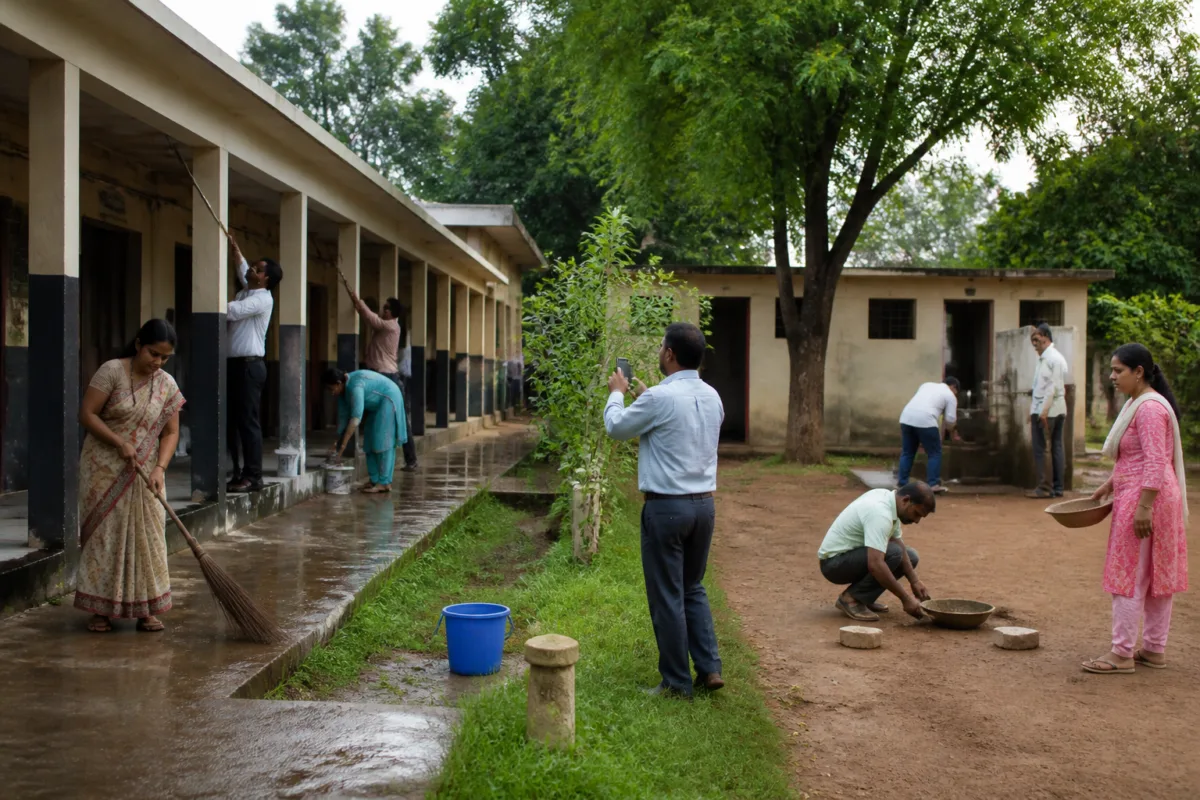
Maharashtra’s school cleanliness drive, scheduled from October 18 to 31, has placed primary teachers under additional administrative and maintenance responsibilities just before the Diwali break, while schools have been told to use existing grants rather than receive separate funding.
The fortnight-long campaign, titled ‘Majhi Shala, Majhi Jawabdari’ or ‘My School, My Responsibility’, has been launched under the broader ‘Chala Shalat Jauya’ initiative. According to a government resolution issued by Tushar Mahajan, Deputy Secretary in the School Education Department, schools must inspect their premises, prepare action plans and complete cleaning, minor repairs and beautification work during the campaign.
The first phase, from October 18 to 24, requires schools to inspect classrooms, laboratories, libraries, computer rooms, drinking water outlets, sports grounds and toilets. Staff must prepare detailed defect lists and action plans based on these inspections.
The second phase, from October 25 to 31, involves deep cleaning, sanitation maintenance, wall painting, beautification and minor structural repairs. Headmasters have been designated as primarily responsible for implementation, while Centre Heads, Block Education Officers and District Education Officers will monitor progress.
Schools have also been instructed to preserve photographic evidence showing conditions before and after the work. The photographs are to be uploaded or archived for official inspection through designated portals, adding a documentation requirement to the physical maintenance work.
The circular does not provide a separate financial allocation for the drive. Schools are expected to use their existing composite school grants under the Samagra Shiksha scheme, and the order prohibits mandatory contributions from students or parents. The arrangement has raised concerns among teachers and headmasters, particularly in rural schools where existing grants are already required for routine expenses such as stationery and electricity.
Teachers cited in the report said the campaign would add to responsibilities that already include online record-keeping, election-related data updates, surveys and non-academic census work. A senior primary teacher from Pune district questioned whether educators could maintain attention on foundational literacy and numeracy while also being assessed on school cleanliness and facility conditions.
Another primary educator said the funding available to rural schools may not be sufficient to purchase cleaning equipment, paint or repair materials. The teacher warned that headmasters could face pressure to spend personal money to meet the campaign’s requirements, although the government order does not authorise mandatory collections from families.
The campaign has therefore placed school heads in the position of coordinating inspections, arranging maintenance, documenting compliance and continuing regular academic work within a fixed two-week window. The current schedule requires the execution phase to be completed by October 31, when monitoring by education authorities is expected to assess the reported work.

