


Maharashtra is preparing to begin the third phase of the Jalyukt Shivar water-conservation programme from December, with a target of making 15,000 villages water-secure over three years, according to a report by Loksatta.
The proposed Jalyukt Shivar 3.0 will cover the financial years 2026-27 to 2028-29. The plan is to take up work in 5,000 villages each year. The stated objectives are to increase water availability, improve groundwater levels and make Maharashtra drought-free. The Chief Minister has directed that implementation be undertaken on a priority basis against the backdrop of drought, the report said.
The programme began in December 2014 under the then Chief Minister Devendra Fadnavis. Its first phase, which ran until 2019, aimed to make around 5,000 villages water-scarcity-free each year by promoting the harvesting and percolation of rainwater within village boundaries.
According to claims cited from the government, work was completed in 22,593 villages during the first phase, covering 632,896 projects. The government also said that 20,544 villages had become fully water-secure, and that the work created water-storage capacity and irrigation potential. Loksatta reported the figures as 2,708,297 TMC of water storage and irrigation potential for 3,904,394 hectares.
The first phase faced allegations of irregularities and misuse, according to the report. It did not provide details of specific cases or independent findings. The second phase, Jalyukt Shivar Abhiyan 2.0, was launched in January 2023 despite those concerns.
The second phase focused on villages that had not previously received watershed or water-conservation works, as well as other villages identified as needing intervention. It also placed emphasis on greater public participation in soil and water-conservation activities and on raising groundwater levels.
More than 5,858 villages have taken up works under the second phase, the report said, while over 110,000 projects have been completed. The Soil and Water Conservation Department has claimed that 80 per cent of the targeted work has been completed.
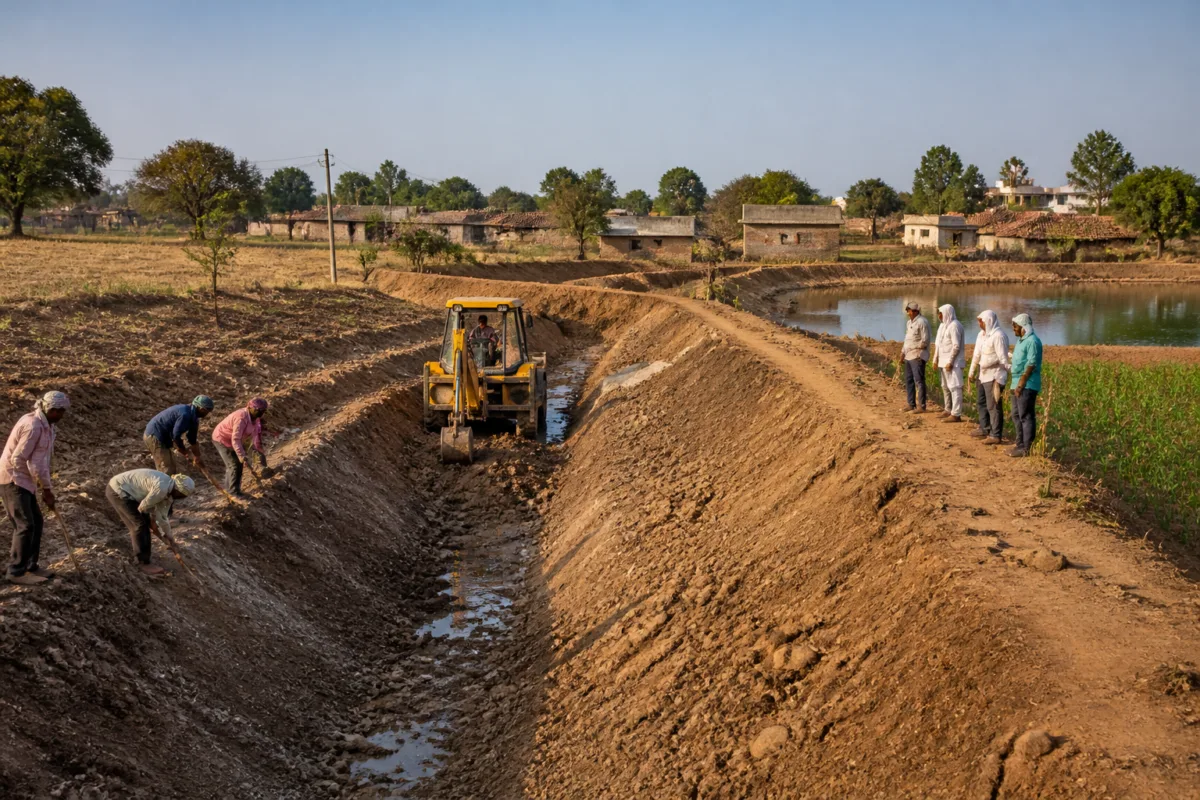
The reported works include deepening and widening drainage channels, constructing cement and earthen bunds, excavating farm ponds, and repairing old or damaged bunds. These interventions are intended to slow surface runoff, improve local water retention and support irrigation, although the report does not provide an independent assessment of their long-term performance.
The third phase will therefore expand a programme whose earlier outcomes remain principally documented through government-reported figures. Its success will depend not only on the number of projects completed, but also on site selection, technical quality, maintenance, public participation and transparent measurement of groundwater and irrigation gains. The report does not specify the final list of villages, the proposed budget or the monitoring framework for Jalyukt Shivar 3.0.

