


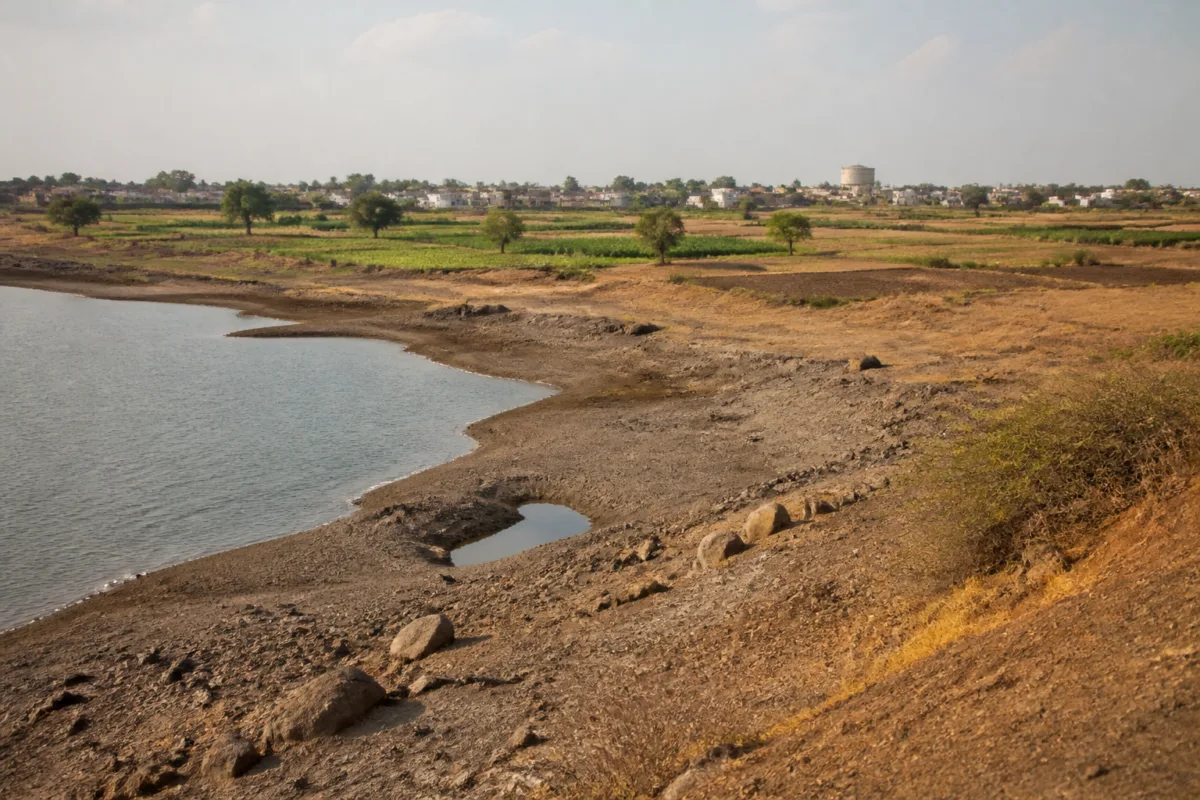
Maharashtra’s monsoon deficit has turned the end of the rainy season into the beginning of a water-management problem. The state received 804.4mm of rainfall between June and September, against a normal 994.5mm, leaving a shortfall of about 19%. With a potentially strong El Niño forecast to persist into February 2027, the pressure could extend from reservoirs and groundwater to rabi crops, food prices and the water planning of Mumbai and its metropolitan region.
The immediate concern is not simply that Maharashtra received less rain than usual. It is that rainfall deficits affect several linked urban and rural systems at the same time. Lower precipitation can reduce soil moisture, groundwater recharge and reservoir inflows. That increases irrigation demand, places greater pressure on drinking-water supplies and narrows the margin available to cities when the next dry period begins.
Nineteen of Maharashtra’s 36 districts recorded deficient rainfall, according to the report. Marathwada was the worst-affected subdivision, with a 39% deficit, followed by Vidarbha at 27%. Konkan performed relatively better, with only one of its seven districts recording deficient rainfall. These regional differences matter because Maharashtra’s water stress is not distributed evenly: the areas facing the greatest crop and groundwater pressure are not necessarily the same areas that have the strongest storage position or the most reliable access to urban infrastructure.
For Mumbai, the monsoon deficit does not translate automatically into an immediate shortage at the tap. The city’s water security depends on the level of live storage in its reservoirs, subsequent inflows and the pace of demand. That distinction is important. Rainfall is an input into the water system, while municipal supply depends on how much of that rainfall is captured, stored, treated and distributed. A weak monsoon therefore raises the risk that authorities will need tighter monitoring and demand management later, but it does not by itself establish that Mumbai will face a supply cut.
The available storage data point to a narrower buffer rather than an immediate collapse. Central Water Commission figures cited in the report show that live storage in 178 monitored reservoirs stood at 78.71% of the corresponding period last year and 87.08% of normal as of October 8. Storage in the western region was at 82.42% of its normal level. These figures describe the position at a particular point in the season; they do not settle how reservoirs will perform through the coming summer. Future inflows, withdrawals and local rainfall will determine how much of that buffer remains available.
The agricultural implications are equally connected to urban conditions. Prolonged dry spells reduce soil moisture and groundwater recharge, increasing farmers’ dependence on irrigation, said Dr G V Ramanjaneyulu, executive director of the Centre for Sustainable Agriculture, as cited in the report. The reported response includes greater attention to short-duration pulses, oilseeds and millets, together with improved soil management. Such changes can reduce water requirements in some circumstances, but the acreage data alone cannot establish final production losses.
The report says rice acreage nationwide as of October 5 was 15.56 lakh hectares lower than in the corresponding period of 2025-26, including a decline of 1.15 lakh hectares in Maharashtra. Sugarcane and cotton acreage also fell, while pulses and oilseeds expanded. This pattern may indicate a shift towards crops requiring less water, but it should not be read as a direct measure of output. Production depends on the crop cycle, yields, irrigation access, soil conditions and subsequent weather.
The national backdrop makes Maharashtra’s situation more consequential. India’s monsoon ended with a 13% deficit, described in the report as the weakest performance in a decade. East and Northeast India received 1,017.1mm against a normal 1,367.3mm, a deficit of 25.6% and the region’s lowest monsoon total since 1901. The South Peninsula received 542mm against a normal 716mm, its fourth-lowest monsoon total since 1901. Karnataka recorded a 30% deficit, Kerala 28%, Andhra Pradesh 25% and Tamil Nadu 20%.
These numbers suggest that Maharashtra is part of a broader national water and agriculture stress pattern rather than an isolated state-level anomaly. The effects will still vary sharply by district. The report cites a 91% shortfall in Ramanagara in Karnataka and a 64% deficit in Thoothukudi in Tamil Nadu, while central and northwest India received near-normal rainfall. National averages can therefore conceal the local conditions that determine whether a village depends on tankers, whether a farmer can plant a second crop or whether an urban water utility can maintain adequate storage.
The next uncertainty is the winter. The report cites an 83% probability of El Niño becoming the strongest such event since 1950 during October-December, with conditions highly likely to persist until February 2027. It also cites an India Meteorological Department forecast of below-normal winter rainfall across most of India and above-average temperatures. These are projections, not established outcomes. Their significance lies in the possibility that a deficient monsoon could be followed by a warmer and drier period, leaving less time for groundwater and reservoirs to recover before summer demand rises.
A warmer winter would also affect the rabi season. Dr K J Ramesh, former director-general of the India Meteorological Department, warned that low groundwater levels and reduced soil moisture could affect rabi and summer crops. Climate scientist Dr Roxy Mathew Koll said global warming raises background temperatures and can intensify the impacts of El Niño. The reported foodgrain production target for 2026-27 is 373.93 million tonnes, 2.63 million tonnes below the estimated output for 2025-26. The target is a planning figure, not proof of a production decline, but it shows that the agricultural outlook is already being assessed against a more difficult climate background.
This is where the water issue becomes an urban governance issue. Municipal administrations, irrigation departments, reservoir managers, agriculture agencies and disaster-management authorities operate through different institutional responsibilities, but they are responding to the same hydrological conditions. Drinking-water security requires storage surveillance and distribution planning. Agriculture requires information on soil moisture, crop suitability and irrigation availability. Heat preparedness requires public-health systems to anticipate higher temperatures. Treating these as separate seasonal problems can obscure their shared dependence on rainfall and groundwater.
The reported call for stronger early-warning systems, heat-action plans and public-health preparedness reflects that connection. For Maharashtra, the immediate administrative priorities identified in the report are to safeguard drinking-water supplies, monitor reservoir levels, support crop choices suited to available soil moisture and prepare for heat. The state’s declared drought status also requires careful interpretation: a Climate Trends analysis says Maharashtra is among five states that have declared drought and claims drought affects 75% of the state, but that specific claim needs to be checked against the relevant government notification before it is treated as established fact.
The central lesson is that the monsoon deficit is not a single-season rainfall story. It is a test of how Maharashtra manages the links between catchments, reservoirs, groundwater, farms, cities and public health. The confirmed figures show reduced rainfall across much of the state, lower monitored storage than normal and pressure on crop conditions. The longer-term severity will depend on the accuracy of the winter and El Niño projections, subsequent inflows, groundwater behaviour and the decisions made by authorities before summer demand peaks.

