


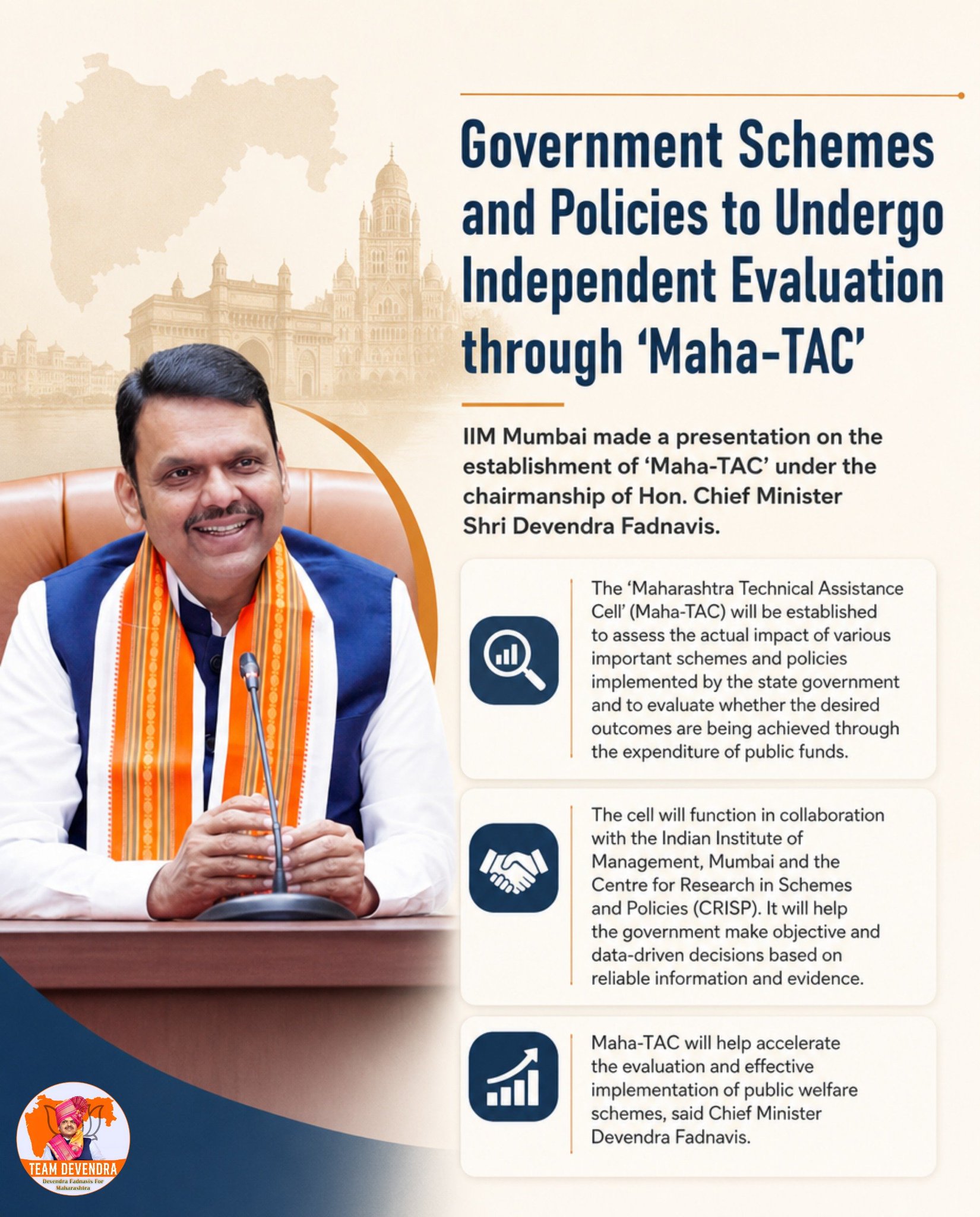
The Maharashtra government has approved the creation of the Maharashtra Technical Assistance Cell, or Maha-TAC, under the Chief Minister’s Office to evaluate 25 major welfare schemes and 25 key government policies, according to a report by Loksatta – Mumbai. The proposed unit will assess whether programmes are reaching intended beneficiaries, whether public funds are being used for their stated purposes and whether implementation problems can be corrected while schemes are still running.
The Cabinet decision was taken at a meeting chaired by Chief Minister Devendra Fadnavis. The schemes listed for evaluation include the Chief Minister Majhi Ladki Bahin scheme, the Punyashlok Ahilyadevi Holkar loan waiver programme, the Pradhan Mantri Awas Yojana, the Mahatma Gandhi National Rural Employment Guarantee Scheme, Jal Jeevan Mission and Ayushman Bharat.
The decision comes against the backdrop of large annual allocations for welfare and development programmes. The report said the state currently does not have a dedicated mechanism to consistently assess whether these schemes are achieving their intended outcomes. Maha-TAC is expected to create a parallel evaluation process during implementation rather than relying only on reviews after funds have been spent.
The proposed cell will work under the supervision of the Chief Minister’s Office. A steering committee headed by the Chief Secretary and involving Maha-TAC is also expected to be established. In addition, 13 committees will be formed to examine government policies, although the report did not provide the individual mandates or membership details of these committees.
The cell’s stated responsibilities include conducting objective assessments of 25 major state policies, consulting government departments, industry representatives, implementing agencies, local self-government institutions and beneficiaries, and proposing campaigns where policy changes are considered necessary. It will also submit progress reports to the Chief Minister’s Office.
For housing, water and employment schemes, the evaluation framework could bring local implementation into closer view because delivery often depends on district administrations, municipal bodies, gram panchayats and other agencies. The government’s stated objectives include checking whether financial assistance reaches the correct person on time and in full, and whether spending produces useful assets rather than infrastructure or facilities that remain underused.
Maha-TAC will also examine whether separate government schemes can be integrated to reduce costs and improve benefits for citizens. The report said the outcomes of schemes will be measured according to United Nations criteria, but it did not specify which indicators or reporting framework will be adopted.
The proposed system therefore combines financial monitoring, implementation review and outcome measurement. Its effectiveness will depend on the details still to be issued, including the cell’s staffing, access to departmental data, evaluation methodology, public reporting process and the authority it will have to require corrective action. The state government’s next steps are expected to include constituting the steering and policy committees and operationalising the quarterly evaluation process.

