


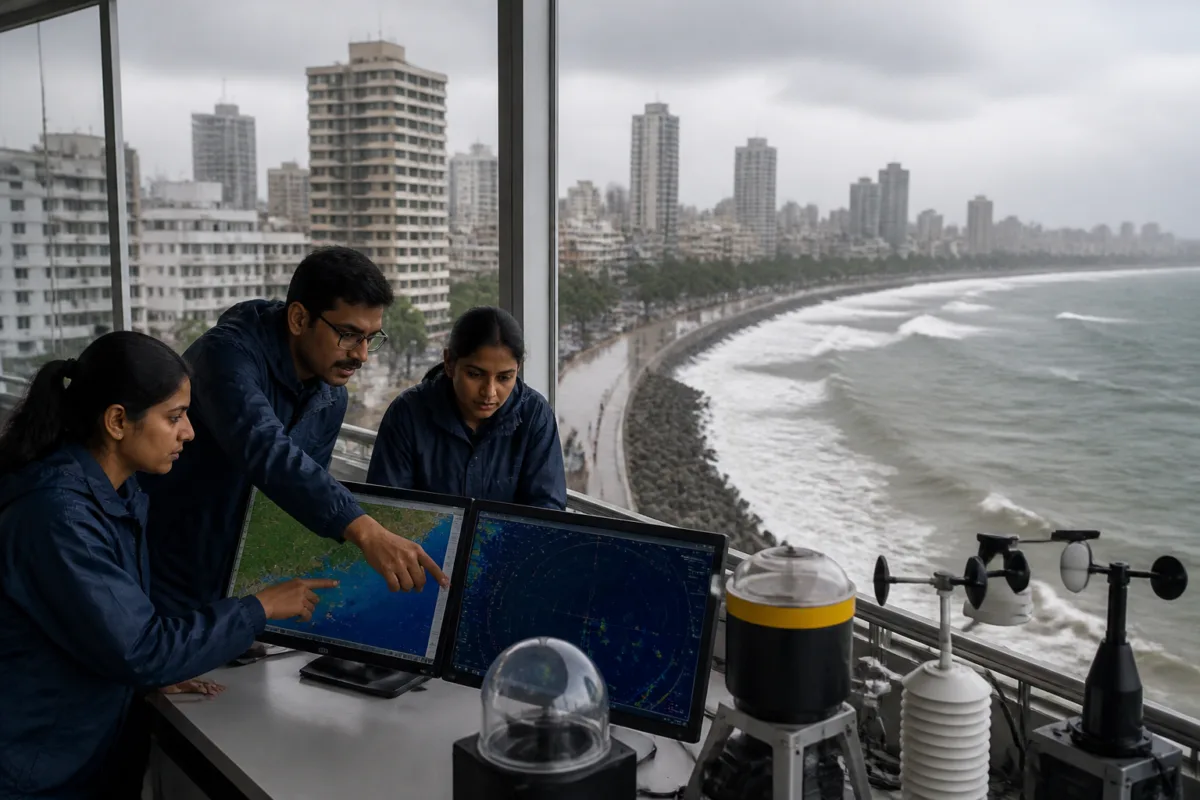
The planned joint research centre between the University of Mumbai and the Indian National Centre for Ocean Information Services (INCOIS) places Maharashtra’s coastal safety challenge within a wider institutional framework: warnings about tsunamis, storm surges, high waves and changing sea levels must be connected to the communities, authorities and infrastructure expected to act on them. The partnership, formalised through a memorandum of understanding signed on Friday, is intended to strengthen early warning systems and disaster preparedness along the state’s 720-km coastline.
The announcement is significant because it links two different kinds of capacity. The University of Mumbai brings academic and research capabilities, while INCOIS, based in Hyderabad, brings expertise in ocean information services. According to the report, the proposed centre will combine these strengths to develop scientific solutions, promote ocean-based technologies and undertake joint research and development projects. The stated objective is not only to improve understanding of marine hazards but also to support response mechanisms and coastal resilience.
That distinction matters. Coastal risk is not created by a single event alone. It is shaped by the interaction between ocean conditions, settlements, transport links, public infrastructure and the ability of institutions to communicate and respond. A warning system can provide information about an approaching hazard, but its public value depends on whether the information reaches exposed communities in time and whether local agencies have an established response mechanism. The supplied report does not specify the centre’s operating structure, funding, implementation schedule or the agencies that would be responsible for converting its research into local action. Those details will determine how far the initiative moves beyond collaboration on paper.
The proposed centre is expected to focus on several hazards with different characteristics. Tsunamis can generate rapid and potentially destructive coastal inundation. Storm surges and high waves can affect shorelines during severe weather, while fluctuations in sea levels create a longer-term planning challenge. Treating these risks as part of a single coastal safety system could help institutions develop a more integrated understanding of exposure and response. However, the MoU announcement, as reported, does not identify specific monitoring technologies, alert thresholds, evacuation protocols or public communication systems.
The partnership’s geographic relevance is also wider than Mumbai. University of Mumbai vice-chancellor Ravindra Kulkarni said the collaboration would particularly benefit coastal communities in Mumbai, Palghar, Ratnagiri and Vengurla. These locations represent different coastal settings and communities, but the report does not provide a district-wise assessment of risk or explain how research activities will be distributed among them. The reference to these areas nevertheless signals that the initiative is intended to serve a network of coastal communities rather than remain confined to a university campus or a single city.
For Mumbai, the announcement brings the city’s coastal exposure into focus without reducing the issue to a single infrastructure project. Mumbai is one of the communities identified as a beneficiary of stronger disaster preparedness, but the proposed centre is framed as a Maharashtra-wide initiative. Its work is expected to address coastal protection, marine research, sustainable marine resource management and the sustainable use of ocean resources. This places urban safety alongside environmental management and marine economic activity, rather than treating them as separate policy areas.
The institutional arrangement also reflects the growing importance of applied research in urban and regional governance. Universities can generate local knowledge, train researchers and examine the social and environmental dimensions of risk. A specialised ocean information institution can contribute technical expertise and data services. The proposed research centre is intended to bring these capacities together. The central test will be whether the relationship produces usable information for public agencies, marine industries and communities, rather than only research outputs.
The report describes the initiative as a way to strengthen early warning systems and disaster preparedness, but it does not establish what the existing gaps are. There is no information in the supplied material on current warning coverage, the number of communities to be served, the frequency of alerts, the availability of evacuation infrastructure or the response capacity of local administrations. Without such a baseline, it will be difficult to measure whether the centre has improved coastal safety. Future disclosures about its objectives and performance indicators will therefore be important.
The same issue applies to the phrase “coastal resilience”. The partnership is expected to develop effective measures to address emerging environmental challenges and contribute to coastal protection. Yet resilience can involve several distinct activities: hazard monitoring, public communication, land-use planning, protection of essential services, emergency response and recovery. The supplied report confirms the broad ambition but does not specify which of these functions the centre will directly undertake and which will remain with government departments, disaster management authorities or local bodies.
This division of responsibility is particularly important because ocean information is only one part of disaster governance. INCOIS may provide scientific services and technical knowledge, while the university may support research and development. Implementation, however, would require coordination with the institutions that manage settlements, roads, utilities, public health, emergency services and coastal regulation. The report does not name these agencies or set out a formal coordination mechanism. That omission does not negate the value of the MoU, but it leaves the administrative pathway from research to public protection unresolved.
The partnership also has an economic dimension. The two institutions aim to support marine industries and the sustainable use of ocean resources, and the initiative is expected to create new opportunities in marine science and technology in Maharashtra. The report connects this to India’s Blue Economy, but it does not specify the industries, technologies or employment pathways involved. The centre’s eventual contribution will depend on whether its research can be used by public institutions and marine-sector users while maintaining the stated focus on sustainable resource management.
For coastal communities, the practical question is whether better science will result in clearer and earlier action. A warning that cannot be understood, accessed or acted upon has limited protective value. The supplied account identifies disaster preparedness and response mechanisms as central aims, but it provides no details on community engagement, local-language communication, drills or last-mile delivery. Those questions are especially relevant because the proposed beneficiaries include communities across several coastal districts with differing local conditions.
The MoU therefore represents an important institutional starting point, not a completed coastal safety system. It establishes a formal relationship between a major university and a specialised national ocean information institution. It identifies the hazards the centre will address, names coastal communities expected to benefit and connects research with coastal protection, marine technology and sustainable resource use. It does not yet establish a timeline for the centre, define its funding, identify its facilities or set out measurable outcomes.
The next stage will show whether the collaboration can build a durable link between scientific capability and administrative action. Details about the centre’s mandate, projects, warning services, partner agencies and community interface will be necessary to assess its impact. For now, the evidence confirms a clear institutional commitment to strengthen Maharashtra’s coastal safety, while leaving implementation mechanisms and measurable results to be established.

