


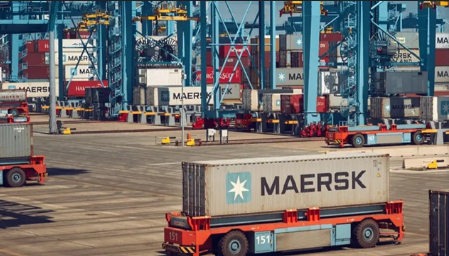
Maersk, the world’s preeminent container shipping firm, has embarked on a pioneering venture into China’s inland waterways, marking a significant expansion of its logistics capabilities. This move aims to offer Chinese clients a more integrated, efficient, and environmentally sustainable logistics solution, thereby bolstering their global business potential.
The initiative was unveiled at a recent launch ceremony for the CCA (Connecting Carrier Agreement) service at Huai’an Port, located in Jiangsu province, East China. This development represents the first instance of Maersk initiating such a service within China’s inland waterway network. The general manager for Maersk Line Greater China’s multimodal transport division highlighted that the new service was conceived in response to growing local logistics demands. It was established following a strategic cooperation agreement between Maersk Line, Shanghai International Port (Group) Co Ltd, and Huai’an Port, formalised earlier this year.
This year is notable for Maersk as it marks a century of its operations supporting China’s trade. The introduction of this inland service is seen as a pivotal step in Maersk’s strategy to enhance river-sea intermodal transport options within China, providing a new avenue for efficient global trade. The Shanghai International Port (Group) Co Ltd’s production business manager noted that this service lays a robust groundwork for Huai’an Port’s future ambitions in international shipping. It enables foreign trade businesses in and around Huai’an to leverage Maersk Line’s global network for container Customs clearance and shipments, thus streamlining their access to international markets.
A spokesperson from the port, underscored the benefits of the new service, including reduced transshipment times and procedures, along with leveraging the low energy consumption, minimal pollution, and high capacity inherent in river-sea intermodal transport. Huai’an Traffic Holding Co Ltd’s general manager also highlighted the strategic importance of this partnership. He emphasised that collaboration with global ports and shipping giants has accelerated Huai’an Port’s development, positioning it as a potential national inland waterway shipping hub. Recent figures underscore this growth, with the port’s container throughput reaching 312,500 TEUs in the first seven months of the year—a 10.04 per cent increase—of which 60,800 TEUs were foreign trade containers, marking a remarkable 105.06 per cent surge compared to the previous year.
Maersk’s entry into inland shipping not only underscores its commitment to expanding its logistics network but also signals a transformative shift in how inland and international shipping can be seamlessly integrated to meet evolving market demands.
