


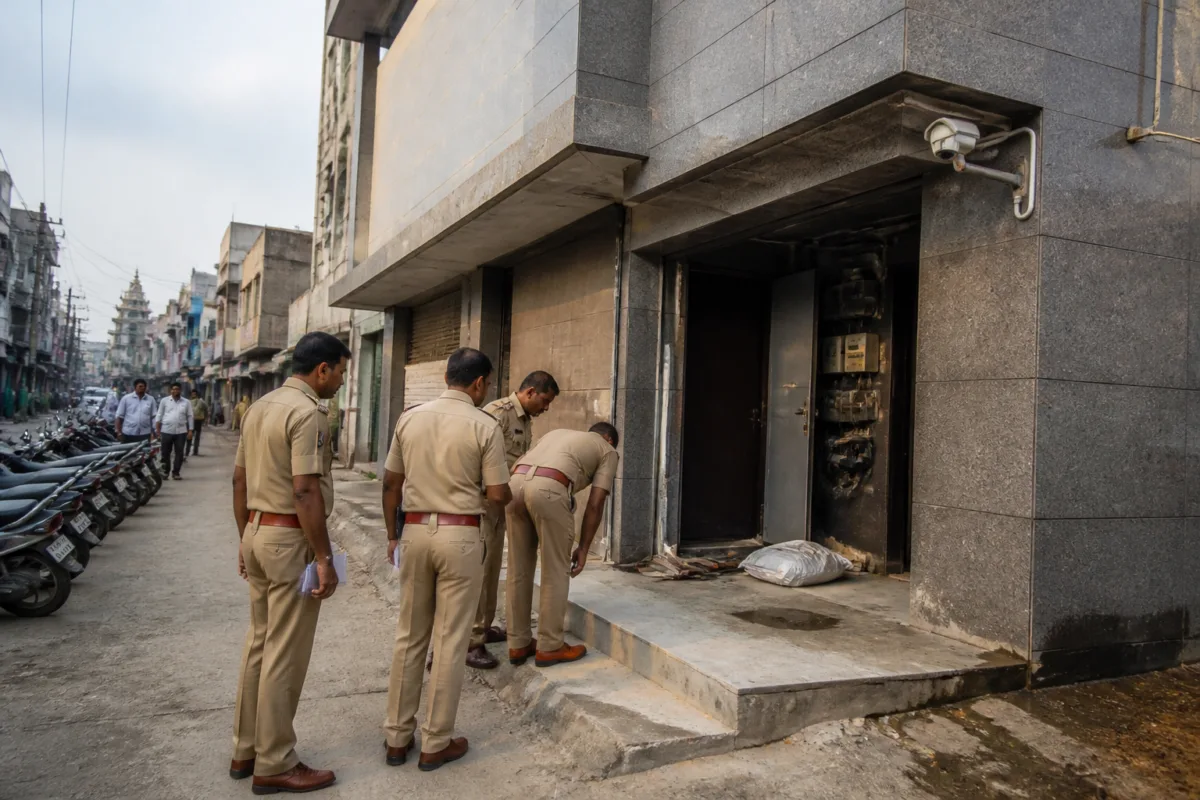
Police have recovered all 11.384 kg of gold jewellery allegedly stolen from a Tanishq jewellery store in Madurai and arrested three people, including Nishanth, whom investigators identified through a tattoo on his hand, Madurai Police Commissioner Rajendran said in a briefing reported by Dinamalar.
According to the commissioner, the jewellery was recovered from locations identified during the investigation. The police said Nishanth did not leave Madurai immediately after the robbery and left the city only after officers arrived at the residence of Meenakshi. Nine special teams were formed to investigate the case, leading to the arrests of Nishanth, Meenakshi and Suresh.
Rajendran said the investigation indicated that debt pressure was the reason behind Nishanth’s alleged decision to rob the jewellery store. Police are also examining whether anyone inside the Tanishq store assisted him, making a possible internal link one of the continuing lines of inquiry. The commissioner did not disclose that the investigation had established such assistance.
The briefing also highlighted how investigators combined physical identification with phone records. Nishanth was recognised through a tattoo on his hand, while conversations from his phone helped police trace and arrest Meenakshi, described in the report as a YouTuber. The commissioner said the complete sequence of events would become clear only after custodial questioning.
Police said the jewellery was recovered from places indicated by Meenakshi during the investigation. However, Rajendran clarified that no jewellery had been recovered directly from her possession. That distinction remains relevant as investigators determine the alleged roles of the three arrested people and establish how the stolen property was moved and concealed.
The commissioner’s comments also identified a physical security gap at the commercial premises. There was no CCTV camera at the rear of the Tanishq store, he said, while recommending surveillance coverage around the entire building. The observation places the case within a wider operational question for urban retail security: whether cameras cover only customer-facing entrances or also less visible service areas, rear access points and surrounding approaches.
For commercial establishments, camera placement is not simply a matter of installing equipment inside a shop. Coverage of the building perimeter, recording continuity and access to footage can affect how quickly police reconstruct movement after an incident. In this case, the reported absence of a rear camera has become part of the police commissioner’s public account of the investigation, although the briefing did not state that the gap directly enabled the robbery.
The arrests and recovery announced by the police mark the current operational outcome of the case. The investigation is continuing into the alleged motive, the roles of Nishanth, Meenakshi and Suresh, and whether any person connected to the store helped facilitate the robbery. Police are also expected to examine the store’s surveillance arrangements, including the need for CCTV coverage around its full perimeter.

