


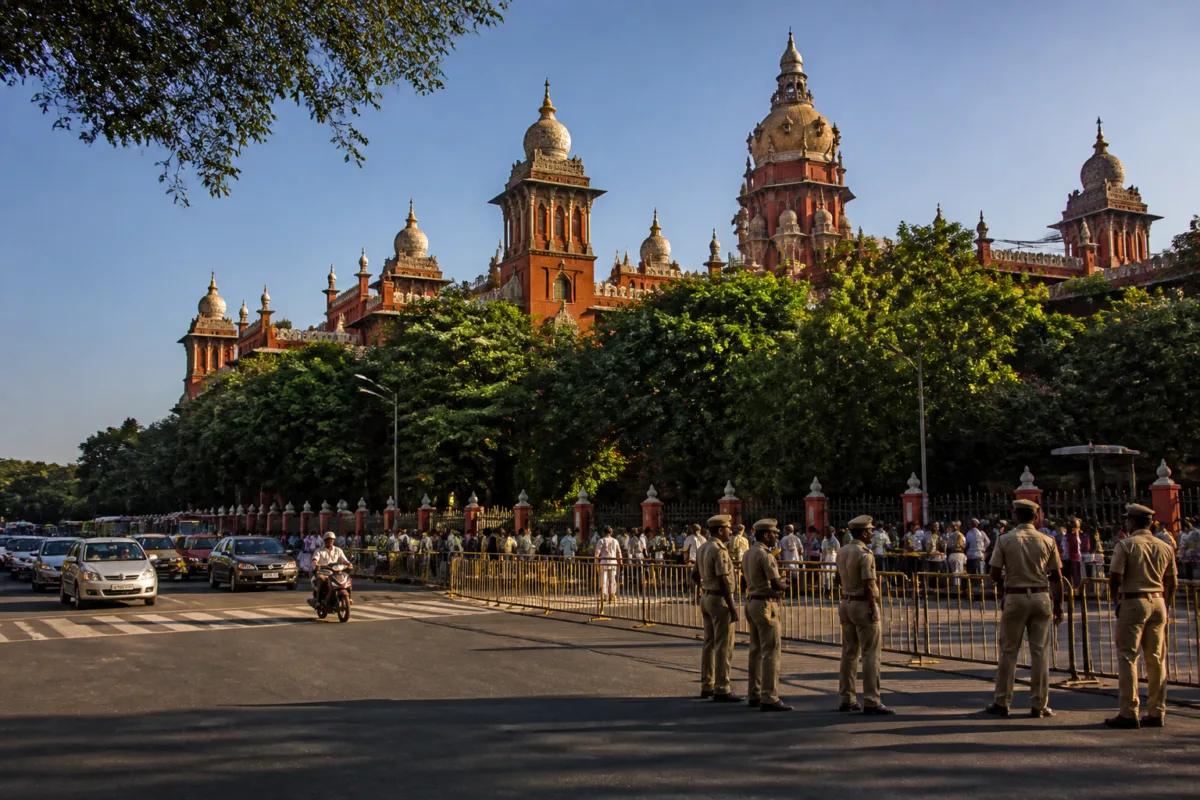
The Madras High Court has directed Tamil Nadu Police to process applications for RSS route marches fairly and avoid rejecting them by applying rigid or repetitive standards, while recording that marches scheduled for October 25 and November 1 may proceed subject to modifications based on local conditions.
Justice V Lakshminarayanan said the police should not behave like Procrustes, a reference to the practice of forcing different situations into one inflexible framework. The court’s observations came while considering applications related to permission for the marches.
“They should not search the applications (seeking permission for RSS route march) for its rejection by placing it on the same bed as they have done all these years,” the judge said, according to the report. He added that an attempt should be made to process and approve the applications rather than look for defects that could support their rejection.
The court noted that guidelines had been framed for the issue following interventions by both the High Court and the Supreme Court. Justice Lakshminarayanan said the same guidelines appeared to be used for rejecting applications instead of facilitating their consideration.
“It is a classic case of using the scalpel not for the purpose of operation, but to kill the patient on whom the operation is said to be performed,” the court observed. The judge also said the police had not offered novel reasons for rejecting applications, but had consistently relied on reasons that the court had previously found to be inadequate.
The Advocate General submitted that the processions scheduled for October 25 and November 1 could go ahead, subject to modifications suggested by police authorities in the districts according to local conditions. The court recorded those submissions while addressing the applications.
The organisers were directed to file an affidavit stating that they would strictly comply with the conditions imposed by the police. The requirement places responsibility on the organisers to follow the conditions governing the marches, while leaving district police authorities with a role in adjusting arrangements to local circumstances.
The court’s observations also concern how administrative guidelines are applied to public use of roads and other shared urban spaces. Permission for processions typically involves decisions about routes, traffic movement, public order and local conditions. In this case, the court stressed that guidelines should support a reasoned decision-making process rather than become a uniform basis for rejection.
The court referred to the hope expressed by the Supreme Court in 2023 and reiterated by the High Court when framing guidelines and disposing of the earlier writ petition. Justice Lakshminarayanan said that hope had been rekindled and expressed the expectation that the police would not reject RSS applications in a manner that forced organisers to return to court.
The immediate next steps are the filing of the organisers’ affidavit and the implementation of any district-level modifications to the scheduled marches. The report does not specify the final routes or the individual conditions proposed by police authorities in each district.

