


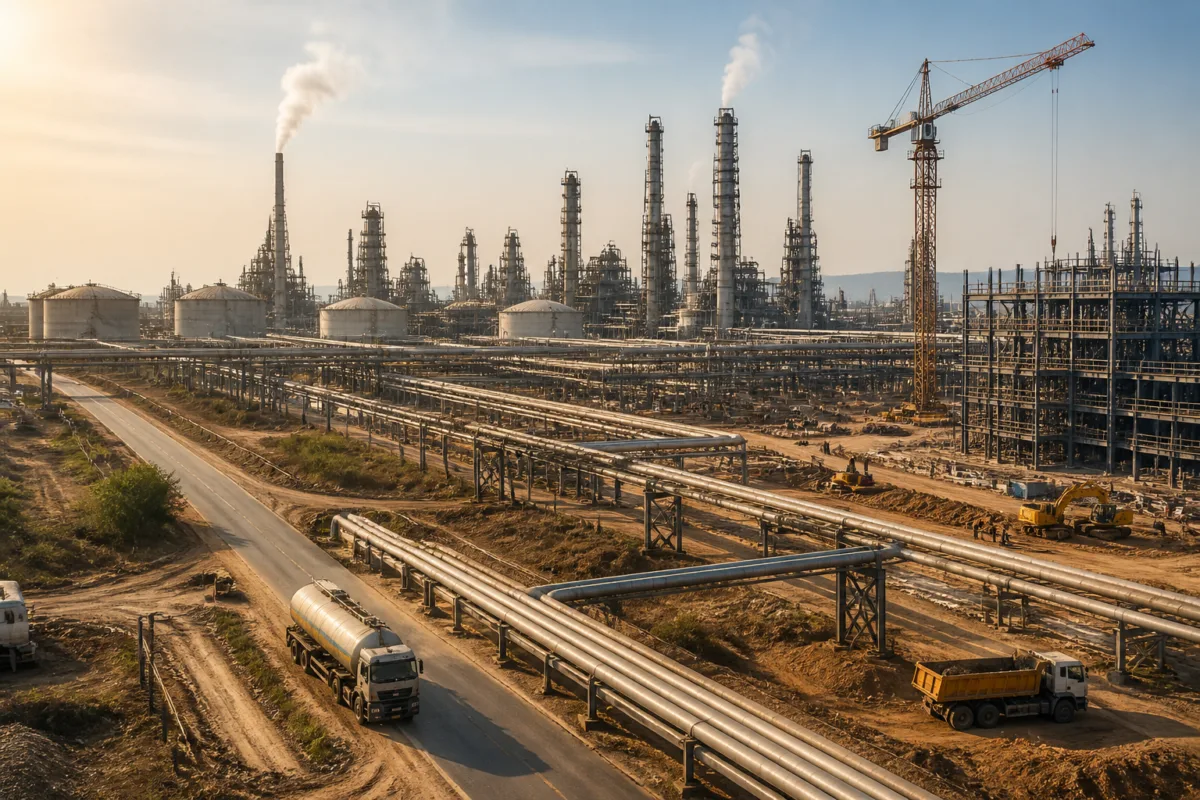
Madhya Pradesh’s pitch to become a petrochemical hub is built around a large industrial bet: the Rs 49,000-crore BPCL ethylene cracker and refinery expansion project at Bina. The state government says the project could produce more than 22 lakh tonnes of petrochemical products a year and create opportunities for polymer processing, packaging, pharmaceuticals and automobile-related manufacturing. The harder question is how effectively that upstream capacity can be converted into a wider industrial network rather than remaining a single major project.
Chief minister Mohan Yadav made the pitch at India Chem 2026 in Mumbai, inviting domestic and global companies to establish manufacturing units in the state. He specifically urged companies including Indian Oil, Reliance and Haldia Petrochemicals to examine polymer processing and distribution opportunities around Bina. Agrochemical manufacturers UPL, PI Industries, Dhanuka and Syngenta were invited to consider Madhya Pradesh as a manufacturing base rather than only a market.
That emphasis is significant because petrochemical capacity by itself does not create a complete industrial ecosystem. The value of an ethylene cracker is realised through downstream units that convert chemical inputs into packaging, auto components, consumer products, pharmaceuticals and other manufactured goods. The state’s stated strategy is therefore not limited to attracting one refinery-linked investment. It is an attempt to position Bina and other industrial locations as nodes in a larger production and distribution chain.
The project’s scale gives the strategy its weight. According to the report, the Bina facility is expected to produce over 22 lakh tonnes of petrochemical products annually. The source does not specify the complete product mix, the project’s construction schedule, the number of jobs expected or the infrastructure spending required beyond the investment figure. Those details will matter in assessing how much of the proposed downstream activity can be supported locally and how quickly.
Yadav said Madhya Pradesh was developing polymer-processing clusters so that micro, small and medium enterprises could benefit from large petrochemical investments. This is an important institutional claim. Large industrial projects often generate their broadest economic impact through supplier networks, processing units, transport operators and specialised service providers rather than through the anchor facility alone. The proposed clusters are intended to provide a formal bridge between major petrochemical production and smaller firms.
The state highlighted two plastic parks as part of that proposition. The park at Tamot in Raisen covers 121 acres, while the facility at Bilaua in Gwalior covers 93 acres. The report does not establish their present occupancy, operating capacity, tenant profile or connectivity. Without that information, the parks demonstrate the availability of planned industrial space but not yet the full extent of the downstream ecosystem they can support.
This distinction between planned capacity and functioning capacity is central to the state’s investment pitch. Industrial land, incentives and simplified approvals can attract proposals, but manufacturers also require reliable utilities, transport links, skilled labour, finance and predictable clearances. The chief minister said the state was ready to provide necessary facilities, support and security, and highlighted simplified investment procedures and industry-friendly policies. The practical test will be whether those assurances translate into operational units and sustained production.
Madhya Pradesh is presenting more than Bina as part of the industrial geography. Yadav cited the potential of Nagda, Vijaypur and Ashta, along with the PM MITRA textile park in Dhar. He said existing infrastructure could support investments in chemicals, polymers and gas-based industries. The source does not provide a detailed map of the infrastructure connecting these locations, nor does it identify the specific utilities, freight systems or processing facilities available at each site. That makes the state’s broader cluster strategy an announced direction rather than a fully documented network.
The governance structure behind the pitch combines state-level facilitation with central-sector support. The chief minister was speaking at an event organised by the Union chemicals and petrochemicals department in partnership with FICCI. Union chemicals and fertilisers minister JP Nadda said the Centre would provide Rs 1,000 crore in assistance for each proposed mega chemical park. He also cited a Rs 1 lakh crore provision for research and development in advanced chemicals and petrochemicals.
These commitments indicate that the proposed expansion is being framed as both an investment and an industrial-policy programme. The state is seeking companies and downstream manufacturing, while the Centre is presenting financial assistance and research support as part of a larger effort to expand India’s chemicals and petrochemicals sector. Nadda said the industry was valued at $220 billion and that the Centre was targeting $1 trillion by 2040. The figures were presented at the event and were not accompanied in the supplied report by a methodology, baseline year or sectoral breakdown.
The investment claims also require careful interpretation. Yadav said Madhya Pradesh had received proposals worth more than Rs 34 lakh crore over nearly three years, of which projects worth over Rs 12 lakh crore had materialised. The report does not define “materialised”, whether the figure refers to commissioned projects, projects under construction, financial closure or another administrative category. That distinction is important because investment proposals and operating assets represent different stages of industrial development.
For urban and regional planning, the proposed hub raises questions about how industrial growth will be distributed. Bina, Raisen, Gwalior, Nagda, Vijaypur, Ashta and Dhar are not simply sites on an investment map. New manufacturing activity can increase demand for worker housing, roads, freight movement, water supply, power, waste management and local public services. The supplied material does not quantify these requirements or state which authority will finance and manage them. But the geography of the announcement makes clear that the investment strategy would extend beyond a single industrial plot.
The environmental and safety dimensions are also part of the infrastructure question, even though the report does not provide project-level environmental assessments or compliance details. Petrochemical and chemical manufacturing requires systems for handling industrial waste, emissions, hazardous materials and emergency response. The source does not establish what safeguards have been approved or proposed for the Bina project, the plastic parks or the other locations mentioned. Those documents will be necessary to evaluate the claims of sustainable and secure industrial expansion when they become available.
The state’s invitation to global companies such as BASF, Dow, Arkema and Mitsubishi Chemical shows the intended scale of participation. It also suggests that Madhya Pradesh is competing for investment not merely by offering land, but by presenting a complete value proposition around feedstock, processing, distribution and public support. Whether the companies named in the pitch commit to projects is not established in the supplied report.
The next milestone identified by the state is the Global Investors Summit in 2027, where Yadav invited industry leaders and international investors to participate. India Chem 2026 will continue until October 24, with Madhya Pradesh among eight state partners at the three-day event. These events may generate further proposals, but the more meaningful indicators will be project approvals, construction progress, commissioned capacity, industrial-park occupancy and the arrival of downstream manufacturers.
Madhya Pradesh has therefore presented a coherent industrial ambition centred on petrochemicals, but the evidence currently available describes an investment pitch rather than a completed hub. The Bina project provides the anchor, while plastic parks, polymer clusters, incentives and central assistance are intended to build the wider network. The delivery test will be whether these announced components become connected, operating infrastructure that creates durable manufacturing capacity across the state.

