


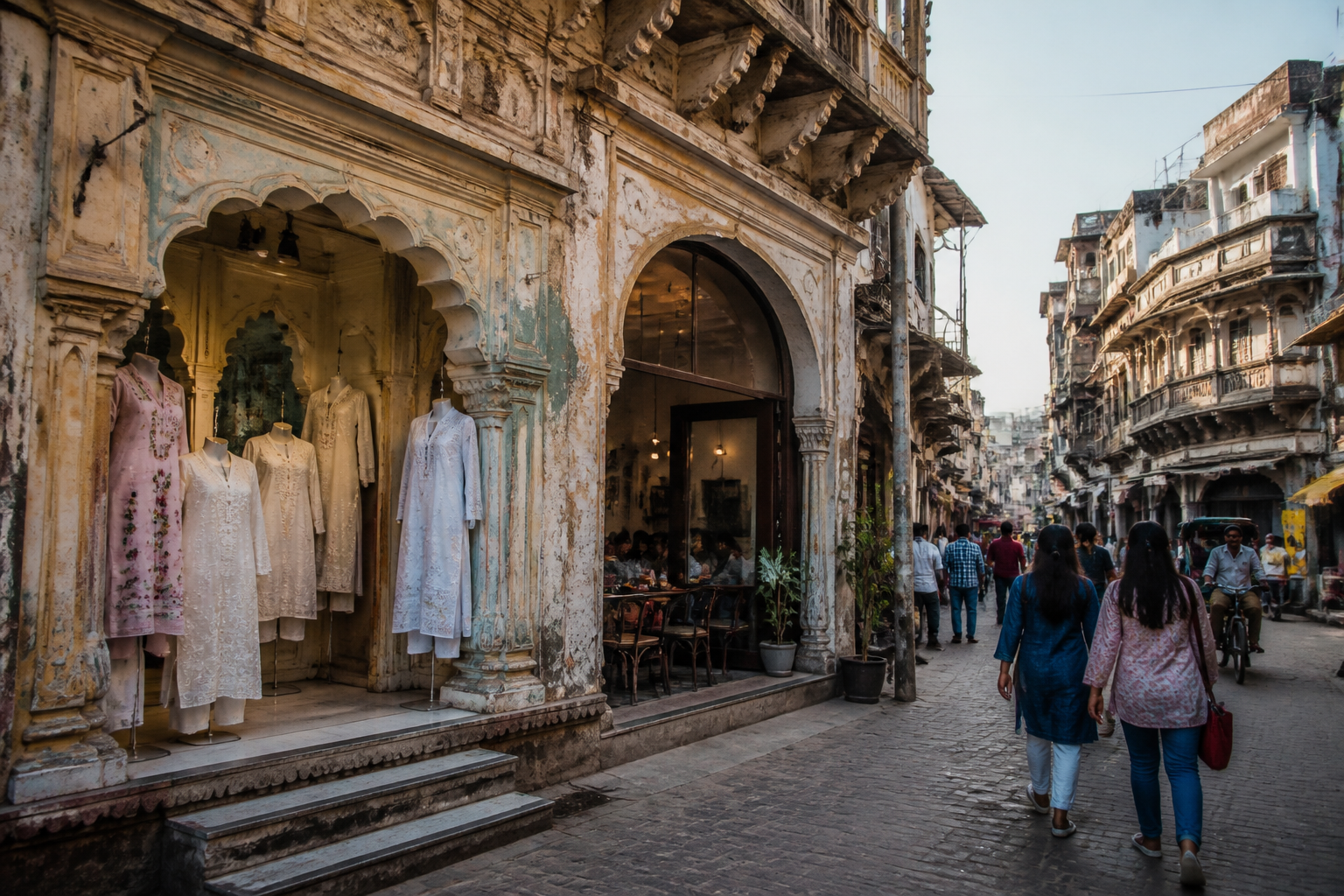
Lucknow heritage is no longer confined to monuments, museums or formal histories. It is being carried into clothing, food businesses, creative workspaces, cafés and the everyday choices of a younger generation. That shift reveals how a city can retain its identity not by freezing its past, but by allowing inherited cultural practices to move through new urban settings.
The change is visible across Lucknow’s contrasting spaces. In the older city, Chowk remains associated with food, traditional buildings and the rhythms of established neighbourhood commerce. Hazratganj and Aminabad retain their own forms of urban charm, while Gomti Nagar represents a newer Lucknow of start-ups, restaurants, malls, media studios, universities and professional workplaces. These places do not describe one uniform city. Together, they show a city negotiating between inherited form and contemporary use.
That negotiation is central to Lucknow’s urban story. The city’s history stretches across several political and cultural phases, including the ancient Kosala region, the Delhi Sultanate, the Sharqi rulers, the Mughals, the Nawabs of Awadh, the East India Company and the British Raj. When the Nawabs made Lucknow their capital in the 18th century, the city attracted poets, musicians, dancers, artisans, architects, chefs and scholars. The built environment that emerged during this period included the Bara Imambara, Rumi Darwaza, Chhota Imambara, Chattar Manzil and Kaiserbagh.
These landmarks are often treated as separate heritage objects. But the broader significance of Lucknow’s history lies in the way cultural practices entered daily life. The city’s legacy was expressed through speech, dress, hospitality, food, craft and social behaviour, not only through monumental architecture. That is why the idea of tehzeeb remains important to the city’s identity. It describes a social style built around courtesy, wit and making space for another person, rather than simply a ceremonial phrase associated with the Nawabi past.
The same history also contains conflict and disruption. The annexation of Awadh in 1856 and the uprising of 1857 transformed Lucknow. The Residency, Begum Kothi and Sikandar Bagh remain associated with violence, resistance and political upheaval. The city later became an important centre of the freedom movement and hosted the Lucknow Pact in 1916. Its heritage, therefore, is not a single celebratory narrative. It includes royal patronage, colonial intervention, resistance, political change and the ordinary practices that survived those transitions.
What distinguishes the present moment is the movement of heritage into new formats. Chikankari offers the clearest example. Once strongly associated with pastel kurtas and summer clothing, the craft is now described in the supplied account across denim jackets, gowns, skirts, coats, blazers, tuxedo shirts, wide-leg trousers and Indo-western menswear. Designers are experimenting with brighter colours and sharper silhouettes. The craft is consequently being positioned for college wardrobes, workplaces, travel and formal occasions, rather than one limited category of traditional dress.
This is more than a change in fashion. It changes the relationship between craft and the city. A craft survives in a meaningful urban sense when it remains connected to work, markets, design and everyday consumption. The shift from a conventional chikankari kurta to contemporary garments does not by itself establish the financial condition of artisans or the fairness of the value chain. The supplied material provides no figures on artisan incomes, employment, exports or market size. It does, however, show how design adaptation can keep an inherited practice visible in spaces where younger consumers and new businesses operate.
The story also points to a wider question about who gets to shape heritage. Traditional motifs appearing in contemporary clothing can make cultural forms more accessible to new audiences. At the same time, the continued importance of the craft depends on the people who produce it, the patience involved in its making and the systems through which it reaches designers and consumers. Without evidence on those institutional and commercial relationships, it would be premature to describe the transformation as either a complete revival or an assured economic success.
Food provides another route through which Lucknow’s identity is being carried forward. The city’s culinary culture combines royal associations with neighbourhood food, family recipes, street snacks and newer kitchens. Kebabs and rich gravies exist alongside kachoris and other everyday foods. This distinction matters because a city’s gastronomic identity is not sustained only by elite or heritage restaurants. It also depends on ordinary food practices, local reputations and the ability of recipes to move through changing forms of service.
The supplied account notes that UNESCO named Lucknow a Creative City of Gastronomy in 2025 and inducted it into the UNESCO Creative Cities Network. It attributes the recognition to the city’s Awadhi food traditions, its culinary ecosystem and continuing efforts to preserve and reinvent its gastronomic culture. The designation gives formal international recognition to something residents already experience informally: food is part of the city’s social identity and public image.
Yet recognition is not the same as preservation. A designation can strengthen visibility, but the material supplied does not establish what programmes, funding arrangements, administrative responsibilities or measurable outcomes followed the UNESCO recognition. It does not state whether the designation changed conditions for food workers, small restaurants, street vendors or producers. Those questions remain important because gastronomy is an urban economy as well as a cultural symbol.
Lucknow’s built environment provides the setting in which these changes become visible. The old city’s lanes, historic buildings and established markets carry one layer of the city’s identity. Newer areas, especially Gomti Nagar, represent another layer shaped by professional work, modern retail, start-ups and contemporary hospitality. The coexistence of these spaces creates a city where heritage is not located in one enclosed district. It appears in clothing, restaurants, homes, studios, cafés and digital media as well.
That does not mean every adaptation automatically protects the physical city. The source describes old havelis becoming studios or cafés, but it does not provide details about restoration standards, ownership, permissions, structural safety or the effect of such conversions on residents. These are the administrative mechanics that determine whether adaptive reuse supports heritage or merely uses its appearance. The evidence supports the observation that older spaces are acquiring new uses; it does not support a conclusion about whether those changes are well regulated or broadly beneficial.
The younger generation described in the account is also significant. Young Lucknowites are presented as combining chikankari with sneakers, creating content at heritage sites, turning family businesses into contemporary brands and returning after studying or working elsewhere to build new ventures. For them, heritage can function as a design language, a business idea and a source of cultural confidence. This differs from a preservation model in which the past is maintained mainly through formal institutions and tourist viewing.
The urban implication is that identity can become an active resource without becoming a static brand. Lucknow’s past is being used in different ways: as a visual reference for fashion, a foundation for food businesses, a setting for digital content and a source of legitimacy for new enterprises. The same process can broaden public engagement with heritage because it places historical forms in ordinary settings. It can also simplify a complex history if only the most marketable images survive.
The city’s challenge, therefore, is not simply to preserve monuments or promote a distinctive image. It is to hold together several forms of continuity: the physical survival of historic places, the viability of traditional work, the integrity of food and craft practices, and the ability of residents to adapt them without losing their meaning. The supplied material shows strong cultural continuity, but it does not provide enough evidence to measure the distribution of benefits or the pressures created by urban change.
Lucknow’s transformation is best understood as an interaction between heritage and contemporary city-making. Lakshman Tila belongs to the city’s sacred imagination, the Nawabi period to its cultural memory, and Gomti Nagar to its newer entrepreneurial present. These layers do not exist independently. They meet in markets, homes, restaurants, workplaces and digital spaces. What the evidence confirms is a city that continues to carry its past into new forms. What remains to be established is whether the institutions, workers and neighbourhoods that sustain that inheritance are receiving the protection and economic support required for the transition to last.

