


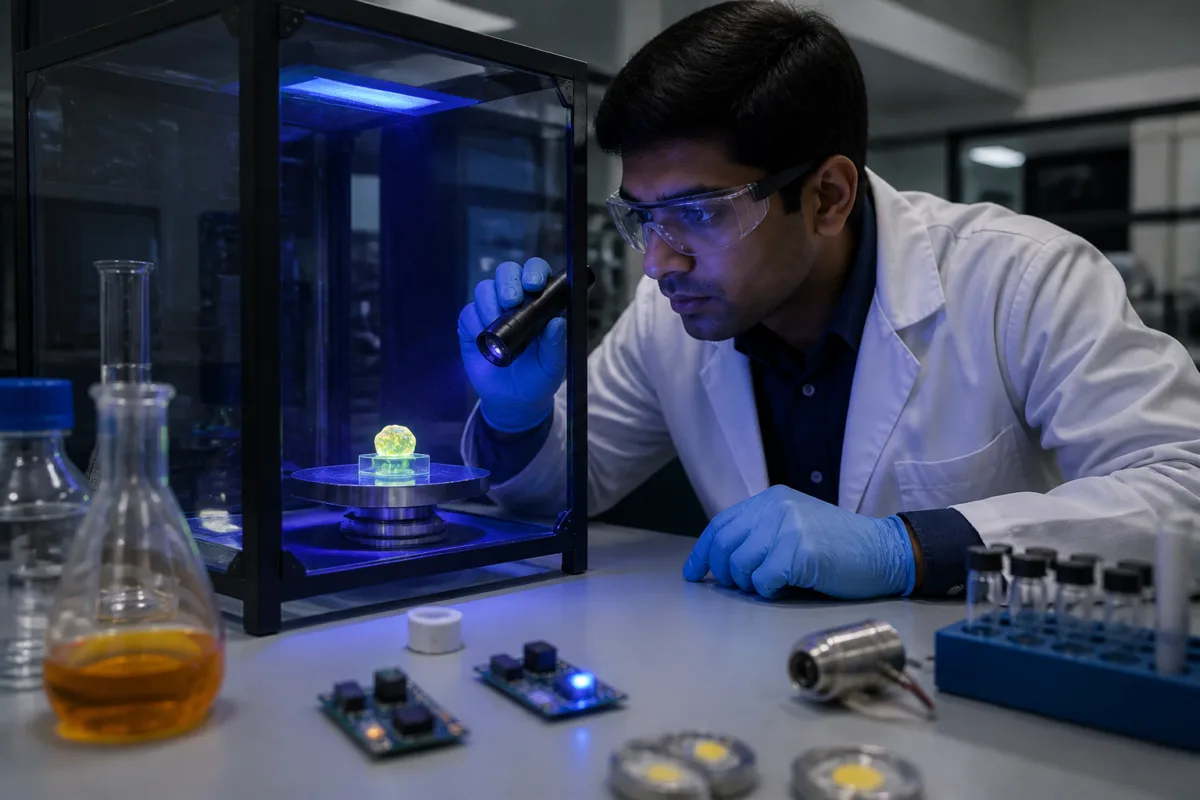
A research team led by the National Institute of Technology, Rourkela has developed a lead-free bismuth-based material that changes its light emission when exposed to heat, moisture and ultraviolet light. The work could support safer anti-counterfeiting systems, humidity sensors and lighting technologies, although the material is still at the research and development stage.
The team includes scientists from NIT Rourkela, IIT Guwahati, IIT Bombay and NISER Bhubaneswar. According to an NIT Rourkela press release issued on Wednesday, the researchers developed organic-inorganic bismuth compounds that emit different colours under ultraviolet exposure and undergo a reversible structural change when surrounding conditions change.
That combination is significant because it places a material response at the intersection of two challenges faced by modern infrastructure: the need for inexpensive, responsive sensing and the environmental risks associated with some conventional materials. The reported applications are not limited to laboratory demonstrations. The team identified possible uses in document security, food packaging and storage, humidity monitoring and light-emitting devices. However, the release also makes clear that efficiency, stability, sensor reliability and white-light performance still need improvement before practical applications can be developed.
The central feature of the material is its response to water trapped within its structure. When heated, the material loses that water and emits blue light under ultraviolet light. When moisture returns, it absorbs water again and the blue emission disappears. The process can be reversed by changing the surrounding conditions, the researchers said.
This behaviour gives the compound a built-in visual signal. Instead of merely detecting heat or humidity through an electronic readout, the material itself changes its optical response. Under controlled conditions, that could make it possible to inspect whether a particular environmental condition has occurred. The research does not establish that the material is ready for commercial deployment, but it demonstrates a mechanism that could be adapted for sensing and verification systems.
The research also addresses the material-safety problem surrounding lead-based photoluminescent compounds. Lead-based materials have been widely studied for their light-emission properties, but the NIT Rourkela release said concerns about lead toxicity create environmental and health risks. The bismuth-based compounds were investigated as an alternative that retains useful light-emitting characteristics without relying on lead.
The substitution is important in applications where materials may be handled repeatedly, incorporated into products or discarded after use. In cities, those questions are linked to the full life cycle of technologies: how materials are manufactured, how safely they are used in public and commercial systems, and what happens when products reach the end of their service life. The supplied research does not provide a life-cycle assessment or compare the complete environmental footprint of the bismuth compounds with competing materials. Its contribution is narrower but meaningful: it reports a lead-free route to responsive light emission.
The chemistry also matters for the possibility of scaling. The team said the bismuth-based organic-inorganic hybrid halide compound was synthesised using cheaper and environmentally friendly constituents through a simple synthesis technique. That claim comes from the research team and is not accompanied in the supplied material by a production-cost analysis, industrial trial or manufacturing volume estimate. It therefore indicates a potential advantage rather than a demonstrated commercial one.
For security systems, the material could be incorporated into anti-counterfeiting inks used on certificates, signatures and security labels. The release said that authenticity could be checked under ultraviolet light after controlled heating. A security feature that responds to a defined sequence of heat, moisture and UV exposure may be harder to reproduce than a static colour or visible mark. The source material does not provide details on resistance to copying, durability under repeated testing or performance in outdoor conditions, so those questions remain open.
The proposed sensing use is similarly practical in concept. Food packaging and storage facilities require monitoring of environmental conditions because moisture can affect the quality and shelf life of products. A material whose emission changes when moisture enters or leaves its structure could provide a visual indicator for humidity exposure. In an operational setting, such an indicator might be useful where a simple visual check is preferable to a powered electronic sensor. The research, however, does not report a field trial, detection threshold, response time or accuracy under packaging and storage conditions.
Those missing measurements are important for the built environment. A laboratory material can respond clearly under controlled conditions, while a deployed sensor must continue to work amid dust, temperature fluctuations, mechanical handling, changing humidity and prolonged exposure to light. Buildings, warehouses and infrastructure systems also need sensors that can be calibrated, maintained and replaced at predictable cost. The NIT Rourkela team said it plans to improve sensor reliability and stability, indicating that these engineering questions remain part of the next stage of the work.
The lighting application provides a second route from material science to urban technology. The researchers developed lead-free LEDs that produce yellow light under ultraviolet exposure. When combined with a commercial blue-light material, the system produced a stable, cool, daylight-like white LED, according to the release.
The reported result does not mean that a new lighting system is ready to replace existing urban or building technologies. Lighting performance depends on more than colour generation. Efficiency, operating life, thermal management, manufacturing consistency and cost determine whether a material can move from a laboratory device to a product used in homes, offices, streets or industrial facilities. The team has identified efficiency, stability and white-light performance as areas requiring further improvement.
The collaboration itself reflects how advanced materials research is increasingly distributed across institutions. Prof. Saroj L. Samal and research scholar Subhasish Sahoo led the NIT Rourkela work, with contributions from Prof. Parameswar K. Iyer and Chakali Srinivas of IIT Guwahati, Rajanikanta Rana of IIT Bombay, and Prof. Himansu S. Biswal and Laxmipriya Dash of NISER Bhubaneswar. The findings were published in the Journal of Materials Chemistry C.
That institutional network matters because the reported material combines several areas of expertise: inorganic and organic chemistry, light emission, structural transformation and potential sensing. The research was not presented as a municipal project or a deployed infrastructure programme. Its urban relevance lies in the kinds of systems it may eventually support, including safer security labels, environmental indicators and lighting components.
The policy and governance dimension is therefore indirect but important. Public agencies, building operators and manufacturers increasingly rely on materials embedded in everyday infrastructure, yet the safety of those materials is often considered separately from their performance. A lead-free alternative can contribute to safer product design, but adoption would still require testing, standards, procurement specifications and evidence of reliability. None of those deployment steps is reported as complete in the supplied material.
The research also illustrates why a material’s environmental claim must be examined across more than one parameter. Replacing lead addresses one recognised concern, but responsible adoption would require information about the sourcing of bismuth, the durability of the compound, its behaviour during disposal and the chemicals used in production. The press release describes the constituents as cheaper and environmentally friendly, but the supplied report does not provide the comparative data needed to assess the entire environmental profile.
What the evidence confirms is more specific. The team has developed a bismuth-based compound that changes its light-emission behaviour in response to heat and moisture, with the process described as reversible. It has demonstrated lead-free yellow-light LEDs and combined the material with a commercial blue-light material to produce a stable, cool, daylight-like white LED. The team has proposed applications in anti-counterfeiting, humidity sensing and lighting.
What remains uncertain is equally important for readers evaluating the technology. The supplied material does not establish commercial production, field deployment, durability over long periods, response thresholds, manufacturing scale, cost competitiveness or regulatory approval. It also does not show that the material has been integrated into building management systems, public infrastructure or operational food-storage networks.
The larger urban question is how materials that visibly respond to their environment can be made useful without creating new safety and maintenance problems. If the research progresses, its value will be measured not only by the colour change observed under ultraviolet light but by whether the material can operate reliably, safely and affordably outside the laboratory. The next developments to monitor are the team’s work on efficiency, stability, sensor reliability and white-light performance, which will determine whether the reported chemistry can move towards practical applications.

