


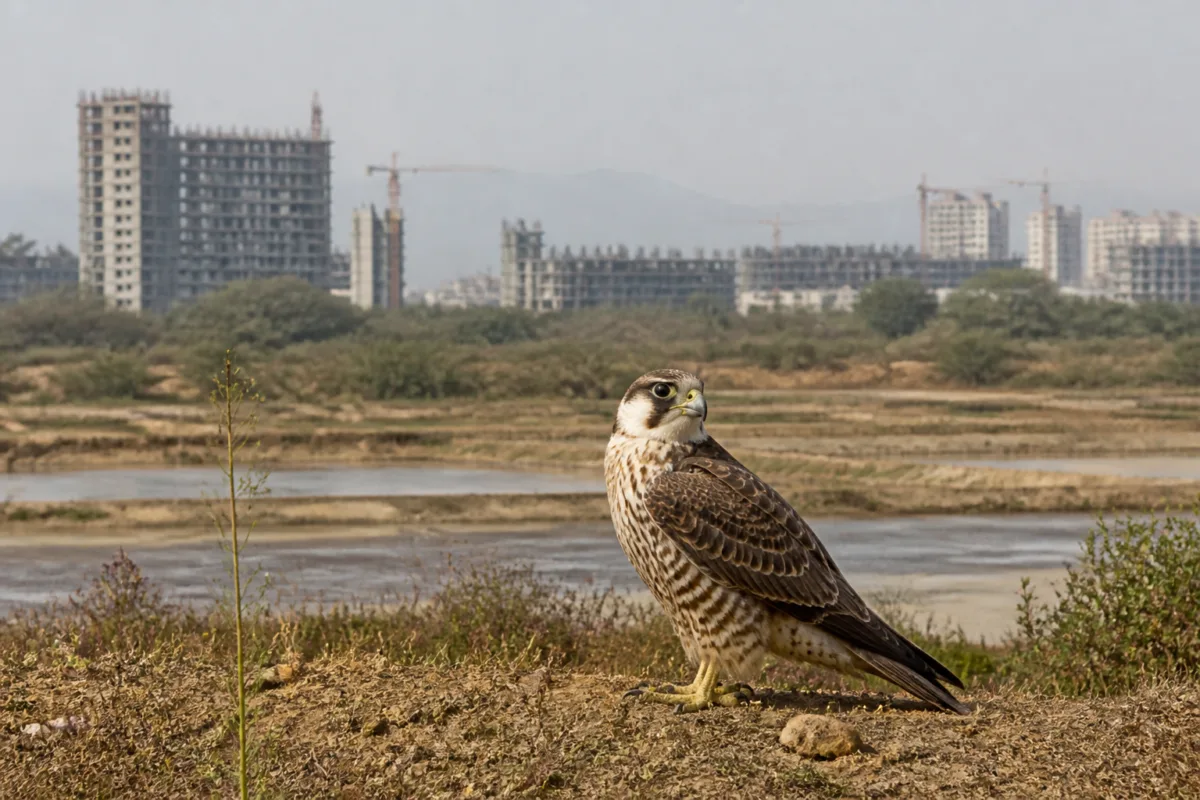
A rare Laggar falcon sighted at Nalasopara’s Gogte salt pan has drawn attention to a part of the Vasai-Virar landscape that is often treated as vacant land rather than urban ecological infrastructure. The bird’s documented appearance is significant not only because it is believed to be the first recorded sighting of the species in Palghar district, but also because it shows how rapidly urbanising edges can continue to support biodiversity even as their remaining open habitats face development pressure.
The sighting was recorded on November 1 by naturalist Vaibhav Haldipur, who was leading a birdwatching trail for Jungle Buddies with fellow birdwatcher Rikita Sheth. The Laggar falcon was seen at 12.35 pm, sitting on the ground in a scrubland habitat at the Gogte salt pan in Nalasopara. Mid-Day reported the observation on November 8.
Haldipur said the species was last sighted in Mumbai in 2001, making the Nalasopara record particularly notable for birdwatchers and wildlife enthusiasts. The Laggar falcon, scientifically known as Falco jugger, is described in the report as an uncommon raptor in Maharashtra, with published records from relatively few locations across the state. It is distributed across parts of the Indian subcontinent and is classified as Near Threatened on the IUCN Red List.
The significance of the record therefore rests on two connected facts. First, it adds a species observation to the biodiversity record of Palghar district. Second, it places attention on the ecological function of scrubland and salt-pan landscapes within an expanding metropolitan region. These areas may not resemble conventional parks, forests or wetlands, but they can provide feeding, resting and movement spaces for birds and other species.
That distinction matters in cities because land-use decisions often recognise ecological value only where a landscape already has a formal conservation label. Open scrub, salt pans and other transitional habitats can appear degraded or unused when viewed solely through the lens of construction potential. Yet Haldipur said such landscapes support birds, reptiles, mammals and invertebrates, and that they are often overlooked in conservation planning.
The sighting does not, by itself, establish the size, health or long-term presence of a Laggar falcon population in Nalasopara. It is a single documented observation, and the supplied report does not provide a population survey, a breeding record or a longer-term monitoring dataset for the site. Its value is instead as an ecological signal: a reason to ask what habitats remain, how they are changing and whether biodiversity records are being systematically maintained as urbanisation advances.
This is where the Nalasopara observation becomes a built-environment story. The Vasai-Virar landscape is undergoing rapid urbanisation, according to Haldipur, while its remaining natural habitats face development, fragmentation and other human-induced disturbances. Fragmentation is particularly important in urban edges because the impact is not limited to the loss of one plot. The breaking up of open landscapes can reduce the continuity of habitat and make it more difficult for species to move, feed or find suitable resting areas.
The supplied report does not identify a specific development project or quantify the land lost to construction around the Gogte salt pan. It therefore cannot support a conclusion that a particular agency, project or decision caused the falcon’s appearance or threatens the site. What it does establish is a tension common to expanding urban regions: ecological importance may become visible only after a rare species is recorded, while the planning process may already be treating the surrounding land as available for other uses.
A biodiversity record is also an institutional resource. When observations are documented consistently, they can help establish what species use a landscape and how that use changes over time. Without systematic records, individual sightings remain isolated moments. With repeated documentation, they can become part of the evidence available to planners, municipal authorities, conservation agencies and researchers when land-use decisions are considered.
Haldipur’s call to monitor these habitats and maintain systematic biodiversity records is therefore more than a request for birdwatching documentation. It points to a gap between the way cities are mapped administratively and the way ecological systems function on the ground. Municipal boundaries, development parcels and infrastructure plans do not necessarily correspond to the movement patterns or habitat requirements of wildlife.
The Gogte salt pan also illustrates why the urban ecology of the Mumbai region cannot be understood only through the city’s formal core. Nalasopara lies within a metropolitan landscape where settlements, transport links, construction activity, open land and natural systems overlap. The ecological condition of such places is shaped by decisions about development, land management and monitoring, even when the site is not described as a major urban park or protected forest.
The available evidence is not sufficient to determine whether the Laggar falcon was a temporary visitor, a regular but previously undocumented presence or part of a wider population using the Vasai-Virar landscape. It is also not sufficient to assess whether the species’ reported Near Threatened status is reflected in local population trends. Those questions would require repeated observations and a structured ecological assessment, neither of which is included in the supplied report.
What can be established is that the species has a limited published record in Maharashtra, that it had not been recorded in Mumbai since 2001 according to Haldipur, and that the Nalasopara observation is believed to be the first recorded sighting in Palghar district. These facts give the observation regional importance while also underlining the limits of existing knowledge about urban-edge habitats.
The policy question is not whether every open parcel should be treated identically. It is whether planning systems can distinguish between land that is genuinely devoid of ecological function and land that performs less visible but important habitat roles. Salt pans, scrublands and other open landscapes may be assessed primarily through ownership, development potential or infrastructure access unless biodiversity information is brought into the process.
That requires coordination among local authorities, environmental agencies, land managers, researchers and citizen observers. The report does not identify a specific monitoring programme or institutional mechanism currently operating at the Gogte salt pan. It does, however, show why such mechanisms would matter. A single sighting can attract attention, but only systematic records can show whether the habitat continues to support the species and the wider ecological community described by Haldipur.
The observation also raises a question about what counts as urban infrastructure. Roads, drainage networks and public transport are usually recorded as essential systems because residents depend on them. Ecological habitats are less often understood in the same way, despite their role in supporting species and maintaining the environmental character of urban regions. Treating every non-built space as an interim condition before development can erase that function from planning discussions.
For residents, the immediate relevance is not limited to the presence of one uncommon raptor. The sighting offers a view of Nalasopara beyond its image as a rapidly expanding settlement. It shows that the city’s edge contains ecological assets that may not be visible in conventional accounts of housing, transport and construction. It also suggests that the quality of urbanisation depends partly on whether these landscapes are documented before they are altered.
The Nalasopara Laggar falcon record confirms the ecological significance of a landscape under pressure, but it does not answer how much habitat remains or what protection it receives. The next useful step is sustained monitoring: repeated species records, clearer documentation of habitat change and greater attention to scrublands and salt pans in urban planning. Until that evidence exists, the sighting should be read as both a rare biodiversity event and an early warning about what rapidly urbanising regions may lose without systematic ecological records.

