


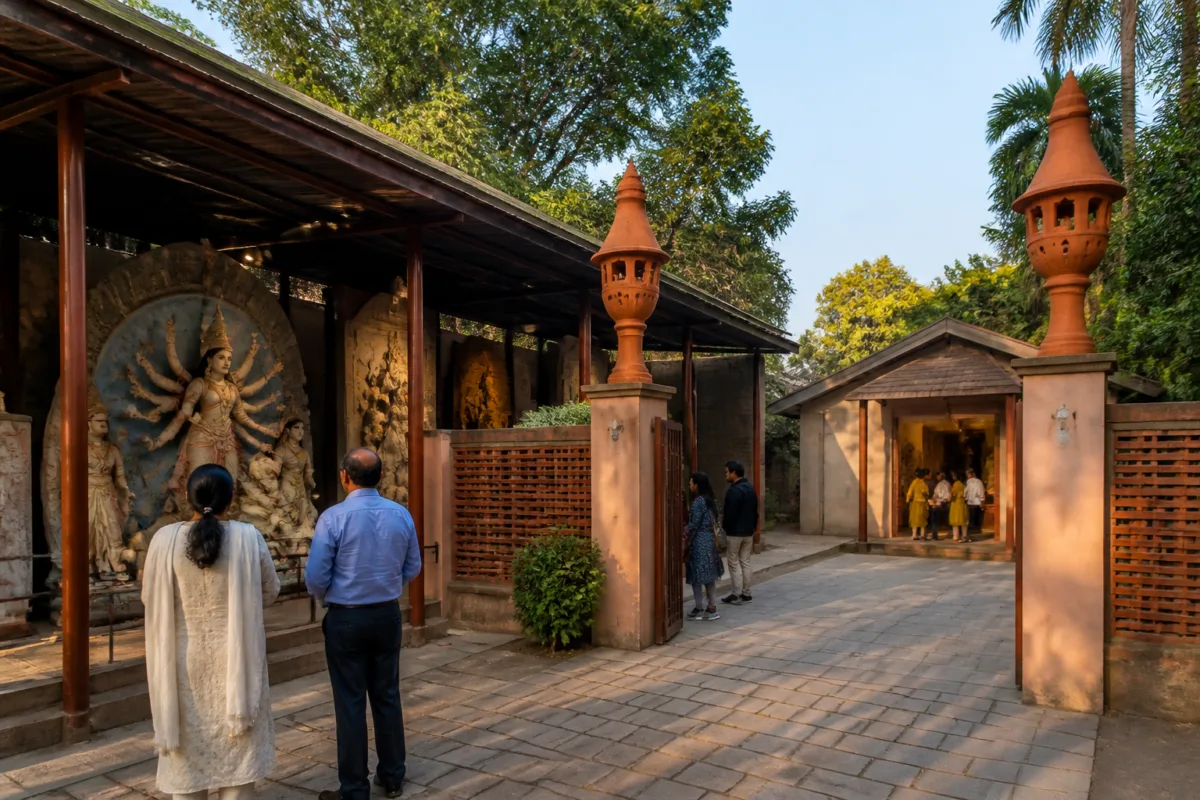
Kolkata’s Durga museum at Rabindra Sarobar is set for a refurbishment that will alter how one of the city’s most distinctive public cultural spaces preserves and presents festival art. The proposed work, to be executed by the Kolkata Metropolitan Development Authority (KMDA), includes new lighting, floor tiles and a redesigned ceiling framework intended to make the gallery feel less cramped.
The project matters beyond the physical repair of a gallery. The museum, named Maa Phirey Elo, was established by the state government and the Kolkata Municipal Corporation in 2012 to preserve Durga Puja’s artistic heritage beyond the annual festival and create a public archive of Bengal’s craftsmanship. Its revival shows how a civic authority is attempting to keep a temporary festival tradition visible in a permanent urban setting.
That task is not straightforward. Durga idols are designed for public display during a limited period and are generally associated with pandals, processions and immersion. At Rabindra Sarobar, selected installations have instead been placed within a structured museum environment. Visitors can examine their materials, colours and construction more closely than they typically can in a crowded festival setting. The museum therefore performs two functions at once: it preserves objects and changes the way they are encountered.
According to the report, the gallery houses nearly a dozen award-winning idols collected from puja organisers across Kolkata. The collection includes the wooden Durga idol created for Chetla Agrani Club’s 2017 Puja. Other installations are placed in a central courtyard beneath protective sheds supported by terracotta pillars, while the gallery itself has walls made of terracotta panels.
The proposed refurbishment responds to practical problems in that arrangement. The idols are currently positioned closely along a single pathway, and the gallery’s existing design has been described as cramped. New lighting could improve the visibility of intricate details, while a redesigned ceiling framework may change the sense of enclosure. New floor tiles would also affect the movement of visitors through the space, although the supplied report does not specify the project’s cost, construction duration or final design.
The choice of material is also significant. KMDA plans to replace the terracotta tiles used across the enclosure and museum with new tiles from Bishnupur, a location strongly associated with Bengal’s terracotta craft traditions. The idols placed in the open arena are to be polished as part of the revamp. These interventions suggest that the project is not being treated solely as routine building maintenance; the material character of the complex is itself part of the visitor experience.
Yet the museum’s physical expansion remains constrained. An attempt to extend the gallery to accommodate more idols has been halted following a court directive, a senior KMDA official said, according to the report. That limitation places greater importance on the existing layout. If the collection cannot simply grow outward, the quality of lighting, circulation, display and conservation becomes central to how much the museum can achieve within its current footprint.
This is a familiar challenge for urban cultural infrastructure. A city may possess a valuable collection or heritage site, but its public usefulness depends on less visible systems: access, maintenance, display design, building condition and the ability to accommodate visitors without damaging the objects being preserved. In the case of Maa Phirey Elo, the refurbishment is an attempt to address those systems while keeping the museum within the Rabindra Sarobar complex.
The institutional arrangement is equally important. The state government and KMC jointly set up the museum, while KMDA is the custodian of Rabindra Sarobar and will execute the work. That places the project at the intersection of cultural policy, municipal administration and management of a major urban open-space complex. The museum is not an isolated private attraction. Its condition is shaped by decisions made across multiple public agencies with different responsibilities.
The official explanation reported for the project is to make the museum more attractive to visitors to the lake. This links the gallery’s future to Rabindra Sarobar’s wider role as a destination rather than treating it as a stand-alone exhibition building. The museum sits in the southern part of the lake complex, with an entrance marked by two tall decorative terracotta lamps topped with flames. A gateway leads to a central courtyard, and a smaller pathway connects that courtyard to the gallery.
The spatial sequence matters because visitors experience the museum through the complex around it. The approach, courtyard, protective sheds, terracotta elements and gallery together create a cultural landscape. Improvements to the gallery may therefore increase the value of the entire visit, but they also make the quality of the surrounding public realm more consequential. The report does not provide details on accessibility, signage, visitor numbers or operating hours, so it is not yet possible to assess how effectively the refurbished museum will serve different groups of visitors.
The second project announced by KMDA expands this cultural and civic agenda. A long-abandoned school building near the museum is to be converted into an archive documenting the evolution of Rabindra Sarobar since its excavation, believed to have taken place sometime in the 1920s. The archive is also expected to present information on more than 100 species of birds, mammals and aquatic life.
Together, the two projects propose a broader interpretation of the lake complex. The Durga museum records an important part of Kolkata’s living cultural practice, while the proposed archive would document the history and ecological life of the site itself. One is centred on festival craftsmanship; the other on the urban landscape and its non-human inhabitants. Their proximity could allow visitors to understand Rabindra Sarobar as both a cultural destination and an environmental asset.
The archive project also illustrates how underused public buildings can be brought into a wider civic purpose. The school building had been abandoned, but its renovation is now complete, according to the KMDA official quoted in the report. Work on the conceptual plan is expected to begin within a few weeks. The supplied material does not establish when the archive will open, what agency will operate it, or how its content will be developed and maintained.
Those unanswered questions will determine whether the projects become durable public institutions or remain limited refurbishment exercises. A museum requires more than a repaired ceiling and new tiles. It needs regular upkeep, appropriate conservation, a clear programme and a reliable relationship with its host public space. An archive documenting wildlife and the history of a lake similarly requires accurate interpretation and continuing maintenance. The available information confirms the direction of the projects but not yet their operating framework.
There is also a larger planning question around the preservation of temporary cultural production. Kolkata’s Durga Puja generates new artistic work each year, much of which is designed for a short public life. A permanent museum can preserve selected examples, but it cannot represent the full scale or changing character of the festival. Its role is therefore selective: it creates a record, offers close observation and gives civic institutions a way to connect festival heritage with everyday public life.
The proposed revamp acknowledges that preservation depends on presentation. If the gallery is too cramped, poorly lit or difficult to navigate, the existence of the collection alone will not ensure public engagement. Conversely, a more accessible display can make the craftsmanship of the idols visible outside the intense but temporary conditions of the festival season. The project’s stated emphasis on visitors suggests that use, rather than storage alone, is becoming a central measure of the museum’s purpose.
For Rabindra Sarobar, the immediate test will be whether these interventions are coordinated with the character of the lake complex. The reported plans bring heritage, architecture and ecological interpretation into one part of the city, but they will require clear implementation details. The museum refurbishment has a preliminary estimate and is expected to begin shortly. The school building’s renovation is complete, while the archive’s conceptual planning is due to start within weeks.
What the evidence confirms is a public-sector attempt to renew a neglected cultural facility and add a new interpretive use to an abandoned building. What remains unclear is the budget, delivery timeline, visitor-access plan, conservation method and long-term management structure. Those details will determine whether Maa Phirey Elo becomes a stronger civic institution and whether the proposed Rabindra Sarobar archive can connect the lake’s cultural history with its ecological value.

