


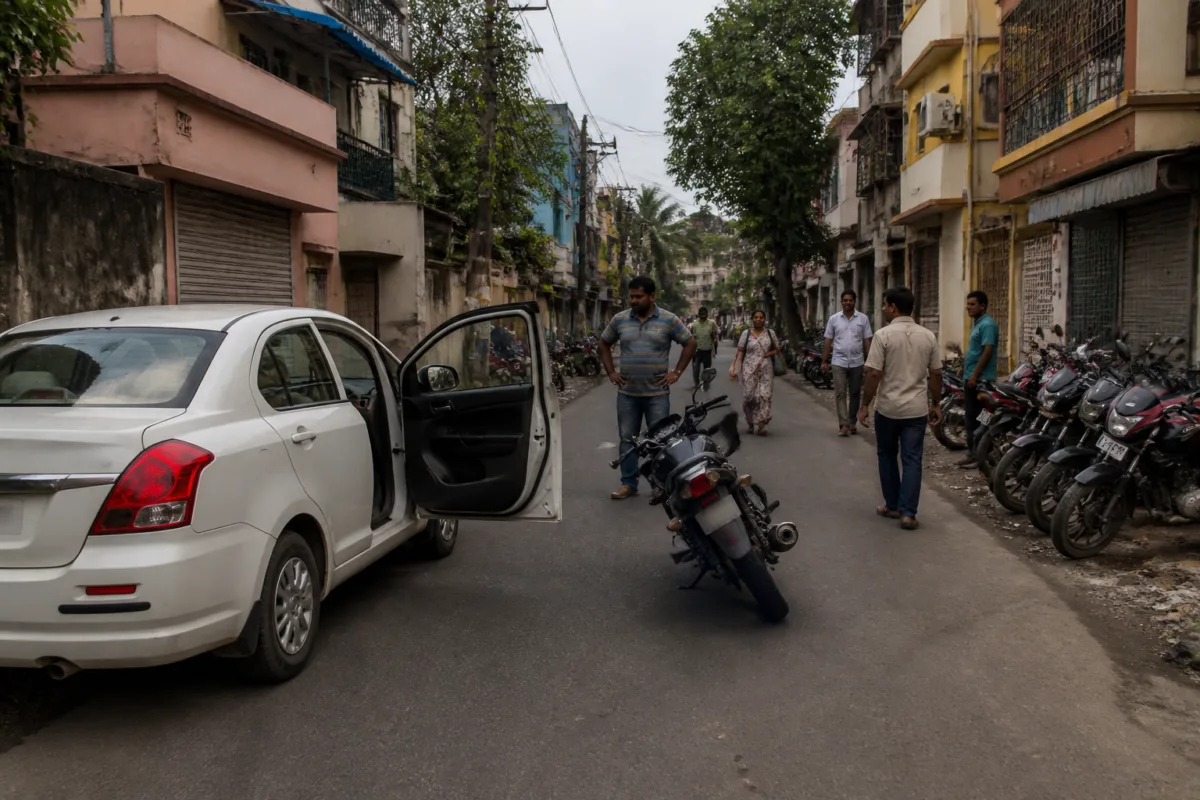
The Garia dooring crash, in which a motorcycle rider suffered serious injuries after an app-cab passenger allegedly opened a door into his path, is more than an isolated traffic case. It exposes a routine urban risk created at the point where app-based travel, narrow neighbourhood roads and vulnerable road users meet. Police have booked both the passenger and the driver, making the case significant not only for the injured rider but also for how responsibility is understood when a passenger exits a vehicle.
According to the FIR registered at Patuli police station, the crash occurred around 1.10 pm near 21, Milan Park, south Kolkata, on November 1. Shubanu Basu, a 44-year-old CCTV trader riding to work, was travelling on a motorcycle when the cab stopped on a neighbourhood road. The police complaint states that the vehicle was not pulled fully to the left and that the woman passenger suddenly opened the right-side door, striking the motorcycle.
Basu was thrown several feet from the bike. He suffered fractures to his right hand and an eye injury, while the motorcycle was badly damaged. He was first taken to Baghajatin State General Hospital and later shifted to Peerless Hospital, where he underwent multiple procedures, including plastic surgery. Doctors told the family that basic recovery could take nearly a month and warned that three fingers on his right hand could face permanent damage. The treatment cost had crossed Rs 2 lakh, according to the report.
The police have charged the cab driver and the passenger under Sections 281, 125(b) and 324(4) of the Bharatiya Nyaya Sanhita. The sections cited in the case relate to rash driving, endangering the life or personal safety of others, and mischief causing damage. The decision to name both occupants is important because the immediate physical act that caused the collision was allegedly the opening of the door, while the vehicle’s stopping position and the driver’s conduct are also part of the complaint.
The legal and traffic question is therefore not limited to who was behind the wheel. In a city street, the person opening a door can directly enter the movement path of motorcycles, bicycles and other two-wheelers. Legal and traffic experts cited in the report said primary liability in such cases rests on the person opening the door, who must check mirrors and blind spots and allow approaching riders enough time to react. The case places that principle within the growing operational environment of app-based cabs, where passengers may be unfamiliar with local roads and drivers may stop briefly to complete a drop-off.
The setting matters. The crash did not take place on a high-speed expressway or at a major junction. It occurred inside a neighbourhood lane, where road space is constrained and stopping practices can be informal. Such roads are often shared by pedestrians, parked vehicles, two-wheelers and cars making short passenger trips. A vehicle that stops without moving fully to the side can leave a rider with limited lateral space. If a door then opens suddenly, the rider may have little distance or time to avoid it.
That interaction is at the centre of the dooring problem. A moving two-wheeler generally travels close to parked or stopped vehicles because of the width and arrangement of urban roads. The vehicle door becomes a temporary obstruction that can extend into the rider’s line of travel. The danger is especially acute when the occupant looks only at the immediate pavement or traffic ahead rather than checking the side and rear of the vehicle before opening the door.
Basu told the newspaper that the driver had warned the passenger before she opened the door. He alleged that the passenger later blamed him for the accident and initially offered Rs 1,000 for first aid. Local residents called the police after tensions rose, he said. He also alleged that the passenger later stopped answering his calls, leaving him to approach the police after the treatment expenses mounted. These claims are part of the injured rider’s account and have not been independently established in the supplied report.
The financial dimension shows why a dooring collision can quickly become a wider household crisis. Basu remains immobilised while recovering, faces the possibility of permanent damage to three fingers and has already incurred medical expenses exceeding Rs 2 lakh. The supplied report does not establish whether insurance payments, compensation or other assistance will cover those costs. It does, however, demonstrate that a momentary passenger-safety failure can impose medical, income and mobility consequences far beyond the damaged vehicle.
The case also follows another serious dooring crash in Kolkata earlier this year. On Beleghata’s Raja Rajendralal Mitra Road, a suddenly opened door of a parked car was linked to a collision in which seven-year-old pillion rider Satvik Kundu, rider Parashar Saha and another pillion passenger suffered serious injuries. Investigators in the Garia case invoked charges against the passenger in line with that earlier incident, according to the report.
The two cases point to a recurring urban design and enforcement problem: road safety is often treated as a matter of vehicle movement, while the stationary phase of a trip receives less attention. Yet a passenger entering or leaving a vehicle is also a road-safety event. The risk is shaped by where the vehicle stops, which side the passenger uses, whether the door opens towards moving traffic and whether the occupant has a clear view of the approach lane.
App-based cab operations make this more complicated. A driver may be completing a short stop on a street that is not designed as a formal pick-up or drop-off bay. The passenger may be focused on reaching a destination or may not know the local traffic pattern. The driver may have limited time to explain which side is safe. The supplied material does not establish what safety instructions, if any, were provided through the app or by the driver in this case. It does establish that the FIR records an alleged warning from the driver and an alleged failure by the passenger to wait before opening the door.
This leaves responsibility distributed across several points in the journey. The passenger must check before opening the door. The driver must choose a safe stopping position and ensure that the exit does not endanger other road users. The platform connects the trip but, based on the supplied report, its role in the incident has not been identified. Police and courts must then determine how the available facts fit the legal provisions cited in the FIR.
For Kolkata’s streets, the larger issue is whether ordinary road behaviour is being designed around the most exposed users. A rider struck by a door has little protection compared with a person inside a car. Neighbourhood lanes may appear low-speed, but their constrained geometry can make sudden obstacles particularly dangerous. The absence of a formal traffic junction does not mean the absence of a serious conflict point.
The Garia case therefore deserves attention as an example of how urban mobility failures can emerge from small, repeated actions rather than from a single dramatic breach. A vehicle stopping a few feet from the edge, a passenger opening a door without checking, or a rider travelling through a narrow gap can combine into a severe injury. The police case will determine responsibility in this instance. The broader safety question is whether Kolkata’s daily passenger drop-offs adequately account for the two-wheelers sharing the same limited road space.
What remains to be established is the final legal outcome, the findings of the investigation and whether the injured rider receives compensation for medical costs and loss of work. Until then, the FIR and the reported injuries confirm the immediate consequences of the crash, while the earlier Beleghata case indicates that dooring is not an isolated category of road conflict in the city.

