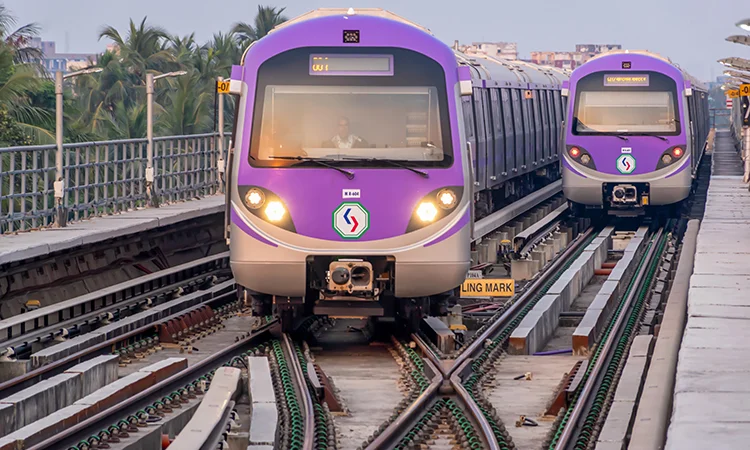
Kolkata Pink Line Advances After Water Pipeline Clearance
The long-delayed Baranagar–Barrackpore stretch of Kolkata’s Pink Line has cleared a major civic hurdle, bringing a 12.5-kilometre elevated metro corridor closer to construction. The approval addresses utility conflicts beneath Barrackpore Trunk Road, but it also places water-supply protection at the centre of the project’s next phase.
The Kolkata Municipal Corporation has permitted the temporary closure of a 48-inch water transmission pipeline along the route and approved a replacement 72-inch pipeline between the Palta water treatment plant and Talla Pumping Station. The arrangement is intended to allow metro works without compromising a network that supplies drinking water to large parts of the city.That balance is significant because the metro alignment passes through a dense utility corridor. Government records earlier identified utility shifting as a central reason for the Baranagar–Barrackpore section remaining stalled. The project had been awaiting the necessary clearances even as the wider Kolkata Metro network continued to expand.The renewed movement follows the floating of a tender worth about ₹1,587.3 crore for the elevated viaduct and 10 stations. The full corridor is planned with 11 stations, linking Baranagar with neighbourhoods including Kamarhati, Agarpara, Panihati, Sodepur, Khardaha, Titagarh and Barrackpore.
For residents along Barrackpore Trunk Road, the economic value of the Kolkata Pink Line will depend less on the announcement itself and more on whether it delivers reliable connections to employment, education and essential services. A direct rapid-transit option could reduce dependence on congested road travel and crowded suburban rail services, while making northern neighbourhoods more accessible to the wider metropolitan economy.Urban planners, however, are likely to watch the construction phase closely. Utility-heavy corridors can generate traffic disruption, construction dust, access problems and service interruptions if works are poorly sequenced. In this case, water security is particularly important: recent reporting has highlighted concerns that inadequate replacement capacity could affect supplies to northern and central areas.
The Kolkata Pink Line therefore represents more than a transport extension. Its success will depend on coordinating mobility infrastructure with essential services, construction management and neighbourhood access. The next test is whether the project can convert the latest clearance into timely execution without shifting its costs on to residents through disrupted water supply or prolonged road works.