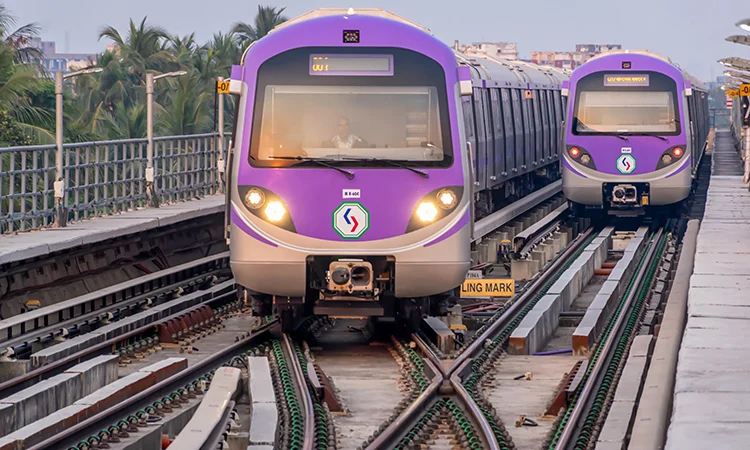
Kolkata’s long-delayed Metro Pink Line has moved closer to construction after the Kolkata Municipal Corporation cleared a critical utility issue along Barrackpore Trunk Road. The approval allows work linked to a major water pipeline network, removing one of the biggest obstacles to the proposed 12.5-km Baranagar–Barrackpore corridor. For residents across Kolkata’s northern suburbs, the project could reshape daily commuting and reduce dependence on congested roads and suburban rail.
The corridor has been held up for years largely because Barrackpore Trunk Road carries several large underground water pipelines. The road is an important transport artery, but its utility network makes construction of an elevated metro viaduct more complicated.The latest clearance covers the closure of an existing 48-inch water transmission pipeline. Plans also include a new 72-inch pipeline connecting the Palta water treatment facility with the Talla pumping station. The replacement arrangement is intended to protect Kolkata’s water supply while allowing metro construction to proceed.That infrastructure trade-off is significant. Water supply and mass transit are both essential urban services, and replacing critical utility capacity before removing an existing pipeline will be important for avoiding disruption to households. The project therefore illustrates a wider challenge for mature cities: new transport infrastructure increasingly has to be integrated with ageing underground networks rather than built independently.
The Kolkata Metro Pink Line is planned as an elevated connection from Baranagar to Barrackpore, with 10 new stations forming the main stretch. Baranagar will provide an interchange with the existing Blue Line, potentially giving commuters from northern neighbourhoods a more direct route towards the wider metro network.For citizens, the most immediate benefit could be shorter and more predictable journeys. The corridor is expected to reduce travel time between Baranagar and Barrackpore by around 30 minutes. It could also take some pressure off buses, cars and other road-based modes on the heavily used BT Road corridor.The economic implications extend beyond commuting. Better public transport can improve access to employment, education and services while reducing the need for longer private-vehicle journeys. For northern Kolkata, improved connectivity could also influence how residential and commercial activity develops along the corridor.
However, the civic clearance is not the same as completion. A construction tender worth about ₹1,587 crore has already been floated for the elevated viaduct and stations, but delivery will depend on coordinated utility relocation, construction progress and sustained project management.For Kolkata, the next test is therefore execution. A successful project will need to deliver faster mobility without compromising essential water services, road safety or the liveability of neighbourhoods along the construction corridor.