


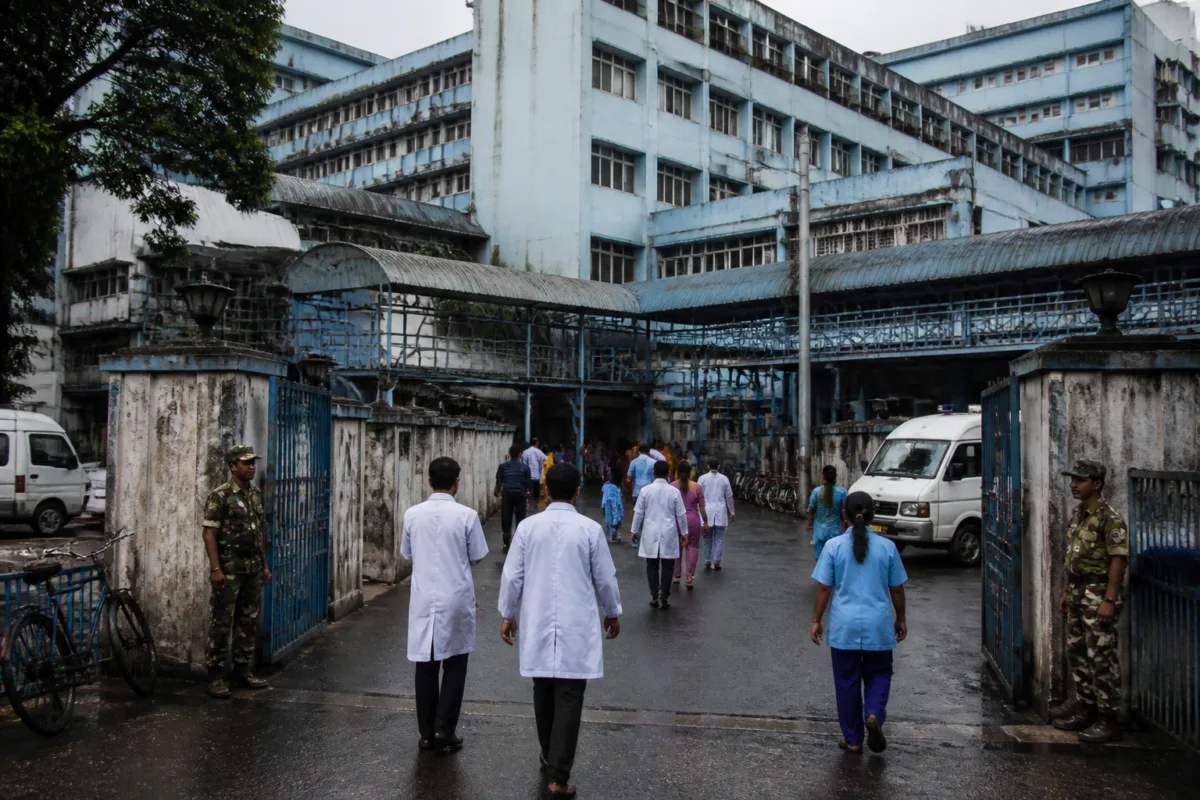
A directive issued by West Bengal’s health department on Friday has renewed attention on security in government hospitals after violence and competing allegations at Kolkata Medical College. The order instructs district magistrates, police superintendents and police commissioners to enforce strictly a 2009 law intended to protect doctors, nurses and other healthcare workers.
The directive does not name Kolkata Medical College. However, it was issued two days after a confrontation on the campus and referred to a rise in attacks on health workers across West Bengal. The timing has made the incident a test of how the state handles safety, discipline and accountability inside public medical institutions.
The immediate dispute began after injured people were reportedly moved from Kolkata Medical College following the Chorbagan incident. Junior doctors held a press conference questioning the decision and claimed that even a commonly used medicine to stop bleeding was unavailable at the hospital. The health department subsequently questioned the legitimacy of the press conference and issued show-cause notices to eight interns.
The department’s stated position was that the interns had neglected duty to attend the press conference on the night of the incident, allegedly contrary to National Medical Commission rules. The interns submitted their replies within the 72-hour deadline. According to the report, intern Soumyadeep De said they had been accused of falsely claiming that medicines were unavailable even though supplies existed. He said the interns had asked who conducted the inquiry that supposedly established this, and had argued that they could not properly answer the notices until that question was addressed.
The dispute escalated on Wednesday, when junior doctors held a prolonged protest outside the offices of the principal, vice-principal and department heads. Later that evening, members of the Akhil Bharatiya Vidyarthi Parishad and the National Medicos Organisation gathered on the campus in opposition to the protest. Junior doctors accused members of the gathering of creating disorder and attacking them. Those allegations were denied by ABVP state secretary Nilkantha Bhattacharya, who said he had gone to the campus after hearing that the organisation’s unit secretary had been attacked. He questioned whether there was video evidence showing him throwing bricks or attacking anyone with bamboo.
Health Minister Sharadwat Mukhopadhyay had formed a three-member inquiry committee before the junior doctors’ press conference. He said the committee would investigate everything that happened on the campus. The junior doctors, however, questioned the committee’s neutrality. They also disputed the minister’s account that two teacher-doctors, including the medical superintendent and vice-principal, had been injured while trying to end the protest. The students described those injury records as fabricated, a claim not independently established in the report.
The two sides also presented different accounts of the scale of the protest. The minister said only 10 to 15 doctors associated with a far-left organisation had taken part and that at least 1,250 medical students had no connection with it. The junior doctors displayed a document bearing students’ signatures which they said demonstrated wider support.
The institutional response now has two parallel tracks. The inquiry committee is examining the campus events and the role of the protesting students, while the health department’s directive places responsibility on district administrations and police to protect health workers under the existing law. The directive’s statewide scope means the response is not limited to one college or one confrontation.
For public hospitals, the unresolved issue is whether safety measures will be applied consistently to all groups entering or operating on campuses. The report records competing claims over the participation of student organisations, the use of force and the reliability of injury documentation. Establishing those facts through a transparent inquiry will be essential if disciplinary action is to be accepted by staff and students.
The episode also shows how quickly a dispute over hospital supplies and patient transfers can become an institutional crisis involving student discipline, political groups and security arrangements. The state’s decision to revive strict enforcement of the 2009 protection law indicates that safeguarding healthcare workers is being treated as a system-wide administrative concern, even though the Friday directive did not specifically refer to Kolkata Medical College.

