


The proposal to make India the theme country of the 50th Kolkata Book Fair is more than a question of branding. It places the fair’s cultural identity, public administration and city-scale operating model under scrutiny at a moment when the event is preparing for another gathering of millions.
A report by Anandabazar – Kolkata says a proposal to present India as the theme country was raised at a meeting held at Nabanna on 10 September. The meeting brought together government representatives, the Publishers and Booksellers Guild and its advisory committee. The proposal has reportedly found support among government representatives, although the Guild has not yet made a formal public comment and no final decision has been announced.
The proposal is linked to two milestones: the 50th edition of the book fair and the 80th year of India’s Independence. The report says the proposed theme could bring together India’s multilingual character and cultural diversity. It could also incorporate commemorative references to the 150th anniversary of Vande Mataram and the bicentenary of Rajnarayan Basu, identified in the report as one of the figures associated with the Bengal Renaissance.
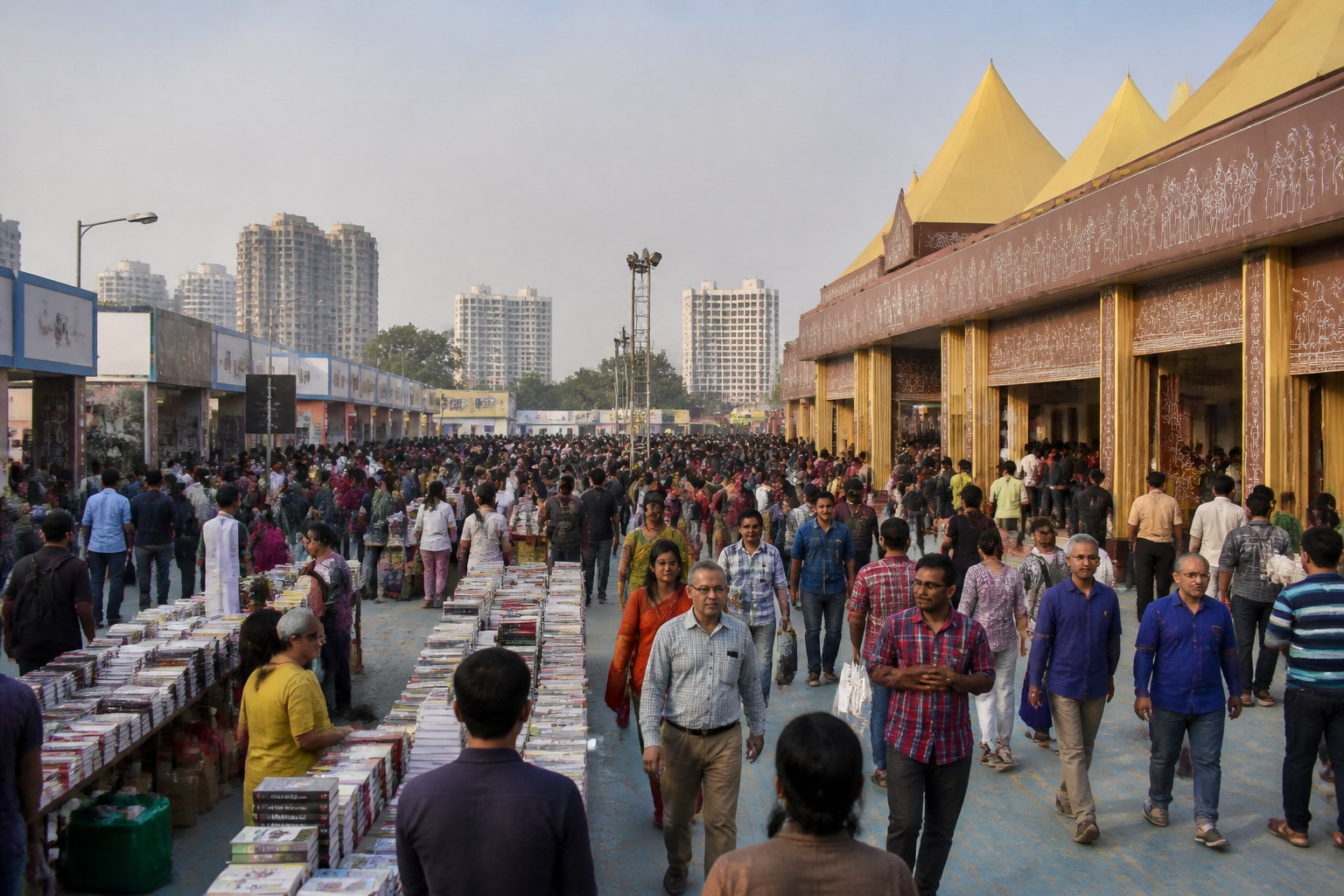
That framing matters because the Kolkata Book Fair is not a small literary event confined to a specialised audience. The previous edition drew 32 lakh visitors and recorded sales of Rs 27 crore, according to the report. It had 1,015 stalls, more than 720 publishers and over 250 little magazines. Those figures make the fair a temporary but highly consequential urban system: publishers need space and access, visitors need transport and crowd management, and public authorities must coordinate with a private or institutional organiser around a high-volume cultural gathering.
The proposed theme therefore has an operational dimension as well as a symbolic one. A fair that presents India through multiple languages and cultural traditions would need its physical and organisational arrangements to accommodate that breadth. The supplied report does not establish whether the proposal includes a detailed programme, pavilion plan, language-wise representation or additional infrastructure. Those decisions, if the proposal moves forward, would determine whether the theme becomes a substantive curatorial framework or remains primarily a commemorative title.
The institutional process described in the report also shows how the fair’s identity is negotiated. Theme-country proposals reportedly came to the authorities after the previous edition, including proposals involving a Latin American country and China. No proposal was finalised at that stage. The later Nabanna meeting brought the organisers, their advisory committee and government representatives into the same process, indicating that the choice is not being treated as an isolated decision by the fair’s organising body.
This arrangement reflects the hybrid nature of major urban cultural events. The Guild is responsible for organising the fair, but the event’s scale gives the state government an interest in its schedule, public order, access and wider cultural positioning. The report indicates that the government representatives’ proposal was viewed favourably, while also making clear that the organisers have declined to comment at present. The distinction between a proposal, administrative support and a final announcement is important: the available information confirms movement in the decision-making process, not a completed theme-country appointment.
The discussion around Israel illustrates how cultural programming can intersect with urban administration. Some sections had circulated the possibility of Israel becoming the theme country, and sections of civil society had reportedly protested against that prospect. The report says no official action had been taken in that direction and that there was no comparable government-level support. It also refers to the issue as sensitive and says authorities were concerned about the possibility of unrest during the fair. The report further places the discussion against India’s position at the recent BRICS summit, where, according to the article, a proposal supporting a free Palestine was passed.
These details show that the theme-country decision is being assessed not only for cultural merit but also for its potential effect on the event’s functioning. A large book fair depends on a predictable environment for visitors, publishers, authors and stall operators. When a proposed theme is politically sensitive, the administrative question becomes inseparable from programming: what is displayed, who participates, how debates are hosted and how public authorities prepare for disagreements can affect the experience of the entire fair.
The India proposal offers a different route. Rather than placing one foreign country at the centre, it would allow the organisers to use the 50th edition to represent India’s internal diversity. That possibility is particularly relevant to a Kolkata-based fair whose identity is closely associated with Bengali publishing and the wider literary culture of eastern India. However, the supplied report does not indicate how the organisers would balance a national theme with the fair’s established regional character. It also does not say whether all language communities or publishing sectors would receive equal visibility.
The fair’s immediate administrative calendar is clearer. Applications for stalls are open until 30 September, and the report says the response has been good so far. The next edition is scheduled to run from 22 January to 3 February. The period includes holidays on 23 January and 26 January, as well as two Sundays, which organisers believe could help draw a large turnout. These dates turn the theme discussion into a planning issue with a fixed deadline: decisions about participation, programming and public arrangements will have to be aligned before the gates open.
The previous edition’s numbers underline the pressure that the schedule creates. More than three million visitors attended, while hundreds of publishers and little magazines operated across more than a thousand stalls. The report does not provide figures for the fairground’s capacity, transport demand, waste generation, policing or emergency services, so the available evidence cannot establish whether the event’s infrastructure is adequate for another high turnout. It does, however, establish that the fair’s public impact is large enough to require coordination beyond the publishing industry.
The stall figures also reveal the breadth of the event’s urban economy. More than 720 publishers and over 250 little magazines participated in the previous edition, making the fair a marketplace for both established and small-scale publishing. For these participants, the theme-country choice is only one part of the event’s significance. Stall allocation, visitor access, sales opportunities and the duration of the fair may matter more directly to their ability to participate. The open application process suggests that the next edition’s commercial and cultural scale is already being assembled.
For visitors, meanwhile, the fair functions as a temporary public destination. Its success depends on more than the number of books sold. It requires an environment in which people can move through the site, meet publishers, attend programmes and return home safely. The report gives no details about transport planning or site management for the forthcoming edition, but the attendance figure means these questions cannot be separated from the fair’s cultural ambitions.
The central question is therefore not simply whether India will be named the theme country. It is whether the 50th edition can translate that theme into a credible representation of the country’s languages, publishing traditions and cultural differences while retaining the openness that has helped make the fair a mass urban event. The evidence currently supports only a proposal and a favourable response from government representatives. It does not yet establish the final theme, programme design or operational plan.
The next concrete milestones are the 30 September stall-application deadline and the scheduled 22 January to 3 February run of the fair. Until the Guild or the relevant authorities make a formal announcement, the India theme remains the leading proposal reported from the Nabanna meeting rather than a confirmed decision. What follows will show whether the 50th edition treats cultural diversity as a programme principle, an administrative framework or primarily a commemorative message.
