


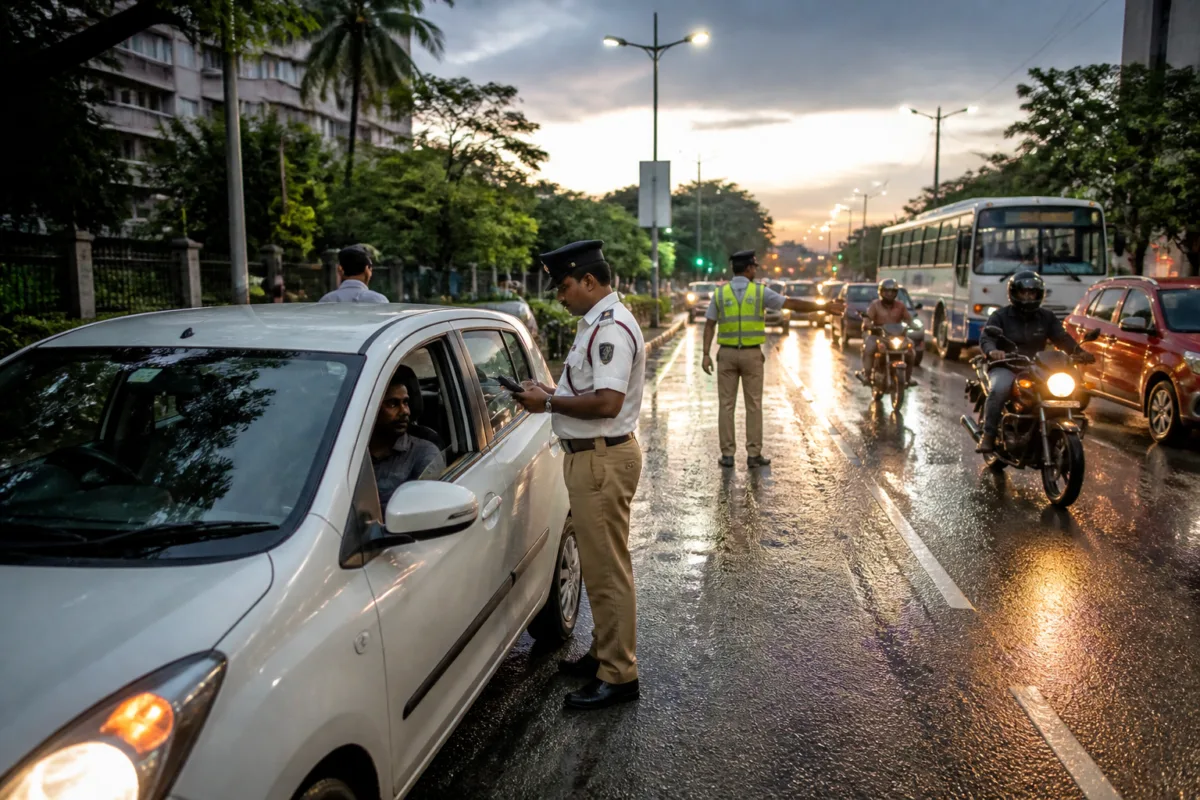
Kochi traffic enforcement is facing a structural test after two fatal crashes involving young drivers exposed gaps that reactive police drives have not addressed. The incidents were different in detail but similar in consequence: high-speed or underage driving continued until people were killed, while enforcement remained largely event-driven rather than preventive.
The concern is not simply that individual motorists violated traffic rules. The report points to a wider failure to identify dangerous behaviour early, maintain visible enforcement across vulnerable roads and ensure that administrative measures announced after incidents are completed. In that sense, the crashes raise a city-level question: whether Kochi’s traffic system is designed to prevent foreseeable risks or merely respond after they become fatal.
The first incident occurred on October 11, when a 19-year-old allegedly driving a luxury car at extreme speed while drunk killed three people on the airport road near Nedumbassery. Videos on his social media pages indicated that he had previously driven recklessly, at times reaching speeds of 200 kmph. The reported pattern suggests that dangerous behaviour may have been visible before the crash, but it was not stopped through routine enforcement.
Two weeks later, on October 25, another teenager, who was a minor, drove from Aluva to Cheranelloor and was involved in a crash that killed the owner of a wayside eatery. The incident prompted disciplinary action over official lapses. However, the report says that a systematic preventive plan against rash driving was still missing. The significance of the sequence lies in the short interval between the two fatal crashes: the first did not appear to produce an enforcement response capable of preventing the second.
That gap is central to understanding the problem. A special drive announced after a crash can demonstrate institutional activity, but it does not necessarily create continuous deterrence. Road users can adapt if checks are predictable, limited to particular points or concentrated on a single day. Road safety expert P D Sunil Babu said surprise checks should be genuine combing operations rather than exercises conducted in name only. He argued that Saturday drives, when motorists can avoid regular checking points by using alternative routes, are not enough.
Babu called for targeted operations every evening, covering each road so that drivers could not predict where checks would take place. His argument is based on the visibility and uncertainty of enforcement: when heavy police deployment is seen regularly across different locations, the perceived possibility of being stopped increases. The evidence in the report does not establish how many violations such a model would prevent, but it clearly identifies the weakness of a system that becomes active only after a high-profile crash.
The reported incidents also expose the limits of enforcement focused only on the driver after a violation. Babu said the law should be updated to target the attachment of properties, while psychiatrist Dr C J John of Medical Trust Hospital questioned the age-appropriateness of giving high-powered vehicles to 18- and 19-year-olds. He noted that although the law permits a licence at 18, the prefrontal cortex takes longer to mature. His comments place responsibility across several points: the driver, the family that provides access to the vehicle and the institutions responsible for detecting dangerous conduct.
This is important because the legal ability to obtain a driving licence does not automatically resolve the risks associated with vehicle power, speed or supervision. The report does not provide data on the number of minors or newly licensed drivers involved in crashes in Kochi, so it cannot establish a citywide statistical pattern. It does, however, document two serious incidents involving young drivers within a short period and records an expert concern that families may be handing over powerful vehicles without adequate consideration of maturity and risk.
The institutional issue extends beyond rash driving. Kochi police had already come under scrutiny over a rise in violent incidents involving private bus crews and continued cases of rash and negligent driving. Nearly a dozen incidents involving private bus crews were reported in August and September, according to the report. This places traffic enforcement within a broader capacity problem: the same police system is expected to manage dangerous driving, public transport-related violence, vehicle verification and routine road monitoring at the same time.
On September 9, police announced that police clearance certificates and identity cards would become mandatory for bus crews within 15 days. More than 2,000 applications were received and verification began. Two months later, however, the matter remained unresolved. The unresolved status of that measure matters because it illustrates the difference between announcing an administrative response and completing it. A verification system has value only when applications are processed, records are maintained and compliance is enforced in practice.
The episode also raises questions about responsibility within urban governance. Traffic police may conduct checks, but preventing dangerous driving depends on coordination among enforcement units, vehicle owners, families, transport operators and licensing authorities. The report does not identify a single agency responsible for an integrated preventive plan, nor does it provide details of staffing, inspection coverage or the status of any citywide enforcement protocol. That absence itself makes the governance problem difficult to measure: the public can see the crashes and the subsequent drives, but not necessarily the system of monitoring that should operate between them.
A preventive traffic regime would require more than a visible response at selected locations. The account provided by Babu points towards regular, unpredictable and geographically distributed checks. The report also records calls for stronger action involving minors and for property-related consequences. These are not presented as an existing policy framework; they are proposals and expert observations. Their relevance lies in showing that the current response is being judged against a higher standard of continuity, coverage and deterrence.
The available data is limited but revealing. One crash involved three deaths on the airport road near Nedumbassery. Another killed a wayside eatery owner after a minor drove from Aluva to Cheranelloor. Social media videos reportedly showed earlier reckless driving in one case, including speeds of up to 200 kmph. Nearly a dozen violent incidents involving private bus crews were reported in August and September. More than 2,000 bus crew applications were received after the police clearance requirement was announced. These figures do not constitute a complete road-safety dataset, but together they show a system dealing with both severe individual violations and a backlog in administrative follow-through.
The geography is also significant. The incidents involved the airport road near Nedumbassery, Aluva, Cheranelloor and a wayside commercial location. They were not confined to one junction or one type of urban street. That spread makes it harder to treat the problem as a single black spot requiring a temporary barricade or checkpoint. The reported movement of one minor driver from Aluva to Cheranelloor also demonstrates how a violation can cross local enforcement boundaries before an intervention occurs.
Kochi’s larger urban question is therefore not whether police can conduct a special drive after a fatal crash. It is whether the city has a functioning system for identifying repeated dangerous behaviour before it produces irreversible harm. The report records disciplinary action after one incident, announcements on bus crew verification and calls for more consistent checks. It does not establish whether these measures have been integrated, completed or evaluated.
What the evidence confirms is that fatal crashes exposed a gap between known risk and timely intervention. What remains uncertain is the scale of unreported dangerous driving, the reach of routine checks, the outcome of the more than 2,000 verification applications and the status of any systematic preventive plan. Those are the measures that will determine whether Kochi’s response moves beyond knee-jerk special drives. Until then, the city’s traffic enforcement remains reactive by design, becoming most visible after the damage has already been done.

