


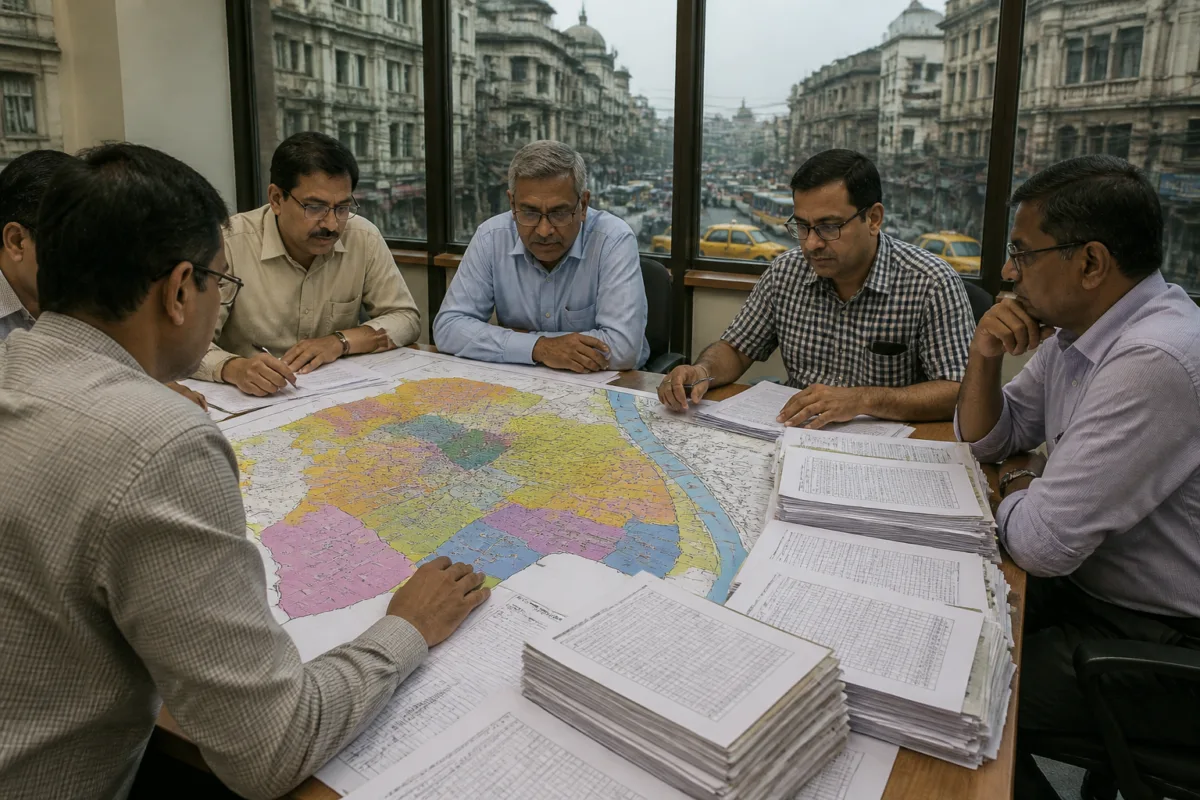
The challenge to KMC ward delimitation has turned Kolkata’s upcoming municipal election into a test of how urban representation is redrawn, voter lists are finalised and public objections are handled. The Calcutta High Court heard a petition on Wednesday against the state government’s decision to increase the number of Kolkata Municipal Corporation wards from 144 to 209, while election preparations move ahead amid disputes over the electoral rolls.
A vacation bench of Justice Hiranmay Bhattacharyya heard the petition filed by the CPM and reserved an interim order for Thursday after hearing both sides. Senior advocate and CPM leader Bikash Ranjan Bhattacharyya, assisted by advocate Shamim Ahmed, argued that the increase in wards had been carried out without hearing political parties and city residents. State advocate-general Surajit Nath Mitra questioned whether the vacation bench should hear the matter.
The immediate legal question is therefore procedural, but the larger urban issue is representational: how should the administrative map of a city be changed when the change affects the boundaries of every municipal constituency? The proposed increase would divide Kolkata’s existing civic geography into 209 wards, creating a new framework for electing councillors and organising polling stations. The exercise would also be the first delimitation of KMC wards since 1984, according to the report.
The legal challenge follows the Assembly’s passage of the Kolkata Municipal Corporation (Amendment) Bill, 2026, on August 12. The state government is now pressing ahead with delimitation ahead of KMC elections expected to be held in November. The State Election Commission has already begun sharing draft electoral rolls and proposed polling-station layouts with political parties.
That meeting, held on Tuesday at the New Administrative Building in Alipore, provided the immediate trigger for the petition’s urgency. Ahmed told the court that the case had been moved before the vacation bench because the commission had shared the draft rolls and polling arrangements, signalling that election preparations were advancing while key questions about voters and ward boundaries remained unresolved.
Senior officials of the South 24-Parganas district administration, led by the additional district magistrate, told party representatives that the draft rolls covered nearly 32 lakh voters across the 209 newly delimited KMC wards. The figure provides the first indication of the electoral scale of the revised municipal map, but the report does not provide a ward-by-ward distribution of voters or explain how the electorate has changed compared with the previous 144-ward structure.
That missing comparison is important because delimitation is not simply a cartographic exercise. Ward boundaries determine which communities are grouped together, how many voters are assigned to each constituency and how residents access their elected municipal representative. They also shape the practical organisation of polling stations and the administrative workload of election officials. The supplied report does not establish whether the proposed wards have uniform electorates or how population and voter distribution were used in drawing the new boundaries.
The Opposition has alleged that the process was arbitrary. Its objections include claims that objections raised during municipal hearings were ignored, that boundary notifications were not transparent and that important data, including the total electorate, was not adequately shared. These are allegations made by Opposition parties and are not findings of the court. The court’s interim order, reserved for Thursday, could clarify the immediate status of the delimitation process, but the report does not state what relief the petitioners have sought beyond the challenge itself.
The timing of the ward exercise has become more contentious because it overlaps with a separate dispute over the electoral rolls. The revised rolls published after the special intensive revision in Bengal have excluded more than one lakh voters who have appealed to SIR tribunals, seeking reinstatement. The report says those tribunals have been functioning slowly, leaving the status of these voters unresolved as civic election preparations proceed.
This creates two linked administrative questions. The first concerns where municipal constituencies should be drawn. The second concerns who should be included in the electorate used to conduct the election. A ward map can be legally notified and polling stations can be planned, but the election’s practical legitimacy also depends on whether eligible residents can find their names on the final rolls and access a process for correcting errors.
The political response has been unusually broad. The Trinamool Congress, CPM and Congress have jointly petitioned State Election Commissioner Krishna Gupta, asking that the proposed civic polls next month be postponed until revised electoral rolls are published in January 2027. The parties have also questioned the November 12 deadline for resolving voter-related discrepancies. The cross-party request does not by itself alter the election timetable, but it shows that the disagreement extends beyond the party that approached the High Court.
For the State Election Commission, the challenge involves coordinating several stages at once: finalising the ward map, preparing electoral rolls, deciding polling-station layouts, processing objections and maintaining the election schedule. The report identifies the commission as the institution sharing draft rolls and polling layouts, while the district administration is involved in presenting the electorate figures. The division of responsibilities makes the process dependent on coordination between the state government, the commission and district-level officials.
The state government’s role is central because the change in the number of wards was enabled through an amendment passed by the Assembly. The election commission, meanwhile, is responsible for moving the poll preparations forward. The High Court’s intervention introduces a judicial review of the process at a point when administrative preparations are already under way. The case therefore sits at the intersection of legislation, municipal administration, election management and judicial oversight.
The numbers reveal the scale of the transition. KMC is moving from 144 wards to 209, an increase of 65 wards, or roughly 45 per cent. The draft rolls cover nearly 32 lakh voters across the proposed 209 wards, while more than one lakh people affected by the SIR-related exclusions have appealed to tribunals. The report does not provide enough information to calculate the average electorate of the old wards, the average for the proposed wards or the distribution of excluded voters across Kolkata. Those gaps limit what can be concluded about equality of representation or the likely effect of the new boundaries.
The process also has a historical dimension. Since the last KMC ward delimitation took place in 1984, the city’s municipal map has remained in place through substantial changes in its built environment, population distribution and administrative pressures. The report does not supply demographic or land-use data to show how Kolkata has changed since then, but the length of the interval makes this more than a routine election notification. It is a structural reset of the city’s civic constituencies.
That reset matters because municipal wards are the basic political units through which residents engage with local government. Complaints about roads, drainage, waste collection, water supply, street lighting and public spaces are often routed through councillors and ward-level administration. Redrawing boundaries can change which neighbourhoods share a representative and which local issues are grouped together. It can also change the accountability chain between residents, councillors and the corporation, although the supplied material does not indicate how specific neighbourhoods have been reassigned.
The central evidence currently available establishes that the delimitation is advancing, that the ward count will rise, that draft rolls and polling layouts have been shared, and that several political parties have objected to the pace and transparency of the process. It does not establish that the delimitation is unlawful, that objections were definitively ignored or that the election will be postponed. Those questions remain subject to the court proceedings, the election authorities’ decisions and the publication of final electoral materials.
The next institutional milestone is the High Court’s interim order after Thursday’s hearing. Beyond that, the process will depend on how the State Election Commission addresses objections, resolves voter-related discrepancies and finalises the electoral rolls and polling-station arrangements. The proposed November civic election timetable, the November 12 deadline cited by the parties and the request for revised rolls in January 2027 will remain the key markers in a dispute that is testing not only Kolkata’s new ward map but also the administrative credibility of the election built around it.

